
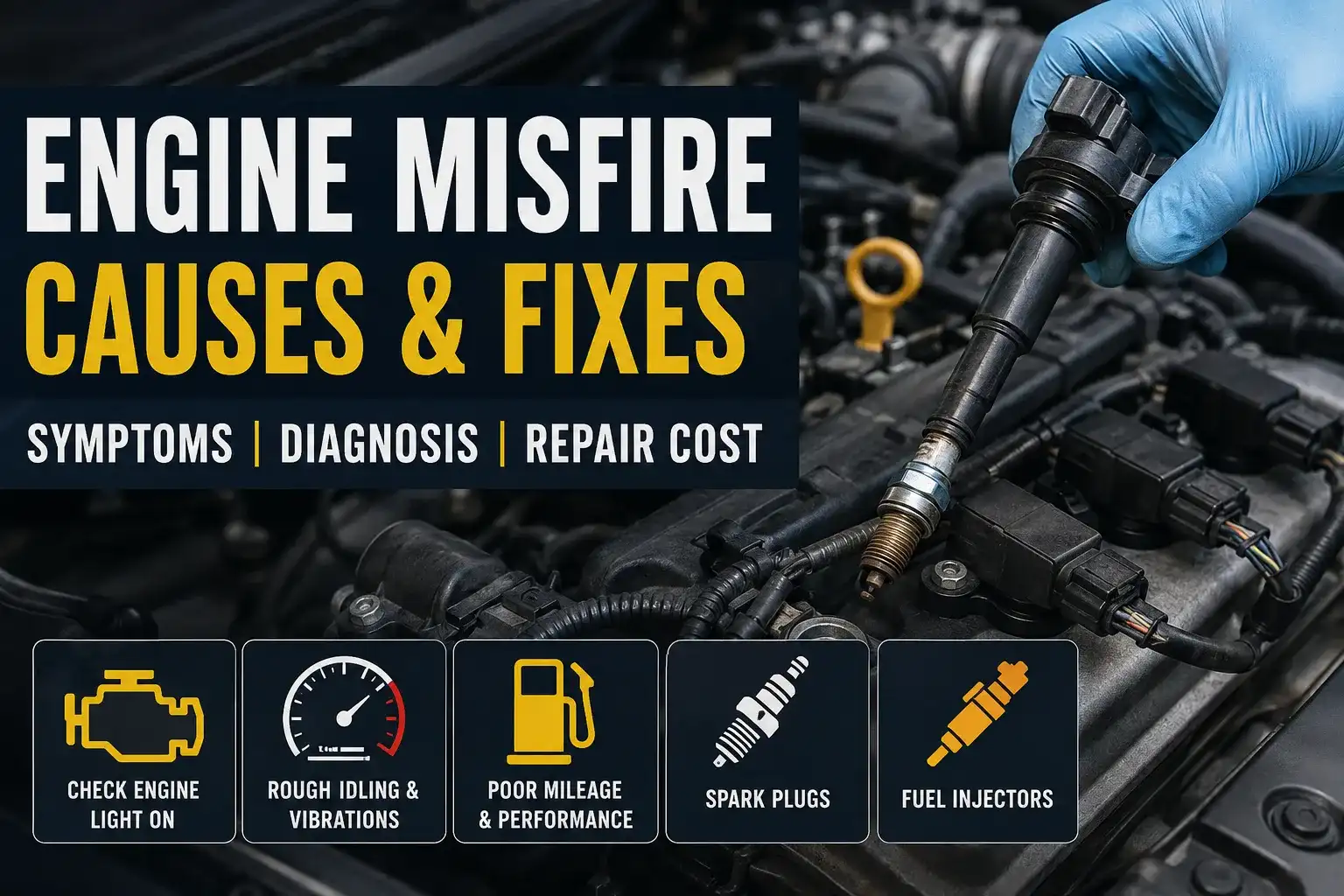
A smooth-running engine should deliver consistent power without unusual vibrations or hesitation. If your car suddenly starts jerking, loses power during acceleration, or the check engine light appears, an engine misfire could be the underlying problem.
Engine misfires are among the most common issues affecting both petrol and diesel vehicles. While some causes are relatively inexpensive to fix, others can lead to severe engine damage if ignored.
If you’ve already noticed symptoms such as reduced acceleration, rough idling, or unusual engine noises, it’s also worth checking whether your vehicle is experiencing loss of power while accelerating or unusual engine knocking sounds, as these problems can sometimes occur together.
This guide explains the most common engine misfire causes, warning signs, diagnostic methods, repair costs in India, and practical maintenance tips to help you avoid expensive repairs.
Quick Answer
An engine misfire occurs when one or more cylinders fail to burn the air-fuel mixture correctly. Common causes include worn spark plugs, faulty ignition coils, clogged fuel injectors, vacuum leaks, sensor failures, or low engine compression. While minor misfires may initially cause rough running, persistent misfires should be diagnosed quickly to prevent catalytic converter damage and more expensive repairs.
Table of Contents
- What Is an Engine Misfire?
- Common Symptoms of an Engine Misfire
- Top Engine Misfire Causes
- Is It Safe to Drive With an Engine Misfire?
- How Mechanics Diagnose an Engine Misfire
- Repair Costs in India
- DIY vs Professional Repairs
- How to Prevent Engine Misfires
- Frequently Asked Questions
- Key Takeaways
What Is an Engine Misfire?
An engine misfire happens when one or more engine cylinders fail to complete the combustion process correctly. Instead of producing smooth, consistent power, the affected cylinder delivers little or no power during its combustion cycle.
Modern engines rely on three essential elements for proper combustion:
- Correct air supply
- Proper fuel delivery
- Strong ignition spark
If any of these elements are interrupted—even briefly—the engine may misfire.
Modern vehicles use sophisticated engine management systems to detect combustion problems. When a misfire occurs, the engine control unit (ECU) often stores a diagnostic trouble code and illuminates the Check Engine Light. The National Highway Traffic Safety Administration (NHTSA) recommends addressing warning lights promptly because they can indicate issues that affect vehicle safety.
Common Symptoms of an Engine Misfire
The symptoms vary depending on the underlying fault, but several warning signs are common across most vehicles.
| Symptom | What You May Notice | Severity |
|---|---|---|
| Rough idle | Engine shakes while stationary | Medium |
| Loss of power | Poor acceleration | High |
| Engine jerking | Hesitation while driving | High |
| Flashing Check Engine Light | Active misfire detected | Very High |
| Poor fuel economy | More frequent fuel stops | Medium |
| Engine vibration | Noticeable through steering wheel or seats | Medium |
| Hard starting | Longer cranking before engine starts | Medium |
For example, a faulty ignition coil may initially cause only a slight hesitation under acceleration. Over time, however, the misfire can become more frequent, reducing performance and increasing fuel consumption.
If your vehicle has also developed unusual vibrations, you may find our article on why your car vibrates while driving helpful, as vibration and misfires often share related causes.
Top Engine Misfire Causes
An engine misfire can result from several mechanical or electrical faults. Proper diagnosis is important because replacing the wrong component can become expensive without solving the actual problem.
1. Worn or Fouled Spark Plugs
Spark plugs ignite the compressed air-fuel mixture inside each cylinder. Over time, the electrodes wear down, deposits build up, or the gap increases beyond specification.
Typical symptoms include:
- Rough idle
- Reduced fuel economy
- Poor acceleration
- Hard starting
- Intermittent misfires
Many manufacturers recommend replacing spark plugs at intervals specified in the owner’s manual, although the exact interval depends on the plug type and engine design.
Following the maintenance schedule in your vehicle’s owner’s manual is the best way to determine when spark plugs should be inspected or replaced. Many manufacturers also provide maintenance guidance through their official owner resources, such as Toyota Owner’s Manuals
2. Faulty Ignition Coils
Modern vehicles generally use individual ignition coils for each cylinder. A weak or failed coil may not generate enough voltage for a consistent spark.
Common signs include:
- Engine shaking
- Check Engine light
- Reduced engine performance
- Jerking during acceleration
Ignoring a faulty ignition coil can eventually overload the catalytic converter because unburned fuel enters the exhaust system.
3. Dirty or Clogged Fuel Injectors
Fuel injectors deliver a precise amount of fuel into each cylinder. Deposits or contamination can restrict fuel flow, creating an incorrect air-fuel mixture.
Possible symptoms include:
- Rough idling
- Hesitation
- Reduced mileage
- Engine stumbling
- Difficult cold starts
If you’ve also noticed that your car’s fuel efficiency has dropped, our guide on why your car mileage is decreasing suddenly explains several additional causes that may be contributing to the problem.
4. Vacuum Leaks
Modern engines depend on carefully controlled airflow. A cracked vacuum hose, leaking intake manifold gasket, or damaged intake component can allow unmetered air into the engine.
This extra air creates a lean fuel mixture, increasing the likelihood of misfires, particularly at idle.
Typical symptoms include:
- High idle speed
- Rough idle
- Whistling sound from the engine bay
- Hesitation during acceleration
5. Low Engine Compression
Each cylinder must build sufficient compression before combustion occurs. Worn piston rings, damaged valves, or a leaking head gasket can reduce compression.
Unlike ignition-related issues, low compression often requires more extensive mechanical repairs.
Warning signs include:
- Persistent misfire
- Blue or white exhaust smoke
- Low engine power
- Increased oil consumption
If you have also observed white smoke from the exhaust or engine oil leakage symptoms, these may point toward more serious internal engine issues that warrant a professional inspection.
6. Faulty Engine Sensors
Modern vehicles rely on multiple sensors to control ignition timing and fuel delivery. If one of these sensors sends incorrect data to the Engine Control Unit (ECU), it can cause one or more cylinders to misfire.
The most common sensors involved include:
Mass Air Flow (MAF) Sensor
A dirty or faulty MAF sensor measures incoming air incorrectly, causing an improper air-fuel mixture.
Typical symptoms include:
- Rough idling
- Hesitation during acceleration
- Reduced fuel economy
- Check Engine Light
Oxygen (O2) Sensor
The oxygen sensor monitors exhaust gases and helps the ECU maintain the correct fuel mixture. A failing sensor may result in poor combustion and intermittent misfires.
Crankshaft Position Sensor
This sensor tells the ECU the exact position of the crankshaft. If it fails, ignition timing becomes inaccurate, often causing severe misfires or even preventing the engine from starting.
If your vehicle refuses to start altogether, our guide on Car Not Starting But Battery Is Fine explains several possible causes.
7. Poor Fuel Quality or Fuel Delivery Problems
Low-quality or contaminated fuel can disrupt combustion.
Common fuel-related causes include:
- Water contamination
- Clogged fuel filter
- Weak fuel pump
- Incorrect octane fuel
- Dirty fuel injectors
In India, fuel quality may vary between filling stations. If misfires begin shortly after refueling, poor-quality fuel should be considered as one possible cause.
Is It Safe to Drive With an Engine Misfire?
The answer depends on how severe the misfire is.
| Condition | Can You Drive? | Recommendation |
|---|---|---|
| Slight hesitation | Yes, for a short distance | Schedule inspection soon |
| Rough idle only | Limited driving | Repair within a few days |
| Flashing Check Engine Light | No | Stop driving immediately |
| Severe power loss | No | Tow the vehicle |
| Loud knocking with misfire | No | Avoid further driving |
Stop driving immediately if:
- The Check Engine Light is flashing.
- The engine shakes violently.
- You hear knocking or metallic noises.
- Thick white or black smoke appears from the exhaust.
- The engine repeatedly stalls.
A prolonged misfire can damage the catalytic converter, which is typically much more expensive to replace than a spark plug or ignition coil.
How Mechanics Diagnose an Engine Misfire
Professional diagnosis usually follows a systematic process.
Step 1: Scan for Diagnostic Trouble Codes
A technician connects an OBD-II scanner to identify fault codes such as:
- P0300 – Random Misfire
- P0301 – Cylinder 1 Misfire
- P0302 – Cylinder 2 Misfire
- P0303 – Cylinder 3 Misfire
- P0304 – Cylinder 4 Misfire
Step 2: Inspect Ignition Components
The mechanic checks:
- Spark plugs
- Ignition coils
- Wiring
- Connectors
Step 3: Check Fuel Delivery
Fuel pressure and injector operation are tested to ensure each cylinder receives the correct amount of fuel.
Step 4: Compression Test
If ignition and fuel systems appear normal, a compression test helps identify worn piston rings, damaged valves, or head gasket problems.
Estimated Repair Costs in India
Actual costs vary depending on the vehicle model, manufacturer, city, and labor charges.
| Problem | Estimated Cost (₹) |
|---|---|
| Spark Plug Replacement | 800–4,000 |
| Ignition Coil Replacement | 2,000–8,000 |
| Fuel Injector Cleaning | 1,500–4,000 |
| Fuel Injector Replacement | 4,000–15,000 |
| MAF Sensor Replacement | 3,000–10,000 |
| Oxygen Sensor Replacement | 3,000–8,000 |
| Fuel Pump Replacement | 6,000–18,000 |
| Engine Compression Repair | 20,000–80,000+ |
These are approximate estimates and may differ significantly between vehicle brands and service centers.
DIY vs Professional Repair
| Problem | DIY Possible? | Mechanic Required? |
|---|---|---|
| Replace spark plugs | ✅ Yes (basic tools) | Optional |
| Replace ignition coil | ✅ On many cars | Optional |
| Clean MAF sensor | ✅ Yes | Optional |
| Fuel injector replacement | ❌ | ✅ Yes |
| Compression repair | ❌ | ✅ Yes |
| ECU diagnosis | ❌ | ✅ Yes |
If you’re unsure about the source of the problem, it’s usually more cost-effective to diagnose the issue properly before replacing parts.
Preventive Maintenance Tips
Preventing engine misfires is generally easier and less expensive than repairing the damage they can cause.
Every Month
- Check engine oil level.
- Monitor dashboard warning lights.
- Listen for unusual engine noises.
Our article on How Often Should You Change Engine Oil in India explains why timely oil changes are essential for engine health.
Every 10,000–15,000 km
- Inspect spark plugs.
- Replace the engine air filter if necessary.
- Check ignition wiring.
Every Service
- Scan for stored fault codes.
- Inspect fuel injectors.
- Check battery voltage and charging system.
If your battery is showing signs of weakness, you may also find Signs Your Car Battery Is Weak helpful.
Common Mistakes Car Owners Make
Avoid these common mistakes:
- Ignoring a flashing Check Engine Light.
- Replacing parts without proper diagnosis.
- Continuing long highway trips with an active misfire.
- Delaying routine maintenance.
- Using poor-quality fuel regularly.
- Ignoring oil leaks that may damage ignition components.
Early diagnosis usually prevents more expensive repairs later.
Expert Tips
- Replace spark plugs according to your vehicle manufacturer’s maintenance schedule.
- Use fuel from reputable filling stations.
- Keep your battery and charging system in good condition.
- Address unusual engine vibrations promptly rather than waiting for the problem to worsen.
- Follow recommended service intervals in your owner’s manual.
If your engine also feels unusually hot, see our guide on Why Your Car Is Overheating to understand whether overheating could be contributing to engine performance issues.
Frequently Asked Questions
What is the most common cause of an engine misfire?
Worn spark plugs and faulty ignition coils are among the most common causes. However, clogged fuel injectors, vacuum leaks, sensor faults, and low engine compression can also trigger misfires.
Can bad fuel cause an engine misfire?
Yes. Contaminated or poor-quality fuel can affect combustion, leading to rough running and intermittent misfires. If symptoms begin shortly after refueling, consider having the fuel system inspected.
Can I drive with a misfiring engine?
Driving short distances with a mild misfire may be possible, but it is not recommended. If the Check Engine Light is flashing or the engine is shaking severely, stop driving and have the vehicle inspected immediately.
Does an engine misfire affect fuel economy?
Yes. A misfiring cylinder burns fuel inefficiently, increasing fuel consumption and reducing overall mileage.
Can low engine oil cause a misfire?
Low oil does not directly cause a misfire in most cases, but it can contribute to increased engine wear and may affect systems such as variable valve timing, which can indirectly impact engine performance.
Will an engine misfire damage the catalytic converter?
Yes. Unburned fuel entering the exhaust system can overheat and damage the catalytic converter, resulting in a much more expensive repair if the misfire is ignored.
How long does it take to fix an engine misfire?
Simple repairs, such as replacing spark plugs or ignition coils, may take less than an hour. More complex issues involving fuel injectors, sensors, or internal engine damage can take considerably longer depending on the diagnosis.
Can a weak battery cause an engine misfire?
A weak battery generally does not directly cause a misfire while the engine is running, but low system voltage can affect ignition performance in some situations. If you’re experiencing starting issues, also read How to Jump Start a Car Battery Safely.
Key Takeaways
- Engine misfires are commonly caused by ignition, fuel, air, or compression problems.
- Rough idling, hesitation, and a flashing Check Engine Light should never be ignored.
- Early diagnosis often prevents expensive catalytic converter or engine damage.
- Spark plugs and ignition coils are frequent causes, but proper testing is essential before replacing parts.
- Routine maintenance and quality fuel reduce the risk of future misfires.
- Severe misfires should be inspected immediately rather than driven long distances.
Conclusion
Engine misfires can range from a minor ignition problem to a sign of serious internal engine damage. Recognizing the warning signs early, diagnosing the underlying cause correctly, and carrying out timely repairs can help protect your engine and avoid significantly higher repair costs.
Regular maintenance, quality replacement parts, and following your vehicle manufacturer’s recommended service schedule remain the best ways to reduce the likelihood of misfires. If your car develops persistent shaking, loss of power, or a flashing Check Engine Light, arrange a professional inspection as soon as possible rather than continuing to drive.
Author: Carsinfos Editorial Team
Published: July 14th, 2026