
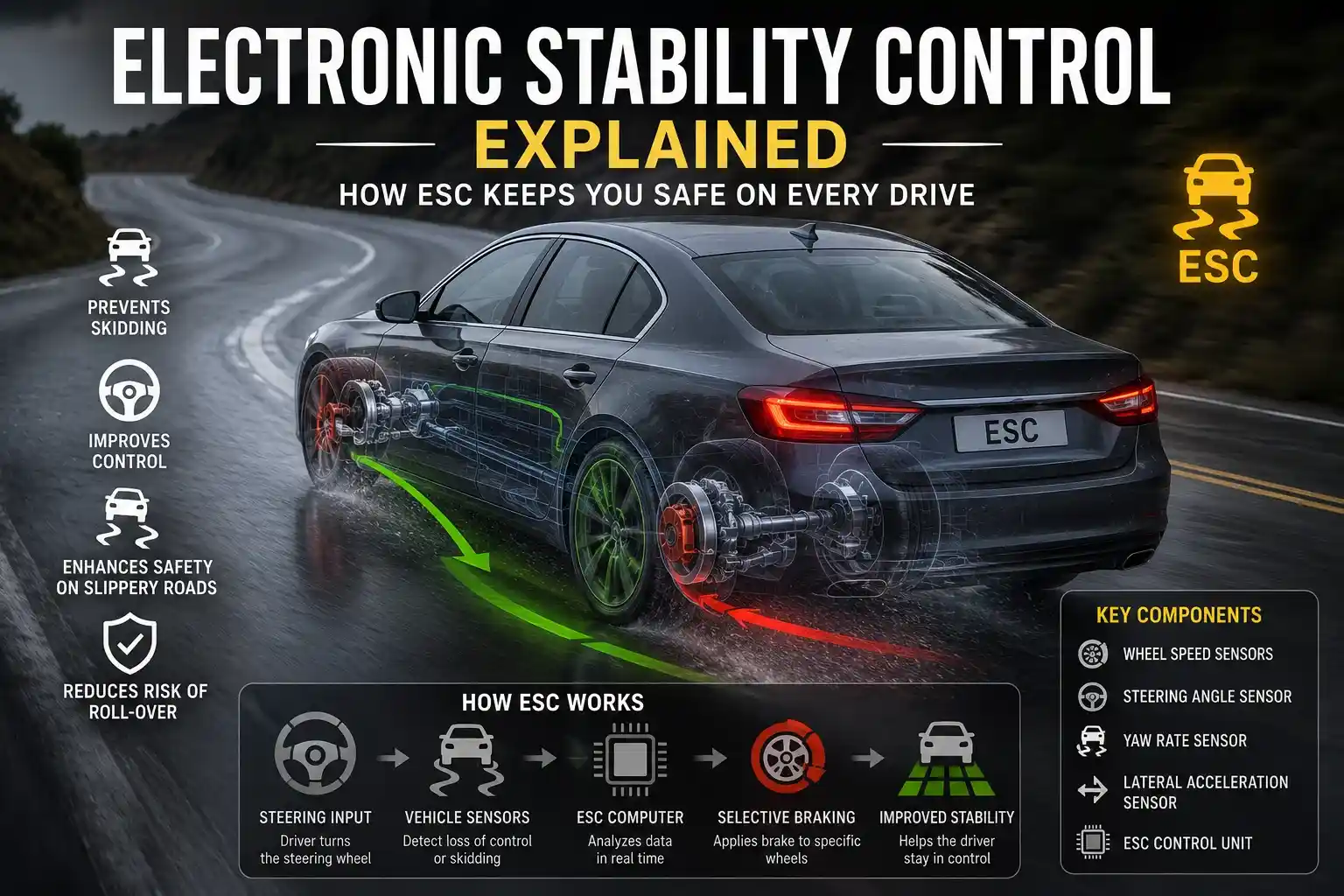
Electronic Stability Control Explained is an essential topic for every driver because Electronic Stability Control (ESC) is one of the most important vehicle safety technologies developed in recent decades. Designed to help drivers maintain control during sudden maneuvers or slippery road conditions, ESC can significantly reduce the risk of skidding, loss of control, and rollover accidents.
Unlike traditional braking systems, Electronic Stability Control constantly monitors your vehicle’s direction, steering input, and wheel movement. If the system detects that the vehicle is beginning to slide or deviate from the driver’s intended path, it automatically applies braking force to individual wheels and may reduce engine power to help restore stability.
In real-world situations, ESC can make a critical difference when avoiding unexpected obstacles, driving on wet roads, navigating icy surfaces, or taking sharp corners at higher speeds. While it cannot overcome the laws of physics, it provides valuable assistance when traction becomes limited.
If you’re interested in modern vehicle safety systems, you may also find our guides on Traction Control Explained and TPMS Explained helpful for understanding technologies that work alongside Electronic Stability Control.
This guide explains Electronic Stability Control, how it works, its key components, benefits, limitations, and why it has become a standard safety feature in most modern vehicles.
What Is Electronic Stability Control (ESC)?
Electronic Stability Control (ESC) is an advanced active safety system that helps maintain vehicle stability when traction is reduced or the vehicle begins to skid.
The system continuously compares:
- Driver steering input
- Vehicle direction
- Wheel speed
- Vehicle rotation
- Lateral movement
If the vehicle begins moving differently than intended, ESC automatically intervenes.
Unlike passive safety systems such as airbags or seat belts, ESC actively helps prevent accidents before they occur.
How Electronic Stability Control Works
ESC combines information from multiple sensors located throughout the vehicle.
The onboard computer continuously analyzes data hundreds of times per second.
When it detects instability, the system may:
- Apply braking to one or more individual wheels
- Reduce engine power
- Improve directional stability
- Help the driver regain control
These corrections happen automatically, often before the driver fully realizes that traction has been lost.
Key Components of an ESC System
Several technologies work together to make Electronic Stability Control effective.
Wheel Speed Sensors
These sensors monitor how fast each wheel rotates.
Differences in wheel speed help identify slipping or loss of traction.
Steering Angle Sensor
This sensor detects where the driver intends the vehicle to travel.
The ESC system compares steering input with the vehicle’s actual movement.
Yaw Rate Sensor
The yaw sensor measures how quickly the vehicle rotates around its vertical axis.
This helps determine whether the vehicle is oversteering or understeering.
Lateral Acceleration Sensor
This sensor measures side-to-side forces acting on the vehicle while cornering.
The information helps calculate overall vehicle stability.
Electronic Control Unit (ECU)
The ECU processes information from all sensors.
It determines when stability correction is necessary and activates braking or engine power reduction accordingly.
When Does ESC Activate?
Electronic Stability Control usually activates automatically during situations where the vehicle begins losing directional stability.
Common examples include:
- Sudden obstacle avoidance
- Slippery roads
- Wet pavement
- Snow-covered roads
- Icy conditions
- Sharp cornering
- Emergency lane changes
Drivers often notice a flashing ESC indicator light when the system is actively working.
Benefits of Electronic Stability Control
Improved Vehicle Stability
ESC helps maintain control by correcting skidding before it becomes severe.
This improves overall vehicle stability during challenging driving conditions.
Reduced Risk of Skidding
By selectively applying braking force to individual wheels, ESC helps reduce both oversteer and understeer.
This allows the vehicle to remain closer to the driver’s intended path.
Enhanced Safety on Slippery Roads
Rain, snow, gravel, and ice reduce tire grip.
ESC assists drivers by improving stability when traction becomes limited.
Better Emergency Handling
In emergency situations, drivers often steer abruptly.
ESC provides additional stability during these rapid steering inputs.
Reduced Rollover Risk
For taller vehicles such as SUVs and crossovers, Electronic Stability Control helps reduce the likelihood of rollover accidents during sudden evasive maneuvers.
According to the National Highway Traffic Safety Administration (NHTSA), Electronic Stability Control has significantly reduced single-vehicle crashes and rollover accidents since becoming widely adopted.
External Reference:
Electronic Stability Control vs Traction Control
Although the two systems work together, they serve different purposes.
Traction Control
Traction Control primarily prevents wheel spin during acceleration.
It focuses on maintaining traction when power is applied.
If you’d like a detailed explanation, our guide on Traction Control Explained covers how the system improves grip during acceleration.
Electronic Stability Control
ESC focuses on maintaining overall vehicle stability during steering and cornering.
It monitors vehicle direction and intervenes when the vehicle begins sliding or rotating unexpectedly.
Many vehicles use both systems together for maximum safety.
Does ESC Replace Safe Driving?
No.
Electronic Stability Control is designed to assist the driver—not replace responsible driving.
Drivers should still:
- Follow speed limits.
- Maintain safe following distances.
- Drive cautiously in poor weather.
- Use appropriate tires.
- Keep the vehicle properly maintained.
Even with advanced safety technology, aggressive driving can exceed the limits of available traction.
Real-World Situations Where ESC Helps
ESC provides valuable assistance in many everyday driving situations.
For example:
- Avoiding an animal crossing the road
- Taking a wet highway exit ramp
- Driving through heavy rain
- Recovering from hitting loose gravel
- Navigating icy intersections
- Performing emergency lane changes
Drivers may not even realize ESC has activated because system corrections happen within fractions of a second.
If you’re learning about modern vehicle technologies, you may also enjoy our guide on Connected Car Technology Explained, which explores how intelligent systems are improving vehicle safety and convenience.
The Insurance Institute for Highway Safety (IIHS) also recognizes Electronic Stability Control as one of the most effective crash-prevention technologies introduced in passenger vehicles.
External Reference:
Limitations of Electronic Stability Control
Although Electronic Stability Control is one of the most effective vehicle safety technologies available today, it is not capable of preventing every accident.
Understanding its limitations helps drivers use the system more effectively.
ESC Cannot Defy the Laws of Physics
ESC improves vehicle stability, but it cannot create traction where none exists.
For example, if a vehicle enters a sharp corner at excessive speed on an icy road, ESC may reduce skidding but may not completely prevent the vehicle from leaving the roadway.
ESC Is Not a Substitute for Safe Driving
Some drivers mistakenly believe ESC allows them to drive aggressively in poor weather.
The system is designed to assist—not replace—safe driving habits.
Drivers should always:
- Drive at appropriate speeds
- Maintain safe following distances
- Slow down on wet or icy roads
- Avoid sudden steering inputs whenever possible
Tire Condition Still Matters
Electronic Stability Control relies heavily on tire grip.
Worn or underinflated tires reduce the effectiveness of the system.
Regular tire maintenance remains essential for maximum vehicle stability.
If you’re learning about tire safety systems, our guide on TPMS Explained explains how Tire Pressure Monitoring Systems help maintain proper tire inflation and support overall vehicle safety.
Understanding the ESC Warning Light
Most vehicles display an ESC or stability control indicator on the dashboard.
Flashing ESC Light
A flashing light usually means the system is actively working to improve vehicle stability.
For example, it may flash briefly while driving on slippery roads or during sudden steering maneuvers.
This is normal.
Constant ESC Warning Light
If the ESC warning light remains illuminated continuously, it may indicate:
- Sensor malfunction
- ABS problem
- Wheel speed sensor failure
- Steering angle sensor fault
- ESC system malfunction
Professional diagnosis is recommended if the warning light remains on after restarting the vehicle.
Drivers can also refer to our guide on Car Dashboard Warning Lights Explained to better understand stability control indicators and other important dashboard alerts.
Common Driver Mistakes
Many drivers unknowingly reduce the effectiveness of Electronic Stability Control.
Ignoring the ESC Warning Light
A continuously illuminated warning light may indicate the system is unavailable.
Ignoring the warning could leave the vehicle without an important safety feature.
Using Worn Tires
ESC depends on available tire grip.
Driving with worn tires limits the system’s ability to stabilize the vehicle.
Driving Too Fast in Poor Weather
Electronic Stability Control improves stability but cannot compensate for excessive speed on wet, snowy, or icy roads.
Reducing speed remains the safest strategy.
Disabling ESC Unnecessarily
Some vehicles allow drivers to partially disable Electronic Stability Control.
Unless driving in specific off-road or low-traction situations where the manufacturer recommends otherwise, ESC should generally remain enabled.
Best Practices for Maintaining ESC Performance
Keeping Electronic Stability Control functioning properly requires regular vehicle maintenance.
Recommended practices include:
- Maintain proper tire pressure.
- Replace worn tires promptly.
- Perform regular wheel alignment.
- Repair ABS faults without delay.
- Address dashboard warning lights immediately.
- Keep suspension and steering components in good condition.
- Follow the manufacturer’s maintenance schedule.
If your vehicle also uses advanced driver assistance technologies, our article on Connected Car Technology Explained explores how intelligent systems work together to improve vehicle safety and convenience.
Can ESC Help Prevent Accidents?
Research has shown that Electronic Stability Control significantly improves vehicle safety by reducing the likelihood of skidding and loss-of-control crashes.
However, its effectiveness depends on several factors, including:
- Tire condition
- Road surface
- Vehicle speed
- Driver reaction
- Proper system maintenance
According to the National Highway Traffic Safety Administration (NHTSA), Electronic Stability Control is one of the most effective safety technologies for reducing single-vehicle crashes and rollover accidents.
External Reference:
The Insurance Institute for Highway Safety (IIHS) also reports that vehicles equipped with Electronic Stability Control experience substantially fewer fatal single-vehicle crashes compared with vehicles without the system.
External Reference:
Frequently Asked Questions
What is Electronic Stability Control?
Electronic Stability Control (ESC) is an active safety system that helps drivers maintain control when a vehicle begins to skid or lose traction by automatically applying braking force to individual wheels and reducing engine power when necessary.
Is ESC the same as Traction Control?
No.
Traction Control primarily prevents wheel spin during acceleration, while Electronic Stability Control helps maintain overall vehicle stability during steering and cornering.
Can ESC prevent every accident?
No.
ESC greatly improves vehicle stability but cannot overcome the limits of tire grip or the laws of physics. Safe driving practices remain essential.
Why is my ESC warning light on?
A continuously illuminated ESC warning light may indicate a fault with the stability control system, wheel speed sensors, steering angle sensor, ABS, or related components. Professional diagnosis is recommended.
Should I turn ESC off?
For normal road driving, ESC should remain enabled. Some manufacturers allow partial deactivation for specific off-road or deep-snow situations, but drivers should always follow the recommendations in the owner’s manual.
Does Electronic Stability Control work on all road surfaces?
ESC functions on most road surfaces, including dry, wet, snowy, and icy roads. However, its effectiveness depends on available tire grip and overall driving conditions.
Conclusion
Understanding Electronic Stability Control Explained helps drivers appreciate one of the most important vehicle safety innovations available today. By continuously monitoring steering input, wheel speed, and vehicle movement, ESC helps reduce skidding, improve directional control, and lower the risk of loss-of-control and rollover accidents.
Although Electronic Stability Control cannot replace careful driving or overcome the laws of physics, it provides valuable assistance during emergency maneuvers and challenging road conditions. Maintaining proper tire condition, addressing dashboard warning lights promptly, and following regular vehicle maintenance schedules ensure the system performs as intended.
By understanding Electronic Stability Control Explained, drivers can make better use of this advanced safety technology, improve vehicle stability, and enjoy safer, more confident driving in a wide range of road and weather conditions.
Author: Carsinfos Editorial Team
Published: July 8th, 2026