Traction Control Explained is one of the most searched topics among drivers who want to understand modern vehicle safety features. Whether you’re driving on a rain-soaked highway, a loose gravel road, or a slippery hill, losing traction can make your vehicle difficult to control. That’s where the Traction Control System (TCS) comes in.
Modern vehicles include several electronic safety technologies that work together to improve stability and reduce the risk of accidents. Traction Control is one of the most important because it helps prevent wheel spin when accelerating on low-grip surfaces.
In real-world situations, traction control can make a noticeable difference when pulling away from traffic lights on wet roads, driving through muddy areas, or climbing steep inclines after rainfall. Although many drivers see the traction control warning light on the dashboard, they may not fully understand what the system actually does.
If you’re learning about modern vehicle technologies, you may also find our guides on Hill Hold Assist Explained and Cruise Control Explained helpful, as these features often work alongside other electronic safety systems.
This guide explains how traction control works, when it helps, its limitations, and why it has become a standard safety feature in many modern cars.
What Is Traction Control?
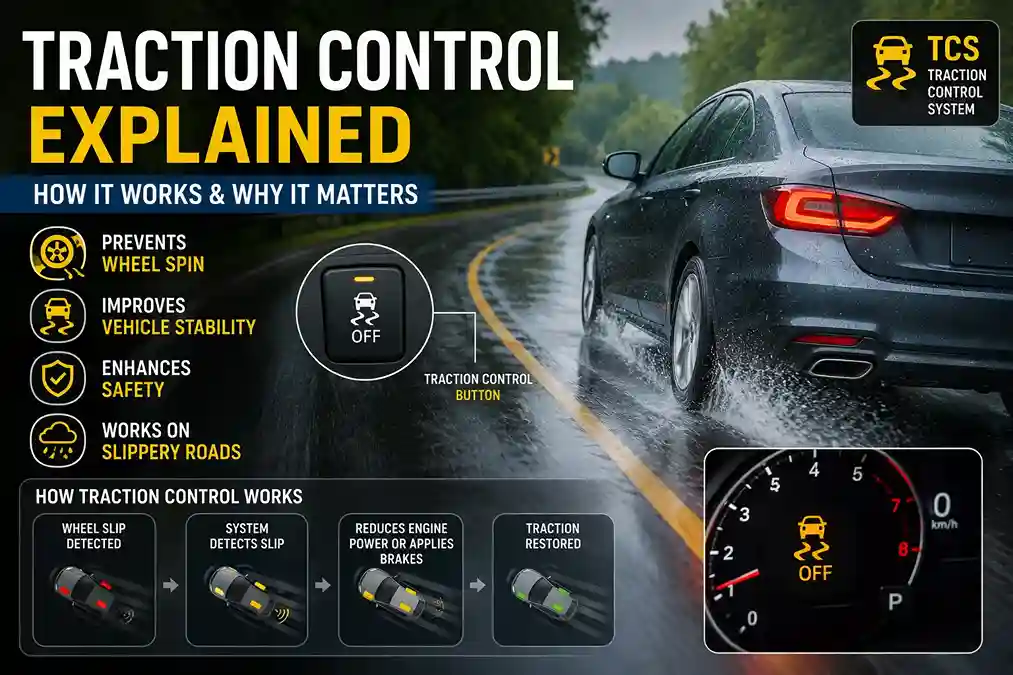
Traction Control, commonly called the Traction Control System (TCS), is an electronic safety feature designed to prevent a vehicle’s drive wheels from spinning when they lose grip.
When excessive wheel spin is detected, the system automatically intervenes by reducing engine power, applying brake force to individual wheels, or both. This helps restore traction and allows the vehicle to continue moving safely.
Unlike older vehicles that relied entirely on driver skill, today’s traction control systems respond within milliseconds, often before the driver even realizes traction has been lost.
According to the National Highway Traffic Safety Administration (NHTSA), electronic vehicle safety systems help improve vehicle control and reduce crash risks when used appropriately.
External Reference:
https://www.nhtsa.gov/
Traction Control Explained: How Does It Work?
Traction control continuously monitors wheel speed using sensors that are also part of the Anti-lock Braking System (ABS).
The system compares the rotational speed of all wheels.
If one or more drive wheels begin spinning significantly faster than the others, the system recognizes that traction has been lost.
It then responds by:
- Reducing engine torque
- Applying braking force to the slipping wheel
- Redistributing available traction
- Helping the driver maintain directional control
The process happens automatically and usually lasts only a fraction of a second.
Most drivers notice this only through:
- A flashing traction control light
- Slight engine power reduction
- Brief brake intervention
Components of the Traction Control System
Several vehicle systems work together.
Wheel Speed Sensors
Each wheel contains a sensor that continuously measures rotational speed.
These sensors provide the information needed to detect slipping wheels.
Electronic Control Unit (ECU)
The ECU processes wheel-speed information hundreds of times every second.
When wheel spin is detected, it determines the appropriate corrective action.
Brake Control Module
The braking system can apply braking force to an individual slipping wheel without requiring driver input.
Engine Management System
The engine computer may temporarily reduce power output until traction improves.
Together, these systems create a highly effective electronic safety feature.
Why Traction Matters
Traction refers to the grip between your tires and the road surface.
Without sufficient traction:
- Tires spin excessively
- Steering becomes less predictable
- Acceleration suffers
- Vehicle stability decreases
Traction can be reduced by:
- Rain
- Snow
- Ice
- Loose gravel
- Sand
- Mud
- Oil on the road
- Uneven road surfaces
Even high-quality tires cannot generate grip where little traction exists.
When Does Traction Control Activate?
Traction control usually activates during acceleration rather than braking.
Common situations include:
Driving on Wet Roads
Rain significantly reduces tire grip.
Traction control limits wheel spin during acceleration, helping maintain vehicle stability.
The Federal Highway Administration (FHWA) recommends reducing speed and maintaining vehicle control during wet-weather driving.
External Reference:
https://highways.dot.gov/
Loose Gravel Roads
Gravel provides inconsistent traction.
The system helps prevent excessive wheel spin while accelerating.
Muddy Conditions
Mud reduces tire grip considerably.
Traction control can improve forward movement by limiting unnecessary wheel spin.
Snow and Ice
Although uncommon in much of India, vehicles driven in mountainous regions benefit greatly from traction control on slippery roads.
Steep Inclines
When starting uphill on slippery surfaces, traction control works alongside systems like Hill Hold Assist Explained to improve vehicle control.
Benefits of Traction Control
Modern traction control provides several practical advantages.
Improved Vehicle Stability
The primary benefit is maintaining stability during acceleration.
Instead of spinning uncontrollably, the drive wheels regain grip more quickly.
Better Driver Confidence
New drivers often become nervous when roads are slippery.
Traction control provides additional confidence without requiring advanced driving skills.
Reduced Tire Wear
Excessive wheel spin accelerates tire wear.
Traction control helps minimize unnecessary tire slipping.
Drivers interested in tire maintenance should also read our guide on When Should You Replace Car Tyres in India.
Safer Acceleration
Instead of wasting power through spinning wheels, more engine power reaches the road effectively.
Better Performance on Slippery Roads
Whether driving after heavy rain or crossing loose gravel, traction control helps improve grip and stability.
Does Traction Control Prevent Accidents?
Traction control improves vehicle stability, but it cannot eliminate every risk.
It does not:
- Shorten stopping distances like ABS
- Prevent all skids
- Replace careful driving
- Override the laws of physics
According to the Insurance Institute for Highway Safety (IIHS), electronic safety technologies significantly improve vehicle control but should always be viewed as driver-assistance features rather than substitutes for attentive driving.
External Reference:
https://www.iihs.org/
How Traction Control Works with Other Safety Systems
Traction control is rarely a standalone technology.
It usually works alongside:
- Anti-lock Braking System (ABS)
- Electronic Stability Control (ESC)
- Hill Hold Assist
- Brake Assist
- Electronic Brake-force Distribution (EBD)
If you’re interested in understanding additional driver-assistance features, our article on ADAS Cars in India Explained explains how these systems work together to improve overall safety.
Traction Control vs ABS vs Electronic Stability Control (ESC)
Many drivers confuse Traction Control, Anti-lock Braking System (ABS), and Electronic Stability Control (ESC). Although they share sensors and electronic components, each system performs a different function.
| Feature | Traction Control (TCS) | ABS | Electronic Stability Control (ESC) |
|---|---|---|---|
| Prevents Wheel Spin | ✅ Yes | ❌ No | ✅ Yes |
| Prevents Wheel Lock During Braking | ❌ No | ✅ Yes | ✅ Yes |
| Helps Maintain Steering Control | Indirectly | Yes | Yes |
| Works During Acceleration | ✅ Yes | ❌ No | ✅ Yes |
| Works During Braking | Limited | ✅ Yes | ✅ Yes |
| Improves Vehicle Stability | ✅ Yes | Limited | ✅ Yes |
In simple terms:
- ABS prevents the wheels from locking while braking.
- Traction Control prevents the drive wheels from spinning during acceleration.
- ESC helps keep the vehicle traveling in the intended direction by correcting understeer or oversteer.
Modern vehicles combine these technologies to create a comprehensive safety system.
When Should You Turn Off Traction Control?
Most drivers should leave Traction Control enabled at all times. However, there are a few situations where temporarily disabling it may be beneficial.
Driving Through Deep Sand
On loose sand, a small amount of wheel spin can help the tires dig through the surface.
Driving in Deep Snow or Mud
If the vehicle becomes stuck, allowing controlled wheel spin may help free it.
Off-Road Driving
Certain off-road situations require greater wheel spin than the system normally allows.
For everyday road use, however, Traction Control should remain switched on.
Common Signs That Traction Control Is Working
Many drivers worry when they see the traction control warning light flashing.
In most cases, a flashing light simply means the system is actively helping maintain traction.
You may notice:
- Flashing traction control indicator
- Slight reduction in engine power
- Brief brake intervention
- Improved grip after wheel slip
However, if the warning light stays on continuously, it could indicate a fault in the system. Understanding dashboard indicators is important, and our guide on Car Dashboard Warning Lights Explained explains what different warning lights mean and when professional inspection is necessary.
Common Mistakes Drivers Make
Although Traction Control improves safety, it is not a substitute for careful driving.
Driving Too Fast in Bad Weather
Some drivers believe electronic safety systems allow them to drive normally in rain or on slippery roads.
In reality, reduced traction still requires slower speeds and greater stopping distances.
Switching Off Traction Control Unnecessarily
Many drivers disable the system without understanding its purpose.
Unless you’re dealing with specific off-road conditions, leaving it enabled is the safest option.
Ignoring Tire Condition
Traction Control cannot compensate for worn-out tires.
Even the most advanced electronic safety systems depend on adequate tire grip.
If your tires are nearing the end of their service life, our guide on When Should You Replace Car Tyres in India explains how to identify the warning signs.
Forgetting Regular Maintenance
Wheel speed sensors, ABS components, and braking systems all require proper maintenance.
Ignoring routine servicing can affect Traction Control performance.
Best Practices for Using Traction Control
To get the most benefit from the system:
- Leave Traction Control enabled during normal driving.
- Drive at appropriate speeds for road conditions.
- Maintain recommended tire pressure.
- Replace worn tires promptly.
- Follow scheduled brake system maintenance.
- Address dashboard warning lights without delay.
- Avoid sudden acceleration on slippery surfaces.
In real-world situations, drivers who combine Traction Control with sensible driving habits are more likely to maintain vehicle stability during unexpected road conditions.
Does Traction Control Improve Fuel Economy?
Traction Control is not designed to improve fuel efficiency directly.
However, by reducing excessive wheel spin and promoting smoother acceleration, it may contribute to slightly more efficient driving under certain conditions.
If fuel economy is one of your priorities, our guides on How to Improve Car Mileage in India and Petrol vs Hybrid Cars: Which Saves More Money offer practical tips for reducing running costs.
Is Traction Control Worth Having?
Absolutely.
Whether you’re an experienced driver or someone buying their first car, Traction Control provides meaningful safety benefits.
It’s especially valuable if you frequently:
- Drive during the rainy season
- Travel on uneven or gravel roads
- Encounter muddy construction areas
- Commute through hilly regions
- Drive on highways in changing weather conditions
Many buyers researching modern safety technologies also explore features discussed in Cruise Control Explained and Hill Hold Assist Explained because these systems often work together to improve driving comfort and confidence.
Frequently Asked Questions
What does Traction Control do?
Traction Control helps prevent the drive wheels from spinning during acceleration by reducing engine power, applying brake force, or both.
Does Traction Control work in the rain?
Yes. It is particularly effective on wet roads where tire grip is reduced.
Is Traction Control always active?
In most modern vehicles, yes. The system remains active unless manually switched off.
Can Traction Control prevent accidents?
It reduces the risk of losing traction during acceleration, but it cannot prevent every accident. Safe driving practices remain essential.
Should I turn off Traction Control?
For normal road driving, no. It should remain enabled unless specific conditions such as deep sand, mud, or certain off-road situations require additional wheel spin.
Does Traction Control use the brakes?
Yes. Many systems apply braking force to individual wheels to restore traction.
Conclusion
Understanding Traction Control Explained helps drivers appreciate one of the most valuable safety technologies found in modern vehicles. By automatically detecting wheel slip and restoring traction during acceleration, the system improves stability, boosts driver confidence, and helps maintain control on wet, slippery, or uneven roads.
Although Traction Control cannot overcome the laws of physics or replace safe driving habits, it serves as an important layer of protection when road conditions become challenging. Combined with well-maintained tires, proper vehicle servicing, and responsible driving, it can significantly improve everyday driving safety.
Whether you’re purchasing your first car or upgrading to a newer model, understanding Traction Control Explained will help you make better-informed decisions and use this feature effectively whenever road conditions demand extra grip and stability.
Author: Carsinfos Editorial Team
Published: June 25th, 2026