
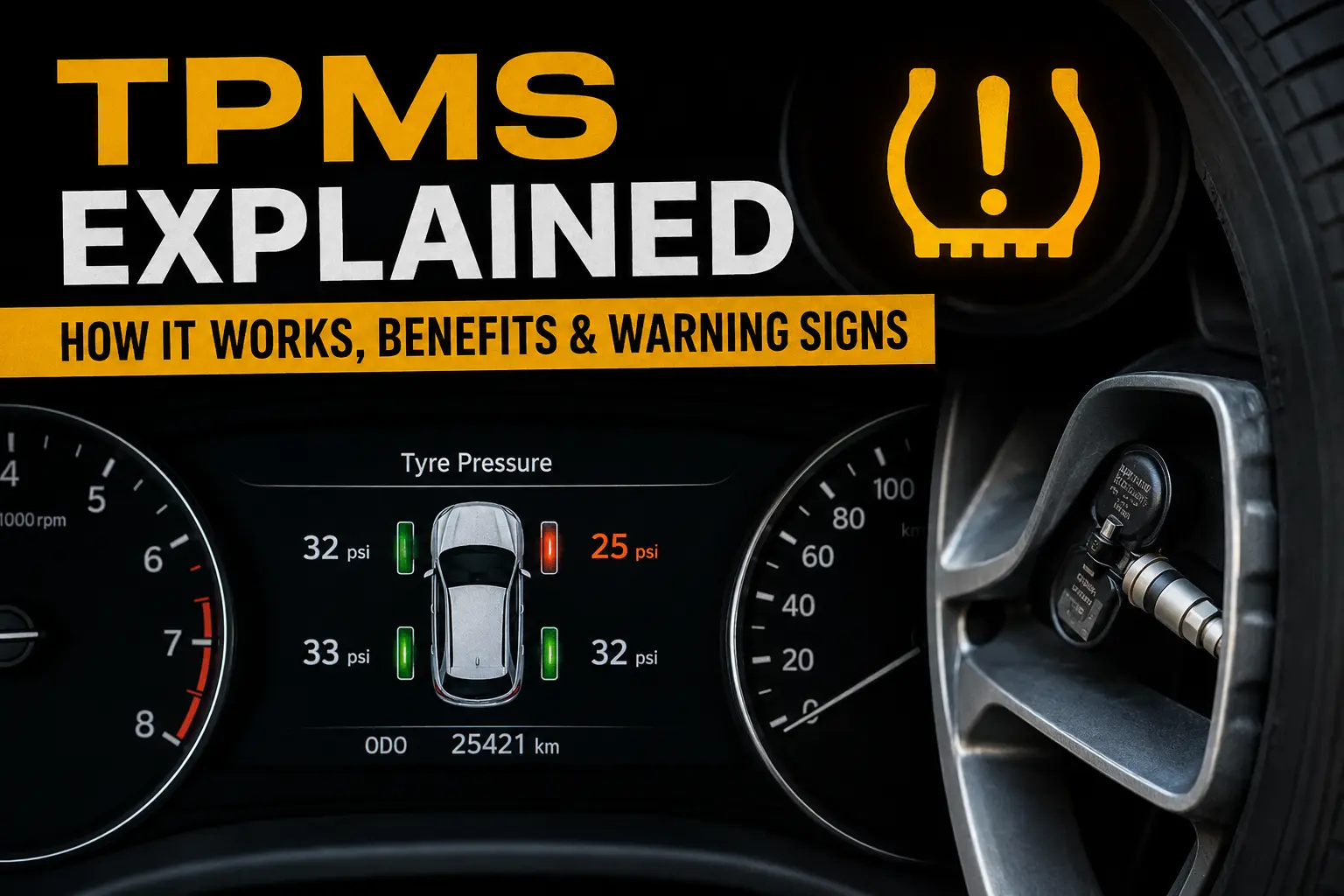
TPMS Explained is an essential topic for every vehicle owner because maintaining the correct tire pressure directly affects safety, fuel efficiency, tire life, and overall driving performance. Many modern cars sold in India now come equipped with a Tire Pressure Monitoring System (TPMS), but many drivers are still unsure about what the warning light means or how the system actually works.
A TPMS continuously monitors tire pressure and alerts the driver when one or more tires fall below the recommended pressure. While it cannot replace regular tire inspections, it provides an important early warning that helps reduce the risk of accidents caused by underinflated tires.
In real-world situations, a slow puncture may not be immediately noticeable while driving. Instead of waiting until the tire becomes dangerously flat, TPMS alerts the driver early, allowing the issue to be addressed before it becomes a serious safety concern.
If you’re interested in improving overall tire maintenance, you may also find our guides on How to Check Car Tyre Pressure at Home in India and When Should You Replace Car Tyres in India? helpful for keeping your vehicle safe and efficient.
This guide explains how TPMS works, the different types of systems available, their benefits, common warning signs, and best practices for maintaining accurate tire pressure.
What Is TPMS?
TPMS stands for Tire Pressure Monitoring System.
It is an electronic safety feature designed to monitor the air pressure inside your vehicle’s tires and notify the driver if the pressure drops below the recommended level.
Rather than preventing tire pressure loss, TPMS acts as an early warning system, helping drivers identify problems before they become dangerous.
Today, TPMS is available on many passenger cars, SUVs, and electric vehicles.
Why Tire Pressure Is Important
Correct tire pressure affects nearly every aspect of driving.
Properly inflated tires help:
- Improve braking performance
- Increase fuel efficiency
- Extend tire life
- Enhance steering response
- Improve vehicle stability
- Reduce tire wear
- Lower the risk of tire failure
Even a small drop in pressure can negatively affect handling and increase rolling resistance.
According to the National Highway Traffic Safety Administration (NHTSA), properly inflated tires improve vehicle safety and reduce the likelihood of tire-related crashes.
External Reference:
How Does TPMS Work?
The Tire Pressure Monitoring System continuously measures tire pressure while the vehicle is moving.
If tire pressure falls below the manufacturer’s recommended threshold, the system activates a warning light on the dashboard.
Depending on the vehicle, the system may also display:
- Individual tire pressures
- Tire location
- Temperature information
- Pressure alerts
This allows the driver to respond before the situation becomes hazardous.
Types of TPMS
There are two primary types of Tire Pressure Monitoring Systems.
1. Direct TPMS
Direct TPMS uses individual pressure sensors installed inside each wheel.
These sensors measure the actual air pressure and transmit the information wirelessly to the vehicle’s control module.
Advantages
- Highly accurate
- Displays actual tire pressure
- Faster warning response
- Better overall reliability
Disadvantages
- Higher replacement cost
- Sensor batteries eventually require replacement
- Tire service may require sensor recalibration
Many premium vehicles now use Direct TPMS because of its superior accuracy.
2. Indirect TPMS
Indirect TPMS does not measure air pressure directly.
Instead, it monitors wheel speed using the vehicle’s ABS sensors.
A tire with lower pressure has a slightly smaller rolling diameter and rotates faster than properly inflated tires.
The system detects these differences and alerts the driver.
Advantages
- Lower cost
- No pressure sensors inside wheels
- Reduced maintenance
Disadvantages
- Less accurate
- Cannot display actual tire pressure
- May require manual reset after tire inflation
TPMS Explained: Direct vs Indirect TPMS
| Feature | Direct TPMS | Indirect TPMS |
|---|---|---|
| Measures Actual Pressure | Yes | No |
| Pressure Display | Yes (Most Vehicles) | Usually No |
| Uses Tire Sensors | Yes | No |
| Uses ABS Data | No | Yes |
| Accuracy | Higher | Moderate |
| Maintenance Cost | Higher | Lower |
Understanding the difference helps owners know what to expect from their vehicle’s warning system.
Benefits of TPMS
Improved Road Safety
Maintaining proper tire pressure improves braking, steering, and stability.
A properly functioning TPMS helps detect pressure loss before handling becomes unsafe.
Better Fuel Efficiency
Underinflated tires increase rolling resistance.
This causes the engine—or electric motor—to work harder, increasing energy consumption.
Drivers looking to maximize efficiency should also read our guide on How to Improve Car Mileage in India.
Longer Tire Life
Incorrect tire pressure leads to uneven tread wear.
By maintaining recommended pressure, tires wear more evenly and often last longer.
Lower Risk of Tire Blowouts
One of the biggest advantages of TPMS is early detection.
In real-world situations, a slow puncture discovered early is far easier—and safer—to repair than a tire that suddenly fails at highway speed.
Improved Vehicle Performance
Correct tire pressure contributes to:
- Better cornering
- Predictable steering
- Improved braking
- Better ride quality
What Does the TPMS Warning Light Mean?
The TPMS warning light usually appears as a horseshoe-shaped symbol with an exclamation mark in the center.
The light may indicate:
- Low tire pressure
- Rapid pressure loss
- Sensor malfunction
- TPMS communication problem
If the warning light flashes before remaining illuminated, it may indicate a system fault rather than simply low tire pressure.
Always inspect the tires before continuing to drive.
Can TPMS Detect a Puncture?
Yes—but not instantly.
A slow puncture gradually reduces tire pressure.
Once pressure falls below the warning threshold, TPMS alerts the driver.
However, sudden tire damage may require immediate driver response before the system has time to react.
When Should You Check Tire Pressure?
Even if your vehicle has TPMS, manufacturers recommend checking tire pressure manually at regular intervals.
Ideally:
- Before long journeys
- At least once each month
- When tires are cold
- After significant temperature changes
Our article on Wheel Alignment vs Wheel Balancing: What’s the Difference? explains why correct tire maintenance extends beyond simply maintaining proper air pressure.
Can TPMS Improve Fuel Economy?
Yes.
Proper tire inflation reduces rolling resistance.
Lower rolling resistance means:
- Less engine effort
- Lower fuel consumption
- Reduced tire wear
- Improved driving efficiency
The U.S. Department of Energy notes that properly inflated tires can improve fuel economy and reduce unnecessary energy consumption.
External Reference:
Is TPMS Mandatory?
Many countries now require TPMS on new passenger vehicles because of its proven safety benefits.
In India, TPMS availability continues to increase as manufacturers add more advanced safety features across different vehicle segments.
Information regarding vehicle safety standards is available through the Automotive Research Association of India (ARAI).
External Reference:
Common TPMS Problems
Like any electronic system, the Tire Pressure Monitoring System can occasionally develop faults. Understanding these issues helps drivers respond correctly instead of ignoring dashboard warnings.
1. Low Tire Pressure
The most common reason for the TPMS warning light is simple underinflation.
Pressure can decrease because of:
- Natural air loss over time
- Seasonal temperature changes
- Small punctures
- Damaged valve stems
- Tire bead leaks
Always verify the pressure using a reliable tire pressure gauge before assuming there’s a sensor problem.
2. TPMS Sensor Battery Failure
Direct TPMS sensors contain small built-in batteries.
Most sensor batteries last 5–10 years, depending on driving conditions and manufacturer specifications.
When the battery reaches the end of its life, the entire sensor usually needs replacement because the battery is not designed to be serviced separately.
3. Damaged TPMS Sensors
Sensors can sometimes be damaged during:
- Tire replacement
- Wheel balancing
- Accident repairs
- Improper tire mounting
For this reason, it’s important to have tire work performed by experienced technicians familiar with TPMS-equipped vehicles.
4. Incorrect Tire Inflation After Service
After tire rotation or inflation, some vehicles require the TPMS to be reset or recalibrated.
Ignoring this step may result in incorrect warnings.
Always refer to your owner’s manual for the correct reset procedure.
5. Faulty TPMS Receiver or Control Module
Although less common, communication problems between the wheel sensors and the vehicle’s receiver can also trigger TPMS warning lights.
Professional diagnostic equipment is often required to identify these faults.
Common Mistakes Drivers Make
Many TPMS-related problems occur because drivers misunderstand what the system can—and cannot—do.
Ignoring the TPMS Warning Light
Some drivers continue driving for days after the warning appears.
This increases the risk of:
- Uneven tire wear
- Poor handling
- Reduced fuel efficiency
- Tire failure
If the warning light appears, inspect the tires as soon as it is safe to do so.
Assuming TPMS Replaces Manual Tire Checks
TPMS is an early warning system—not a replacement for regular maintenance.
You should still check tire pressure manually every month and before long trips.
Inflating Tires Based on Appearance
Modern radial tires can appear properly inflated even when they are significantly underinflated.
Always use a pressure gauge rather than relying on visual inspection.
Overinflating Tires
Some drivers believe higher pressure improves fuel economy.
In reality, excessive tire pressure may:
- Reduce grip
- Increase uneven tire wear
- Affect ride comfort
- Reduce braking performance
Always inflate tires according to the manufacturer’s recommended pressure listed on the driver’s door jamb or owner’s manual.
Ignoring Seasonal Temperature Changes
Air pressure naturally changes with temperature.
A drop in ambient temperature can reduce tire pressure enough to trigger the TPMS warning light even if there is no puncture.
Checking tire pressure during seasonal changes helps prevent unnecessary warnings.
Best Practices for Maintaining TPMS
Following a few simple habits can improve both TPMS accuracy and overall tire performance.
- Check tire pressure at least once a month.
- Measure pressure when the tires are cold.
- Inspect tires for cuts, punctures, or uneven wear.
- Rotate tires according to the manufacturer’s maintenance schedule.
- Replace damaged valve caps.
- Reset the TPMS after tire service if required.
- Replace TPMS sensors when they reach the end of their service life.
If you’re diagnosing other vehicle warning indicators, our guide on Car Dashboard Warning Lights Explained explains several important dashboard symbols that every driver should recognize.
TPMS Myths vs Facts
Myth: TPMS Prevents Flat Tires
Fact: TPMS only warns you about low tire pressure. It cannot prevent punctures or tire damage.
Myth: You Never Need to Check Tire Pressure Manually
Fact: Manual pressure checks remain essential because TPMS only activates when pressure falls below a certain threshold.
Myth: The TPMS Warning Means the Sensor Is Broken
Fact: Most warning lights simply indicate that one or more tires need inflation. A flashing TPMS light is more likely to indicate a system fault.
Myth: Any Tire Pressure Is Acceptable If the TPMS Light Is Off
Fact: A tire can still be slightly underinflated without triggering the warning light. Regular manual checks help maintain the correct pressure for safety and efficiency.
Does TPMS Help Extend Tire Life?
Yes.
Maintaining the recommended tire pressure helps:
- Reduce uneven tread wear
- Improve braking performance
- Enhance steering response
- Lower rolling resistance
- Increase fuel efficiency
Drivers who combine TPMS with routine inspections typically experience longer tire life and more predictable vehicle handling.
For a complete tire care routine, you may also find our guide on Check Car Suspension Problems: Warning Signs & Fixes useful, since suspension condition also affects tire wear.
Frequently Asked Questions
What does TPMS stand for?
TPMS stands for Tire Pressure Monitoring System, an electronic system that monitors tire pressure and warns the driver when one or more tires become underinflated.
Is TPMS always accurate?
Direct TPMS is generally very accurate because it measures actual tire pressure. Indirect TPMS estimates pressure using wheel-speed data and may be less precise.
Can I drive with the TPMS warning light on?
If the light indicates low tire pressure, reduce speed if necessary and check your tires as soon as it is safe. Driving long distances with underinflated tires can increase the risk of tire damage or failure.
Why is my TPMS light still on after filling the tires?
Some vehicles require the TPMS to be reset after adjusting tire pressure. If the warning remains, inspect all tires again and consult your owner’s manual. Persistent warnings may indicate a faulty sensor or another system issue.
Does TPMS work on the spare tire?
It depends on the vehicle. Some models monitor only the four road wheels, while others also include the spare tire if it is equipped with a TPMS sensor.
How often should TPMS sensors be replaced?
Most TPMS sensors last between 5 and 10 years, though actual lifespan varies depending on driving conditions, battery life, and manufacturer design.
Conclusion
Understanding TPMS Explained helps drivers appreciate one of the most valuable safety technologies found in modern vehicles. Although the Tire Pressure Monitoring System does not replace routine tire maintenance, it provides an important early warning when tire pressure falls below recommended levels, helping improve safety, fuel efficiency, handling, and tire longevity.
Whether your vehicle uses a direct or indirect TPMS, combining the system with regular manual pressure checks, timely tire maintenance, and proper wheel care will deliver the best results. Ignoring a TPMS warning can lead to unnecessary tire wear, poor vehicle performance, and increased safety risks.
By understanding TPMS Explained, following the manufacturer’s recommendations, and responding promptly to dashboard warnings, you can enjoy safer driving, lower operating costs, and better overall vehicle performance throughout the life of your car.
Author: Carsinfos Editorial Team
Published: June 29th, 2026