
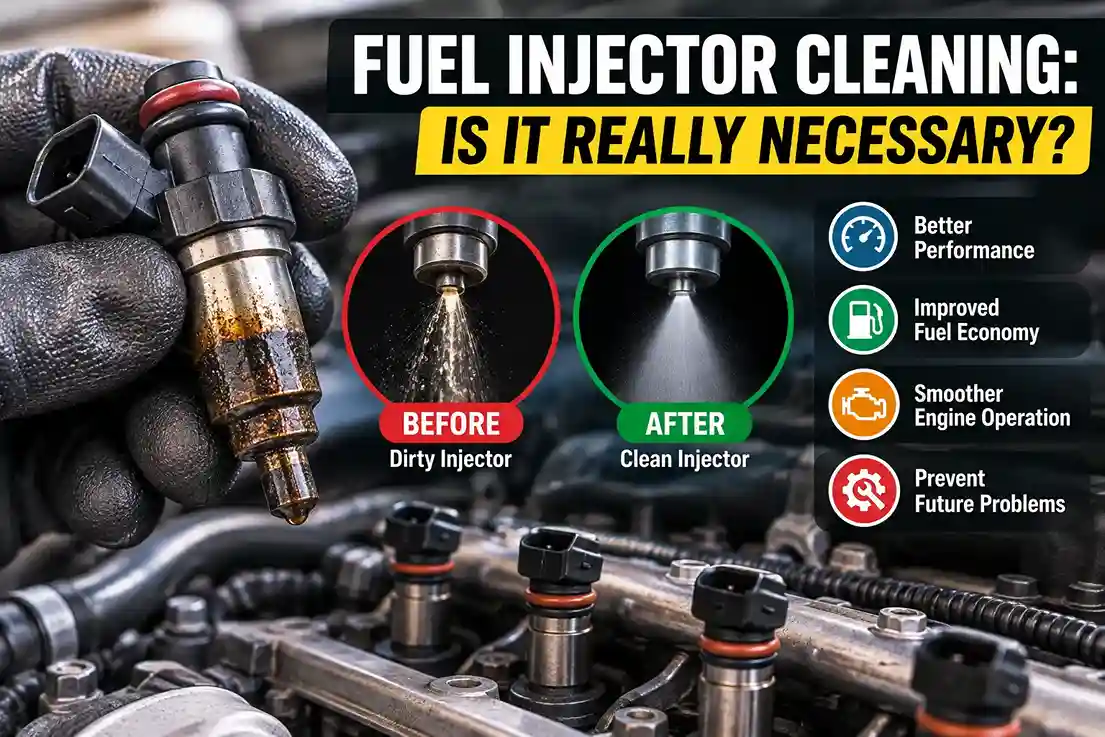
Fuel Injector Cleaning: Is It Really Necessary? It is a question many car owners ask when a mechanic recommends a fuel-system service, when mileage starts falling, or when the engine feels slightly rough. The answer is not as simple as “yes” or “no.” Fuel injectors can develop deposits and flow problems, but a healthy engine does not automatically need professional injector cleaning at every service.
The important distinction is between cleaning because there is a genuine problem and cleaning simply because a workshop offers it as a routine service. A vehicle with poor acceleration, rough idling, hesitation or a misfire may benefit from injector testing and cleaning. A car that starts easily, idles smoothly and performs normally may not need anything more than normal preventive maintenance.
In real-world situations, understanding that difference can save you from spending money on a service that may not solve the actual problem.
What Does a Fuel Injector Do?
A fuel injector is a precision component that delivers a controlled amount of fuel into the engine. Depending on the engine design, the injector may spray fuel into the intake port or directly into the combustion chamber. The engine control system manages the timing and quantity of fuel delivery to maintain the required air-fuel mixture.
The U.S. Department of Energy explains that gasoline engines use fuel injection to introduce fuel into the engine, where it mixes with air before combustion. Injector spray characteristics and fuel-delivery control are important because combustion quality depends partly on how the fuel is introduced.
That is why an injector is more than simply a small nozzle. It is a precision part designed to open and close rapidly and deliver fuel consistently.
Why Do Fuel Injectors Get Dirty?
Fuel-system deposits can develop over time. The process depends on fuel chemistry, injector design, operating temperature and vehicle usage.
Research indexed by the U.S. Environmental Protection Agency has linked injector deposits to fuel-derived chemistry and noted that severe injector fouling can affect spray behavior and contribute to engine misfire and malfunction.
Modern gasoline also commonly contains detergent additives intended to help control engine and fuel-system deposits. The EPA maintains a list of certified detergent additives and explains the regulatory requirements surrounding fuel additives.
Common factors that may contribute to injector deposits include:
- Poor or contaminated fuel
- Long periods of operation under severe conditions
- High temperatures around the injector
- Accumulated fuel-system deposits
- Certain engine and injector designs
- Infrequent vehicle use or long storage periods
However, this does not mean that every injector becomes clogged simply because the car is old. A vehicle can accumulate substantial mileage and still have injectors that perform normally.
Fuel Injector Cleaning: Is It Really Necessary?
For most cars, routine professional fuel injector cleaning is not automatically necessary unless the manufacturer recommends it or there is evidence of a fuel-delivery problem.
That is the practical answer.
If your engine starts normally, idles smoothly, accelerates as expected and has no fuel-related warning signs, there is little reason to assume that the injectors need cleaning just because the vehicle has crossed a certain mileage number.
A workshop saying, “Your car has done 40,000 km, so the injectors need cleaning,” is not the same as diagnosing an injector problem.
Maintenance schedules vary between manufacturers and engines. Rather than following a universal internet interval, check your vehicle’s owner’s manual and service schedule.
Signs That May Point to Injector Problems
Injector issues can produce symptoms that overlap with many other engine faults. That is why the symptoms are clues, not proof.
Possible signs include:
1. Rough or unstable idle
A partially restricted injector may deliver fuel unevenly, causing the engine to feel rough at idle.
You might notice the steering wheel or cabin vibrating slightly while the vehicle is stopped. In some cases, the engine may feel like it is almost about to stall and then recover.
But rough idle can also come from ignition problems, vacuum leaks, throttle-body deposits, sensors or engine mounts.
2. Hesitation during acceleration
A car that hesitates when you press the accelerator may have a fuel-delivery issue. If the engine is not receiving fuel consistently, acceleration can feel uneven.
For example, you may notice the vehicle feels normal during gentle driving but briefly loses response when climbing a hill or overtaking.
3. Misfire or uneven engine operation
A severely restricted or malfunctioning injector can contribute to poor combustion. EPA technical research has identified injector fouling as one potential contributor to misfire and engine malfunction.
Still, do not assume that every misfire is an injector problem. Spark plugs, ignition coils, air leaks and other components can produce very similar symptoms.
That is why our guide on Engine Misfire Causes is useful before paying for an injector-cleaning service.
4. Poor fuel economy
Fuel economy may suffer when combustion or fuel delivery is not operating correctly.
But a mileage drop has many possible causes. Tyre pressure, driving conditions, air filters, spark plugs, braking drag and sensor faults can all influence fuel consumption.
If mileage has recently dropped, it is worth reading How to Improve Car Mileage in India before assuming that dirty injectors are responsible.
5. Hard starting
Starting problems can sometimes be associated with fuel-delivery issues, but a weak battery, starter problem, ignition fault, fuel-pump issue or sensor problem may produce similar symptoms.
That is why the pattern of the problem matters more than one symptom by itself.
Can a Fuel Injector Cleaner Added to the Tank Help?
Fuel injector cleaners added to the fuel tank are designed to help control or remove deposits, depending on the product formulation.
The EPA’s current list of certified detergent additives confirms that fuel-system detergent chemistry is a recognized part of gasoline-fuel management.
However, the existence of a detergent additive does not mean every bottle on a shop shelf will solve every fuel-system problem.
A fuel-system cleaner may be worth considering when:
- The product is compatible with your vehicle and fuel type
- The vehicle manufacturer allows or recommends that type of additive
- You suspect light deposit buildup
- You are following the product’s dosage instructions
It is much less likely to solve problems caused by:
- An electrically failed injector
- A leaking injector
- A damaged injector nozzle
- Severe mechanical wear
- Low fuel pressure
- A faulty fuel pump
- Wiring or ECU problems
For example, adding cleaner to the tank cannot repair an injector with a failed electrical winding.
Is Professional Injector Cleaning Better?
Professional injector cleaning becomes more valuable when there is an actual drivability complaint.
A competent technician may perform checks such as:
- Injector resistance testing
- Fuel-pressure testing
- Leak testing
- Flow testing
- Spray-pattern inspection
- Comparison between individual injectors
On some cleaning machines, injectors can be removed and tested before and after cleaning. That provides more useful information than simply pouring a chemical into the fuel tank.
Imagine a four-cylinder engine where one cylinder is misfiring. Replacing or cleaning all four injectors without testing could waste money. A better diagnostic process identifies whether the affected injector is actually delivering fuel incorrectly.
The same principle applies when a check engine light appears. Instead of guessing, start by reading the diagnostic information. Our OBD2 Error Codes Explained guide explains how diagnostic trouble codes can help narrow down the problem.
Fuel Injector Cleaning vs Injector Replacement
Cleaning and replacing an injector are completely different decisions.
Cleaning may be suitable when:
- The injector is mechanically healthy
- Flow is restricted by deposits
- Spray quality is poor because of contamination
- Testing shows the injector can be restored
Replacement may be necessary when:
- The injector has an electrical fault
- It leaks after testing
- The injector body or nozzle is damaged
- Cleaning does not restore acceptable flow
- The manufacturer specifies replacement
A common mistake is assuming that “cleaning” is always cheaper and therefore always preferable. If the component has actually failed, repeated cleaning attempts simply delay the correct repair.
Does Injector Cleaning Improve Mileage?
Sometimes, but there is no guaranteed mileage improvement.
If deposits have affected fuel delivery, restoring proper injector performance may help the engine return to its normal operating condition. However, a healthy injector does not suddenly make a car deliver dramatically better mileage just because it was cleaned.
This is an important distinction for owners who purchase injector-cleaning services primarily as a fuel-saving treatment.
For example, suppose your hatchback normally returns 16 km/l but suddenly drops to 12 km/l. Before spending money on injector cleaning, check tyre pressure, driving conditions, air filters, spark plugs and dashboard warnings. A maintenance issue somewhere else may be responsible.
Our guide on How Often Should You Change Engine Oil in India is also worth keeping in your maintenance routine because overall engine condition affects long-term efficiency.
Should You Clean Fuel Injectors During Every Service?
Not automatically.
Some service centres include injector cleaning in maintenance packages, but a package recommendation should not be confused with a manufacturer requirement.
The right question is not:
“How many kilometres has the car travelled?”
A better question is:
“Is there evidence that the injectors are not performing correctly?”
If there is no symptom, no diagnostic evidence and no manufacturer recommendation, routine professional cleaning may not be necessary.
This does not mean injector cleaning is useless. It means the service should have a sensible reason behind it.
Common Mistakes Car Owners Make
Assuming poor mileage always means dirty injectors
Fuel economy can change because of traffic, tyre pressure, AC use, driving style, air filters, spark plugs and many other factors.
Buying the strongest-looking cleaner
A more aggressive label does not automatically mean better results. Use a product that is appropriate for your fuel system and follow the stated dosage.
Using too much additive
Adding more than the recommended amount does not guarantee better cleaning.
Cleaning injectors without diagnosing the fault
A car that is misfiring may need a scan, fuel-pressure test or ignition-system inspection before any injector work.
Replacing all injectors after one cylinder develops a problem
Replacement should follow testing whenever possible. One faulty injector does not automatically prove that the remaining injectors have failed.
Ignoring a check engine light
Fuel-system faults can trigger warning lights, but so can many unrelated problems. Our Car Dashboard Warning Lights Explained guide explains why the warning itself is only the starting point for diagnosis.
Best Practices for Keeping Fuel Injectors Healthy
Good fuel-system maintenance is mostly about consistency.
Use appropriate fuel
Buy fuel from reputable stations and follow the fuel type and specification recommended for your vehicle.
Follow the service schedule
Keep up with scheduled maintenance and replace filters and ignition components when required.
Investigate new symptoms early
A slight hesitation today can become a much harder-to-diagnose running problem later. Getting the issue checked while the symptoms are still mild can make diagnosis easier.
Do not treat additives as repairs
Fuel additives can be useful maintenance products, but they cannot repair every fuel-system fault.
Keep records of repairs
If a workshop recommends injector cleaning, note why it was recommended and what testing was performed. This is especially useful if the same symptom returns.
What Should You Ask Your Mechanic Before Paying for Injector Cleaning?
A few simple questions can make the recommendation much clearer:
What evidence shows that the injectors need cleaning?
Is there a diagnostic trouble code?
Was fuel pressure checked?
Was injector flow tested?
Is the injector leaking?
Does the vehicle manufacturer recommend this service?
Is cleaning expected to correct a specific symptom?
For example, “Your injectors may be dirty” is a general statement.
“Cylinder 2 has a fuel-delivery problem, the injector has reduced flow compared with the others, and cleaning is intended to restore that flow” is a diagnosis-based explanation.
That difference matters.
When Should You Get Professional Help?
Do not rely on injector cleaner alone when the engine has significant symptoms.
Arrange a proper inspection when you notice:
- A persistent or severe misfire
- Difficult starting
- Significant loss of power
- A check engine light that stays on
- A flashing check engine light
- Strong fuel smell
- Unusual fuel consumption
- Engine stalling
- Repeated hesitation under load
A serious symptom should be diagnosed rather than repeatedly treated with additives.
FAQ: Fuel Injector Cleaning
Is fuel injector cleaning necessary for every car?
No. A properly running car does not automatically need professional injector cleaning at a fixed mileage interval. It should be based on the manufacturer’s recommendations, symptoms or diagnostic evidence.
How often should fuel injectors be cleaned?
There is no universal interval that applies to every vehicle. Follow the manufacturer’s maintenance schedule and clean the injectors when testing or symptoms indicate a need.
Can dirty fuel injectors reduce mileage?
They can contribute to poor fuel economy when deposits interfere with fuel delivery, but low mileage has many possible causes. Injector cleaning should not be the first assumption.
Does injector cleaner improve performance?
It may help when deposits are affecting injector operation. It will not repair mechanical or electrical injector failures.
Is fuel injector cleaner safe for petrol cars?
A suitable product used at the manufacturer’s or product-maker’s recommended dosage can be appropriate, but compatibility matters. Always check the product instructions before adding it to the tank.
Should I use injector cleaner at every oil change?
Not necessarily. More frequent treatment is not automatically better. Check the vehicle manufacturer’s guidance and use additives for a specific maintenance reason rather than by habit.
Can a bad injector cause a check engine light?
Yes. Fuel-delivery faults can trigger diagnostic codes, but the check engine light can also be caused by many other engine and emissions problems. Scan the vehicle before assuming the injector is at fault.
Conclusion
So, Fuel Injector Cleaning: Is It Really Necessary? The answer for most healthy cars is not as a routine service simply because the vehicle has reached a certain mileage. Fuel injectors are precision components, and modern fuels contain detergent chemistry intended to help control deposits.
Cleaning becomes more worthwhile when the car has symptoms such as hesitation, rough running, poor acceleration, hard starting or a confirmed fuel-delivery problem. Even then, proper diagnosis is important because spark plugs, ignition components, sensors, fuel pressure and air leaks can produce similar symptoms.
The smartest approach is straightforward: maintain the vehicle according to the manufacturer’s schedule, use appropriate fuel and additives, pay attention to changes in engine behavior, and ask the workshop what evidence supports an injector-cleaning recommendation.
When there is a real injector problem, cleaning can be a useful repair. When there is no evidence of a problem, there is usually little reason to clean a healthy injector simply because someone says it is “due.”
Author: Carsinfos Editorial Team
Published: Sep 24th, 2026