
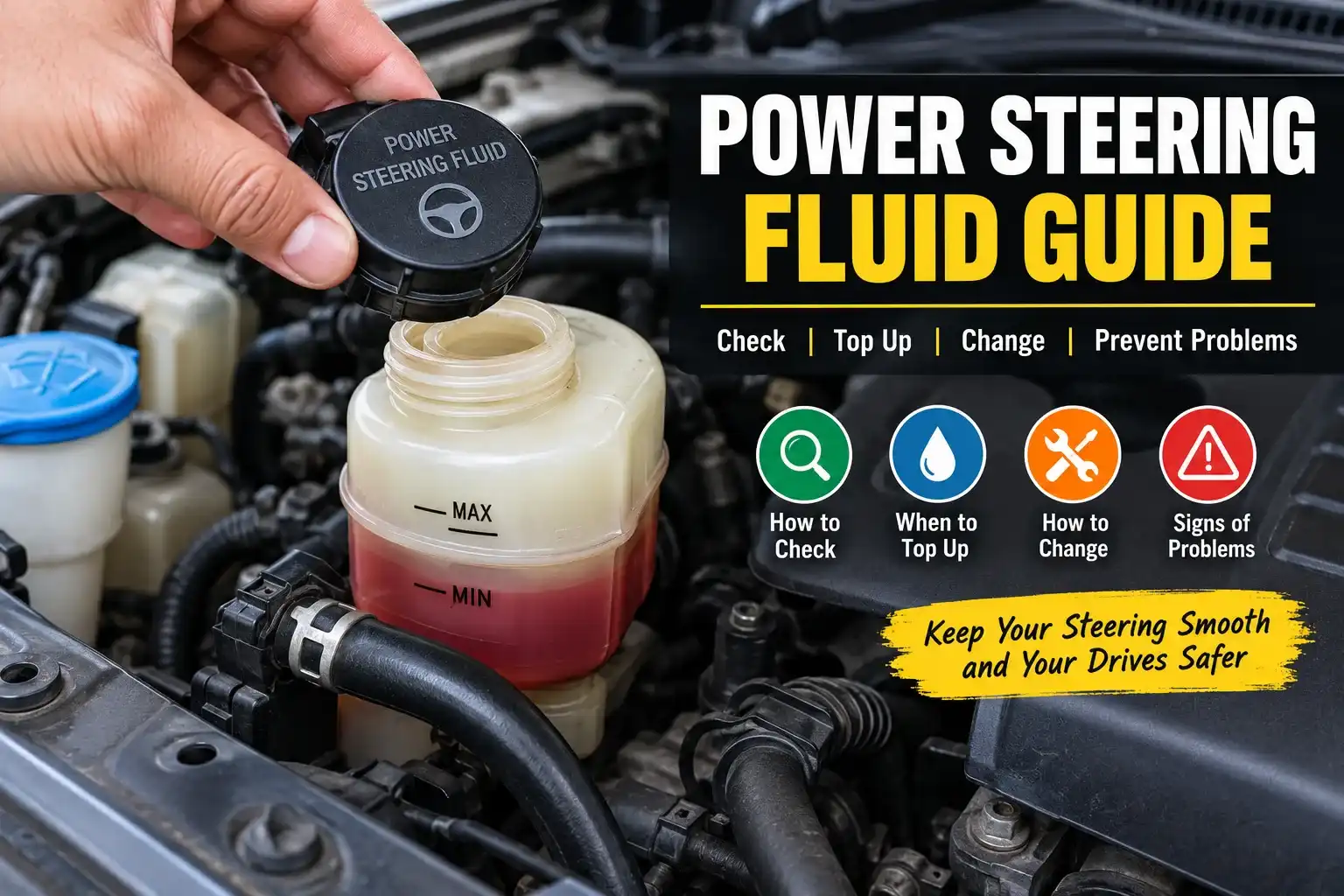
Your steering should feel smooth and predictable whether you’re parking in a tight space or cruising on the highway. If the steering suddenly becomes heavy, noisy, or inconsistent, the power steering system deserves attention. This Power Steering Fluid Guide explains what the fluid does, how to check it correctly, when it needs changing, and which warning signs should send you to a workshop.
One important point comes first: not every modern car uses hydraulic power steering fluid. Many newer vehicles use electric power steering (EPS), which has no fluid reservoir at all. For example, Ford’s owner information for some vehicles explicitly states that EPS systems have no power steering fluid reservoir to check or fill.
So before opening a bonnet and looking for a reservoir, confirm which steering system your car uses. Your owner’s manual is the safest source for that information.
What Is Power Steering Fluid?
In a traditional hydraulic power steering system, fluid transfers hydraulic pressure from the pump to the steering gear or rack. This assistance reduces the effort required to turn the steering wheel, especially at low speeds.
The fluid also helps:
- Lubricate internal components
- Transfer hydraulic pressure
- Reduce friction and wear
- Carry heat away from the system
- Protect seals and other components
Hydraulic steering systems depend on the fluid having the correct properties. Using an incompatible fluid can cause leaks, seal damage, pump problems, or poor steering performance. Both Ford and GM owner information emphasize using the manufacturer-specified fluid rather than choosing a generic fluid by color alone.
That last point is particularly important. Red, amber, or clear-looking fluid does not tell you what specification your car requires.
Does Every Car Need Power Steering Fluid?
No.
There are broadly two steering-assistance setups:
Hydraulic Power Steering
This system normally has:
- A fluid reservoir
- Hydraulic pump
- Hoses or lines
- Steering rack or gearbox
It requires the correct hydraulic steering fluid or, on some vehicles, a specified automatic transmission fluid.
Electric Power Steering
EPS uses an electric motor and electronic controls rather than hydraulic pressure.
There is:
- No hydraulic pump
- No power steering fluid
- No steering fluid reservoir
This distinction matters because searching for a fluid problem on an EPS-equipped vehicle can send you in completely the wrong direction.
Why the Fluid Level Matters
A hydraulic system needs enough fluid to maintain consistent pressure.
When the level becomes too low, you may notice:
- Heavier steering
- Whining or groaning noises
- Jerky assistance
- Fluid leaks
- Steering that feels different from left to right
Low fluid is not usually a problem you should solve simply by topping it up repeatedly. If the reservoir keeps going down, there is likely an underlying leak or another fault that needs to be identified.
NHTSA-hosted manufacturer documentation notes that a low power-steering fluid level or suspected leak should prompt inspection, and it advises checking the level on a level surface and avoiding overfilling.
How to Check Power Steering Fluid Correctly
The exact procedure varies by vehicle, so your owner’s manual should take priority. However, the following method works as a general guide for many hydraulic systems.
Step 1: Park on Level Ground
Park on a flat surface and secure the vehicle.
A slope can make the fluid appear higher or lower than it really is.
Step 2: Switch Off the Engine
For many systems, the fluid is checked with the engine off. Some manufacturers specify a particular temperature or a hot/cold procedure, so don’t assume every reservoir should be checked the same way.
Step 3: Locate the Reservoir
Look for a reservoir labeled:
- Power Steering
- PS
- Steering Fluid
Some vehicles use a translucent reservoir with MIN/MAX markings. Others have a cap with a dipstick attached.
Step 4: Clean Around the Cap
Before opening the reservoir, wipe away dirt and dust.
This prevents contamination from entering the steering system. GM owner information specifically warns that contamination can damage the system.
Step 5: Check the Level
Look for:
- MIN and MAX
- ADD and FULL
- COLD and HOT
Some systems use temperature-specific marks, so read the correct side of the dipstick or reservoir.
For example, one Ford procedure calls for checking the reservoir and keeping the fluid between the appropriate MIN and MAX markings, while another specifies checking at ambient temperature and then rechecking after cycling the steering.
Step 6: Add Only the Correct Fluid
If the level is low, add a small amount of the fluid specified for your vehicle.
Do not:
- Pour in engine oil
- Guess based on fluid color
- Mix random hydraulic fluids
- Overfill the reservoir
The official GM owner guidance warns that using the wrong fluid may damage the system and that the manufacturer’s specified fluid should be used.
How Often Should Power Steering Fluid Be Checked?
There isn’t one universal interval.
Some manufacturers do not require routine fluid checks unless a leak, unusual noise, or steering problem is suspected. NHTSA-hosted owner information from Jeep, for example, states that the fluid does not need to be checked at a defined service interval and should be inspected when a leak is suspected or the system does not operate normally.
For owners, a practical approach is to inspect the reservoir during routine maintenance and whenever you notice:
- Steering noise
- A fluid leak
- Heavy steering
- A change in steering feel
During rainy seasons or long journeys, a broader fluid inspection is also useful; our Monsoon Car Care Tips guide includes power steering fluid among the essential fluids worth checking.
What Color Should Power Steering Fluid Be?
There is no single universal color.
Depending on the fluid specification, it may appear:
- Red
- Amber
- Clear or light yellow
Color can provide clues, but it is not a reliable way to identify the correct fluid.
A better approach is to verify:
- The vehicle specification
- The fluid type in the owner’s manual
- The exact product specification on the bottle
A fluid that “looks right” can still be wrong for the system.
Signs of Low or Contaminated Power Steering Fluid
Your steering system often gives you clues before a complete failure.
Whining or Groaning Noise
A whining noise while turning the wheel can be associated with low fluid or a hydraulic system problem.
Heavy Steering
If the wheel suddenly becomes harder to turn, check the fluid level—but also consider pump, belt, hose, rack, or electrical faults depending on the system.
Fluid Leak
Look for wet areas around:
- Reservoir
- Hoses
- Pump
- Steering rack
- Connections
A recurring low level almost always deserves further investigation.
Jerky Steering Assistance
If steering assistance comes and goes, the issue may be more than low fluid. A professional inspection is appropriate.
Foamy or Aerated Fluid
Foaming may indicate air entering the system or another hydraulic problem.
Don’t simply keep topping up a foaming reservoir without finding the cause.
Can Old Power Steering Fluid Cause Hard Steering?
It can contribute to poor system performance, but hard steering has many possible causes.
For example:
- Low fluid
- Wrong fluid
- Pump wear
- Belt problems
- Hose restriction
- Steering rack issues
- Suspension or tyre problems
- EPS faults on cars without hydraulic steering
That is why diagnosis matters. If you’re also experiencing unusual steering vibration, our guide on Why Your Car Is Vibrating While Driving can help you separate steering-system symptoms from wheel, tyre, suspension, and brake-related issues.
Does Power Steering Fluid Need to Be Changed?
This depends on the manufacturer.
Some vehicles have specified fluid replacement procedures, while others treat the fluid as a condition-based item rather than a fixed-interval service.
A complete fluid change or flush may be appropriate when:
- The manufacturer recommends it
- The fluid is contaminated
- A steering component has been replaced
- A workshop diagnosis identifies degraded fluid
- The system has been opened for repair
Avoid universal claims such as “every car needs a flush every 30,000 km.” There is no single interval that applies to every hydraulic steering system.
A manufacturer service procedure hosted by NHTSA, for example, specifies flushing and refilling with the exact approved fluid for a particular vehicle and repair condition.
Common Mistakes Car Owners Make
Using the Wrong Fluid
This is one of the easiest mistakes to avoid.
Always follow the specification in the owner’s manual.
Overfilling
More fluid does not mean better steering.
Manufacturers commonly specify a defined level range, and overfilling should be avoided.
Ignoring a Leak
If the level drops repeatedly, topping it up only treats the symptom.
Find the leak.
Checking the Wrong Mark
Some dipsticks have separate hot and cold markings.
Using the wrong reference can lead to an incorrect reading.
Assuming Every Car Has Hydraulic Steering
This is increasingly common with modern vehicles. EPS vehicles do not need power steering fluid at all.
Best Practices for Power Steering System Care
A few simple habits can make a difference.
Check the fluid correctly. Follow the manufacturer’s temperature and measurement procedure.
Use only the specified fluid. Don’t substitute based on appearance.
Inspect leaks early. A small wet patch is easier to fix than a failed pump or steering rack.
Don’t hold the steering at full lock unnecessarily. This can increase hydraulic-system load in vehicles with conventional power steering.
Pay attention to changes in steering feel. A steering problem is not something to postpone indefinitely.
For overall vehicle maintenance, it also helps to keep basic fluids under control. Our How to Check Engine Oil Level Correctly guide explains a similar habit: check the fluid properly rather than waiting for a dashboard warning.
When Should You Stop Driving and Get the Car Checked?
You should arrange an inspection promptly if:
- Steering becomes suddenly very heavy
- You hear loud whining when turning
- Fluid is leaking rapidly
- Steering assistance cuts out
- The vehicle pulls unexpectedly
- The steering wheel does not behave normally
If a steering issue appears together with brake or tyre problems, don’t assume one system is responsible for everything. Our guides on How to Check Car Brake Pads at Home in India and When Should You Replace Car Tyres in India? can help with those related checks.
Frequently Asked Questions
Is power steering fluid the same as ATF?
Not always. Some vehicles specify a particular automatic transmission fluid for the power steering system, while others require dedicated power steering fluid. Always follow the exact manufacturer specification.
Can I drive with low power steering fluid?
It is better not to continue driving with a significantly low level, particularly if steering has become noisy or heavy. Low fluid can indicate a leak or system fault that needs diagnosis.
Can I mix two power steering fluids?
Don’t assume that different fluids are compatible. Mixing should only be done when the vehicle manufacturer explicitly allows the specifications involved.
How do I know if my car uses electric power steering?
Check the owner’s manual or under-hood information. An EPS vehicle typically does not have a hydraulic fluid reservoir. Some manufacturer manuals explicitly state that no fluid reservoir is present on EPS-equipped vehicles.
How often should power steering fluid be changed?
There is no universal interval. Follow the vehicle manufacturer’s maintenance schedule or service guidance.
Why does my steering make a whining noise?
Low fluid, air in the hydraulic system, pump wear, belt-related problems, or another steering-system fault can cause noise. The cause needs to be diagnosed rather than assumed.
Is dark power steering fluid bad?
Dark or dirty fluid can be a reason to inspect the system, but color alone does not determine whether replacement is necessary. The vehicle manufacturer’s service guidance should be followed.
Can low power steering fluid damage the pump?
Operating a hydraulic system with insufficient fluid can contribute to damage, especially if the underlying leak or fault is ignored. Prompt diagnosis is advisable.
Key Takeaways
- Not every car uses power steering fluid; many modern cars have electric power steering.
- Hydraulic systems require the correct fluid specification and proper fluid level.
- A low reservoir can indicate a leak, not simply a need for repeated top-ups.
- Never choose steering fluid based only on color.
- Don’t overfill the reservoir.
- Follow the manufacturer’s procedure for checking, replacing, or flushing the fluid.
- Heavy steering, whining noises, or visible leaks deserve prompt inspection.
Conclusion
This Power Steering Fluid Guide comes down to one simple principle: don’t guess with steering-system fluids. First determine whether your vehicle uses hydraulic or electric power steering. If it uses hydraulic assistance, check the reservoir using the procedure and temperature specified by the manufacturer, use the exact recommended fluid, and investigate any recurring loss.
In real-world situations, a steering problem often starts with a small clue—a slight whine, a damp hose connection, or steering that feels heavier than usual. Catching that clue early can prevent a minor maintenance issue from turning into a larger repair. Just as you monitor engine oil, brakes, and tyres, paying attention to steering behavior is an important part of safe, long-term vehicle ownership.
Author: Carsinfos Editorial Team
Published: Sep 21st, 2026