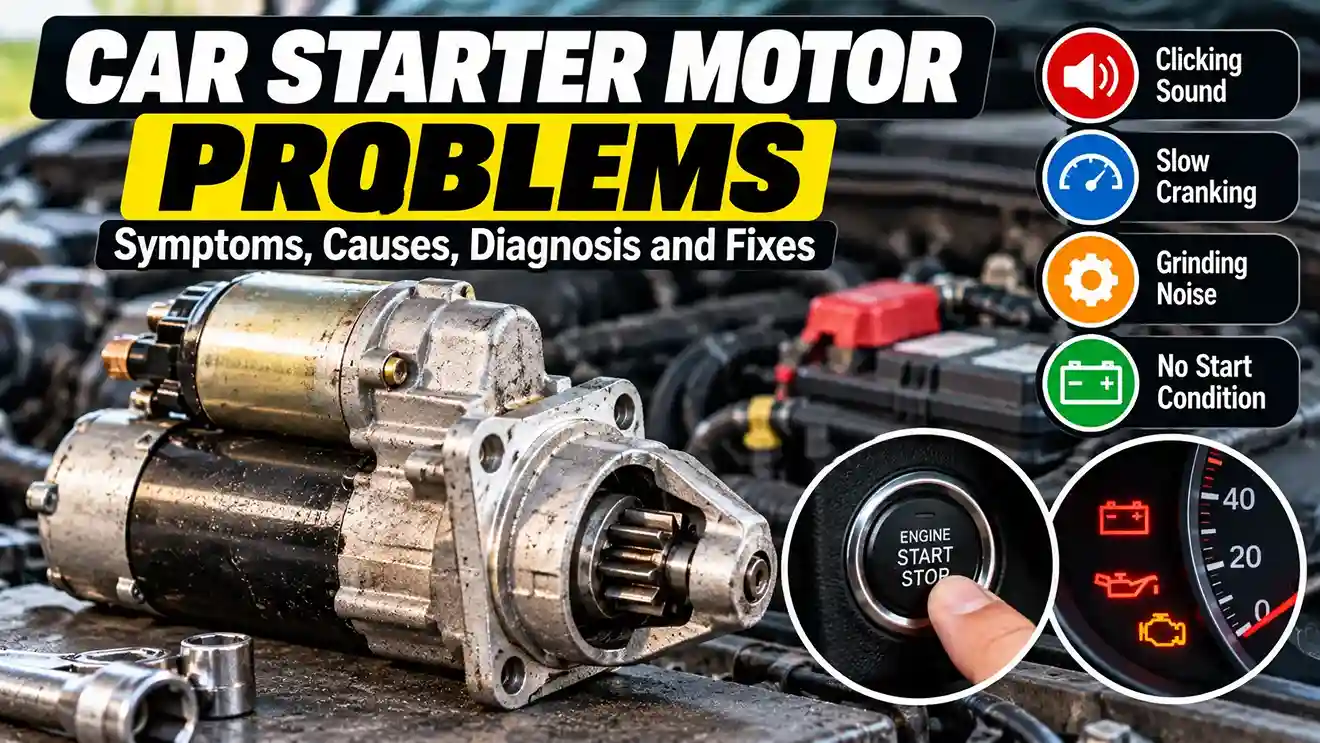
Car Starter Motor Problems can be frustrating because they often show up at the worst possible time: early in the morning, outside the office, or when you are about to leave for a long trip. You turn the key or press the start button, the dashboard lights come on, and then… nothing. Sometimes there is a single click. Sometimes the engine cranks very slowly. In other cases, the starter spins but fails to engage the engine.
The tricky part is that a no-start condition does not automatically mean the starter motor has failed. A weak battery, corroded battery terminals, poor electrical connections, a faulty starter solenoid, an ignition-switch problem, or an immobilizer issue can create similar symptoms.
Knowing how to separate these possibilities can save you from replacing a perfectly good starter. It can also help you recognize when the starter itself really does need attention.
What Is a Starter Motor and How Does It Work?
A starter motor is an electric motor that turns the engine during startup. An internal-combustion engine cannot begin running under its own power, so the starter uses energy from the battery to rotate the engine until combustion can take over.
A typical starting system includes the starter motor, a solenoid or engaging relay, a starter pinion gear, the battery, heavy electrical cables, and control circuitry. HELLA explains that the starter’s engaging mechanism moves the pinion into the engine’s ring gear and then supplies power to the starter motor so it can rotate the engine. HELLA’s technical explanation of starter construction and operation provides a useful technical overview.
The sequence is basically:
Press key/button → starter circuit is activated → solenoid engages → starter pinion meshes → starter motor turns → engine begins cranking → engine starts
When one part of that chain fails, the engine may refuse to crank even though the rest of the car appears electrically normal.
Car Starter Motor Problems: The Most Common Symptoms
Starter faults can produce several different warning signs. Pay attention to exactly what happens when you try to start the vehicle.
1. A single click but the engine does not crank
A single click is one of the classic starter-related symptoms.
You may turn the key and hear:
Click… silence.
If the dashboard and headlights remain reasonably bright, the starter solenoid or starter assembly may be at fault.
However, do not treat a single click as proof that the starter is bad. Battery condition, cable connections and grounds should be checked first.
AAA also notes that a vehicle that has power but produces a click without cranking may have a starter problem, while battery problems can create similar no-start symptoms. AAA’s guide to diagnosing a car that won’t start explains the distinction.
2. Slow or sluggish cranking
The engine may crank, but it sounds noticeably slower than normal.
Instead of:
“rr-rr-rr-start”
you might hear:
“rrrr… rrrr… rrrr…”
before it starts—or it may never start.
A weak battery is one of the first things to check because the starter requires substantial electrical current. Bosch’s starter guidance specifically recommends checking battery power and electrical connections when an engine cranks slowly or will not start. Bosch Mobility Aftermarket’s starter motor guidance highlights low battery power and loose connections as possible causes of starter-related starting problems.
3. Grinding noise during startup
A grinding sound can indicate a problem involving the starter pinion and the engine’s ring gear.
Instead of a smooth cranking sound, you may hear a harsh metallic grinding noise.
Do not repeatedly try to start the engine when this happens. Continued attempts can potentially increase wear on the starter drive or ring gear.
4. Starter spins, but the engine does not crank
Sometimes you can hear the starter motor spinning, but the engine itself is not turning.
This can happen when the starter’s pinion does not properly engage the engine’s ring gear or when the starter’s overrunning clutch or engagement mechanism has a problem.
HELLA lists a starter that audibly turns without engaging as a possible sign of starter malfunction.
5. Intermittent starting problems
One day the car starts perfectly. The next day, you turn the key and hear nothing. Then, after trying again—or waiting a few minutes—it suddenly works.
Intermittent starter problems are particularly frustrating because they can make the car appear healthy during a workshop inspection.
Possible causes include worn internal starter components, solenoid problems, loose electrical connections, or control-circuit faults.
In real-world situations, intermittent failure is a good reason to document exactly when the problem occurs. Note whether the engine is cold or hot, whether the dashboard lights stay bright, and what sound you hear when starting.
6. Starter keeps running after the engine starts
This is not a normal condition.
Once the engine fires, the starter should disengage. If you hear the starter continuing to operate after the engine has started, switch the vehicle off as safely and quickly as possible.
A problem with the starter’s engaging mechanism or electrical control can cause this behavior. It should be investigated promptly rather than ignored.
Starter Motor vs Bad Battery: How Can You Tell?
This is one of the most important distinctions.
A weak battery can make a healthy starter appear faulty. Likewise, a failing starter can look like a dead battery.
Start with the basic clues.
Signs that point more toward the battery
- Headlights or dashboard lights become noticeably dim when attempting to start
- Rapid clicking is heard
- The vehicle starts after a proper jump-start
- The battery is old or has repeatedly gone flat
- Multiple electrical systems are behaving weakly
AAA lists slow starting, dim lights and clicking among common warning signs of battery trouble. AAA’s battery warning-sign guidance is useful when separating battery symptoms from starter symptoms.
Signs that may point more toward the starter
- Dashboard lights remain strong but the engine does not crank
- A single click occurs repeatedly
- The starter sometimes works and sometimes does not
- A grinding sound occurs during startup
- A known-good battery still produces a no-crank condition
This is not a perfect diagnosis, but it gives you a logical starting point.
Could the Alternator Be the Real Problem?
Yes.
The alternator charges the battery while the engine is running. If the alternator is not replenishing the battery properly, the vehicle may eventually develop starting problems even though the starter is fine.
For example, the car may start with a jump in the morning but refuse to restart after you drive for a while and switch the engine off. That pattern can point toward a charging problem rather than a starter failure.
Before replacing the starter, it is often sensible to check the battery and charging system together. Our Alternator Failure Symptoms guide explains how charging problems can mimic battery and starting faults.
Similarly, if you are dealing with repeated battery drain, our Signs Your Car Battery Is Weak guide covers symptoms that can help narrow down the problem.
Other Problems That Can Look Like Starter Failure
A no-crank or no-start condition can have several causes.
Battery terminal corrosion
Corrosion at the battery terminals can increase electrical resistance and prevent sufficient current from reaching the starter.
Loose battery or ground cable
The starter depends on a strong electrical path. A loose positive cable or poor engine ground can create a starting problem without a failed starter motor.
NHTSA-published service documentation illustrates why technicians check battery terminals, starter connections and engine grounds during no-crank diagnosis.
Ignition switch or start button fault
The starter may never receive the command to operate if the ignition switch, start button or related circuit has failed.
Neutral-safety or clutch switch
Automatic vehicles generally need to recognize Park or Neutral before allowing the starter to operate. Manual vehicles may use a clutch-pedal safety switch.
For example, a vehicle that starts in Neutral but not Park can point toward a gear-position or neutral-safety switch issue rather than a starter fault.
Immobilizer problem
Modern vehicles may prevent engine starting if the key or immobilizer system is not recognized.
NHTSA-published vehicle instructions for no-start diagnosis likewise separate starter operation from immobilizer, fuel, fuse and other possible starting causes.
How to Diagnose a Starter Problem
A proper diagnosis usually begins with the simplest checks and works toward the more specific ones.
Step 1: Observe what the car does
Do the dashboard lights come on?
Do the headlights stay bright?
Do you hear clicking?
Does the engine crank?
Does the starter spin without engaging?
These observations can eliminate several possibilities before tools are even used.
Step 2: Check the battery
A battery test should be performed rather than relying only on the fact that the headlights work.
A battery can have enough power to illuminate the dashboard but still fail to deliver the current needed for engine cranking.
Step 3: Inspect terminals and cables
Check for:
- Corrosion
- Loose battery terminals
- Damaged cables
- Poor ground connections
- Loose connections at the starter
Bosch specifically recommends checking battery power and starter electrical connections when addressing starter problems.
Step 4: Check the starting circuit
A technician may test the starter relay, ignition/start signal, solenoid operation, fuses and related wiring.
Step 5: Test the starter
When the battery and control circuit are healthy, the starter itself can be tested for proper operation.
A professional diagnosis may identify whether the issue is with the electric motor, solenoid, brushes, bearings, pinion or overrunning clutch.
Can You Test a Starter at Home?
Some basic checks can be performed safely, but starter diagnosis becomes more technical than many DIY owners expect.
You can observe symptoms, check battery terminals, inspect visible wiring, and test battery voltage with an appropriate meter.
Avoid random “tap the starter with a hammer” advice as a guaranteed repair. Tapping may occasionally change the behavior of a worn starter, but that does not fix the underlying fault and can create safety or component risks.
Also avoid bypassing safety circuits or using improvised high-current jump methods unless you fully understand the vehicle’s electrical system.
If repeated starting attempts produce only clicking or no crank, professional testing is usually more useful than repeated guessing.
When Should You Replace the Starter Motor?
Replacement generally makes sense when testing confirms that the starter has an internal or mechanical fault and repair is not practical.
A technician may recommend replacement when the starter has:
- Failed electric-motor components
- Worn brushes or commutator
- A defective solenoid
- Damaged bearings
- A worn pinion or engagement mechanism
- Internal electrical damage
HELLA notes that starter components such as the electric motor, solenoid and pinion mechanism can develop faults, while normal wear affects mechanical and electrical parts over time.
Depending on the vehicle, you may have a choice between a new starter and a professionally remanufactured unit. Fitment, warranty and quality should be considered rather than selecting purely on price.
Starter Motor Replacement Cost in India
There is no single price that applies to every car.
The total cost depends on:
- Vehicle make and model
- Starter design
- OEM vs aftermarket part
- New vs remanufactured unit
- Labour charges
- Accessibility of the starter
- Additional cable or electrical repairs
A small hatchback may have a relatively straightforward starter replacement, while a vehicle with difficult access can require more labour.
Before approving the repair, ask the workshop whether the starter itself failed testing or whether it is being replaced based only on the no-start symptom.
Also ask whether the battery and charging system have been checked. Replacing a starter without correcting a weak battery or poor cable connection can lead to another starting problem later.
Common Mistakes Car Owners Make
Replacing the starter without testing the battery
A weak battery can mimic starter failure.
Assuming one click always means a bad starter
The battery, cables, grounds and solenoid circuit all need consideration.
Ignoring cable corrosion
A poor electrical connection can create high resistance and prevent the starter from receiving enough current.
Repeatedly turning the key
If the starter is making a grinding or abnormal noise, repeated attempts can make the situation worse.
Replacing the battery and starter at the same time without diagnosis
Sometimes both components are old, but replacing both without testing is an expensive way to troubleshoot.
Ignoring intermittent symptoms
A starter that fails once and then works normally may still be developing a problem. Waiting for total failure can leave you stranded.
Best Practices to Avoid Starting-System Problems
Starter motors do not usually require routine servicing like engine oil or brake fluid, but the surrounding electrical system deserves attention.
Keep battery terminals clean and secure. Check the battery condition as it ages, especially before long trips.
If the car has begun cranking more slowly than normal, investigate early rather than waiting for complete failure.
Our How to Jump-Start a Car Battery Safely guide is also worth keeping handy for emergencies, but remember that a jump-start should not become the permanent solution to a recurring starting problem.
If a battery warning light appears while driving, investigate the charging system rather than assuming the starter is responsible. Our Car Dashboard Warning Lights Explained guide can help you understand where the battery warning fits into the wider electrical system.
What Should You Do If Your Car Suddenly Won’t Start?
First, stay calm and avoid repeatedly trying the ignition.
Check whether the dashboard lights and headlights are working normally. Listen carefully to the sound when you attempt to start the vehicle.
If you hear rapid clicking and the electrical system appears weak, the battery may be discharged.
If you hear one strong click but the electrical system remains bright and the engine does not crank, a starter or starting-circuit problem becomes more plausible.
If the engine cranks normally but does not actually start, the starter is doing its job and the problem lies elsewhere—possibly fuel, ignition, immobilizer, or engine-management related. NHTSA-published no-start diagnostic information distinguishes a starter that does not turn from an engine that cranks normally but fails to start.
For a vehicle with a warning light, our Check Engine Light Explained guide can help you understand why scanning the car may be more useful than replacing parts based on symptoms alone.
FAQ: Car Starter Motor Problems
What are the most common car starter motor problems?
Common starter problems include a failed electric motor, faulty solenoid, worn brushes, damaged pinion or engagement mechanism, and electrical connection problems.
How do I know if my starter motor is bad?
A single click with no crank, intermittent no-start behavior, grinding, or a starter that spins without engaging can point toward a starter problem. Battery, cable and control-circuit testing should be performed before confirming the diagnosis.
Can a weak battery damage the starter?
Repeated attempts to start a vehicle with a weak battery can place abnormal demands on the starting system, but a no-start condition caused by a weak battery does not automatically mean the starter is damaged.
Why does my car click but not start?
Clicking can be caused by a weak battery, poor electrical connections, or a starter-solenoid/starter problem. The exact sound and behavior of the lights provide useful clues.
Can a bad alternator cause starter problems?
A failing alternator may leave the battery undercharged, which can eventually create a no-start condition. The starter may then appear to be the problem even though the underlying issue is the charging system.
How long does a starter motor last?
Starter life varies considerably depending on vehicle design, usage, climate, starting frequency and component quality. There is no universal mileage or age at which every starter needs replacement.
Can I replace a starter motor myself?
Some vehicles allow relatively straightforward access, while others have difficult access or additional electrical considerations. DIY replacement is best attempted only when you have the correct tools, repair information and confidence working around high-current electrical connections.
Is a remanufactured starter worth considering?
A professionally remanufactured starter can be an option when it comes from a reputable supplier and includes appropriate testing and warranty coverage. Compare the warranty and quality rather than choosing solely by the lowest price.
Conclusion
Car Starter Motor Problems can look like battery failure, alternator trouble, or even a completely unrelated engine problem. That is why the sound and behavior during startup are so useful. A single click, slow crank, grinding noise, intermittent operation, or a starter that spins without engaging can each point toward different parts of the starting system.
The most sensible approach is to diagnose the complete system rather than replacing the starter immediately. Check the battery, terminals, cables, grounds and charging system before confirming that the starter itself has failed.
When a starter is genuinely worn or damaged, replacing it with a correctly specified quality unit can restore reliable starting. Until then, avoid repeated cranking and do not ignore warning signs that are becoming more frequent.
A few minutes spent identifying the actual cause can mean the difference between a relatively simple repair and an unnecessary parts bill.
Author: Carsinfos Editorial Team
Published: Sep 28th, 2026