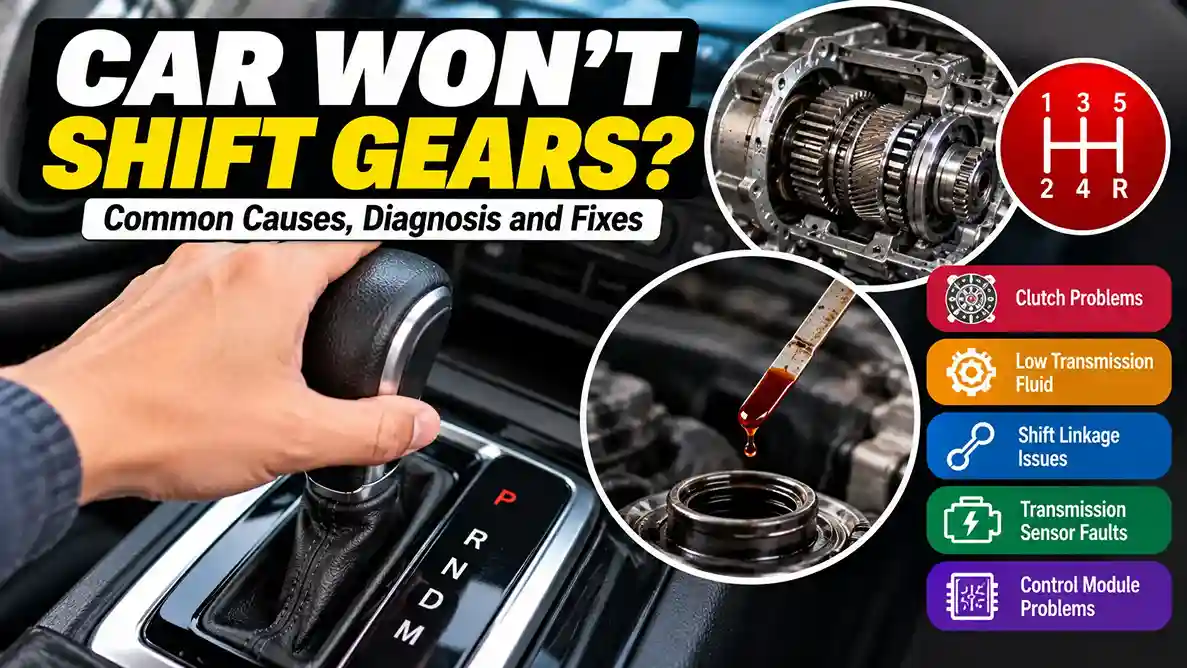
Common Reasons Why Car Won’t Shift Gears is a question that usually comes up after a driver notices something is suddenly wrong with the transmission. A manual car may refuse to go into first or reverse, while an automatic may stay stuck in Park, refuse to select Drive, or become locked in one gear while driving.
The frustrating part is that “won’t shift” can describe several very different problems. Sometimes the fix is simple, such as fully pressing the clutch, correcting a low transmission-fluid level, or resolving a shift-lock issue. In other cases, the problem can involve the clutch hydraulic system, gear selector linkage, shift solenoids, sensors, the transmission control system, or internal transmission components.
The safest way to approach the problem is to identify what the car is actually doing, whether it is a manual or automatic transmission, and whether the symptom appeared suddenly or developed gradually.
Common Reasons Why Car Won’t Shift Gears
Before discussing individual causes, it helps to separate two very different situations:
The gear lever cannot physically move into another position
versus
The lever moves, but the transmission does not actually change gear.
Those two symptoms can point to completely different faults.
For example, a manual transmission that refuses to enter first gear with the engine running may have a clutch-release problem. An automatic that remains stuck in Park may have a brake-shift interlock, electrical, selector, or control-system issue.
That distinction can save a lot of diagnostic time.
1. Clutch Is Not Fully Disengaging in a Manual Car
This is one of the most common reasons a manual vehicle becomes difficult to shift.
When you press the clutch pedal, the clutch should separate the engine’s rotation from the transmission input shaft. That allows the synchronizers and gears to select the next ratio more easily.
If the clutch does not fully disengage, the transmission input shaft can continue spinning. The result may be:
- Difficulty selecting first gear
- Difficulty selecting reverse
- Grinding when selecting a gear
- The car creeping forward with the clutch fully depressed
- A clutch pedal that feels unusual
A clutch problem can come from a worn clutch disc, pressure plate, release bearing, hydraulic issue, cable adjustment, or another component depending on the vehicle.
Hyundai’s owner-manual guidance specifically tells manual-transmission drivers to depress the clutch pedal fully before shifting and notes that difficulty selecting first or reverse after stopping can sometimes be addressed by returning to neutral and then re-engaging the clutch before selecting the gear. Hyundai’s manual-transmission operating guidance provides a useful manufacturer example.
If the clutch pedal feels unusually soft, hard, or low, our Clutch Replacement Cost in India guide is a useful companion because clutch wear and clutch-system faults are closely connected to difficult shifting.
2. Low or Incorrect Transmission Fluid
Transmission fluid does more than lubricate components. In many automatic transmissions, the fluid also plays a role in hydraulic control and clutch operation inside the gearbox.
If the fluid level is too low, contaminated, or incorrect for the transmission, shifting can become harsh, delayed, inconsistent, or may stop working properly.
A common mistake is topping up transmission fluid with whatever product is available. That can be a serious error because fluid specifications vary between transmissions.
Ford’s owner-manual guidance warns that low fluid can cause shift or engagement concerns and that using non-approved automatic transmission fluid can damage internal transmission components. Ford also warns that overfilling can cause shifting and engagement problems. Ford’s transmission-fluid guidance explains why the correct fluid and level matter.
Do not assume that transmission fluid should always be checked the same way on every vehicle. Some transmissions have dipsticks, while others require a specific temperature and workshop procedure.
3. Shift Linkage or Gear-Selector Cable Problem
In many manual and older automatic vehicles, the gear lever is connected to the transmission through cables, rods, bushings, or linkage.
If one of these components becomes worn, bent, disconnected, seized, or damaged, the lever may feel abnormal.
You might notice:
- Excessive play in the gear lever
- A loose or floppy shifter
- Some gears available but others impossible to select
- A gear lever that no longer follows its normal pattern
- Difficulty selecting gears immediately after suspension or transmission work
For example, if the lever suddenly becomes very loose and none of the gears feel where they normally should, the linkage deserves inspection before anyone recommends rebuilding the transmission.
This is one of those situations where a visible mechanical problem can sometimes be much cheaper to repair than an internal gearbox failure.
4. Worn or Damaged Gear Synchronizers
Manual transmissions use synchronizers to help match the speed of rotating components before a gear engages.
When a synchronizer becomes worn, one particular gear may become difficult to select, especially during certain shifts.
A typical pattern might be:
1st, 2nd, 4th, 5th and reverse work normally, but 3rd gear repeatedly grinds or resists.
That pattern is more informative than simply saying “the gearbox is bad.”
For example, if the problem occurs only during the 2nd-to-3rd shift and becomes worse when the transmission is warm, a technician has more clues to work with than when every gear refuses to engage.
Do not repeatedly force the gear lever into position. Forcing a resistant gear can turn a manageable wear problem into additional damage.
5. Transmission Shift Solenoid Problems
Automatic transmissions use electronically controlled hydraulic circuits. Shift solenoids regulate fluid flow to control internal clutches and bands or other transmission elements, depending on the design.
When a solenoid sticks, fails electrically, or receives an incorrect control signal, the transmission may:
- Delay shifting
- Shift harshly
- Stay in one gear
- Refuse a particular gear
- Enter a protective operating mode
This is where electronic diagnosis becomes important.
A transmission that suddenly stays in one gear is not automatically suffering from catastrophic internal damage. A sensor, wiring fault, solenoid, valve-body problem, or control-module issue can sometimes produce the same driving symptom.
If the transmission warning light or check engine light is also illuminated, scan the vehicle instead of guessing. Our OBD2 Error Codes Explained guide explains how diagnostic codes can help identify the system that needs investigation.
6. Brake-Shift Interlock Is Preventing an Automatic From Leaving Park
An automatic vehicle normally has a safety system that prevents the selector from being moved out of Park unless the brake pedal is applied.
If the brake switch, shift-lock mechanism, wiring, or related circuitry has a problem, the selector can remain locked.
This can be confusing because the engine starts normally and the dashboard lights may look completely fine.
Toyota’s owner information describes this shift-lock operation and notes that the brake pedal must be depressed for the selector to move out of Park. Toyota’s official shift-lock guidance also explains that a fault in the shift-lock system can prevent the lever from moving even when the brake pedal is depressed.
If your automatic car is stuck in Park, this possibility should be checked before assuming the transmission itself has failed.
7. Weak or Discharged Battery in an Electronic Shift System
Modern vehicles increasingly rely on electronic shift controls and safety interlocks.
That means a discharged battery can sometimes prevent an electronic selector system from functioning normally.
Hyundai’s current owner-manual guidance explicitly notes that when the battery is discharged, certain automatic-transmission vehicles may not allow normal gear selection and provides an emergency procedure for moving the vehicle to Neutral. Hyundai’s automatic-transmission guidance for a discharged battery explains this situation.
This is one reason a no-shift problem should not always be treated as a transmission-only problem.
If you are also experiencing slow starting, dim lights, or other electrical symptoms, inspect the battery and charging system. Starting and charging problems can be related even though they are separate from the transmission itself.
8. Transmission Control Module or Sensor Fault
Modern automatic transmissions depend on electronic information from multiple sensors.
Depending on the vehicle, the transmission control system may use inputs related to:
- Vehicle speed
- Engine speed
- Throttle position
- Transmission temperature
- Gear position
- Hydraulic pressure
If a sensor gives incorrect information or the control module detects a significant fault, the transmission may change its behavior.
A vehicle may enter a protective or limited operating mode to reduce the possibility of additional damage. The exact behavior varies considerably by manufacturer and transmission design.
This is another reason why diagnostic scanning is useful.
If a warning light appears at the same time as a transmission issue, our Car Dashboard Warning Lights Explained article can help you understand why the warning should be treated as useful diagnostic information rather than simply cleared.
9. Transmission Fluid Is Too Cold
This is less dramatic but worth mentioning.
Cold transmission lubricant can be thicker than it is at normal operating temperature. Hyundai’s manual-transmission instructions specifically note that shifting can be more difficult in cold weather until the transmission lubricant warms up.
In practical terms, a vehicle that is slightly stiff during the first few minutes of a cold morning but returns to normal as it warms up may not have the same problem as a transmission that remains difficult to shift throughout the drive.
However, a new or progressively worsening cold-start shifting problem still deserves investigation.
10. Internal Transmission Damage
Sometimes the problem really is inside the transmission.
Possible internal faults include:
- Broken or worn gears
- Damaged shift forks
- Bearing wear
- Worn clutch packs in an automatic transmission
- Valve-body problems
- Internal hydraulic faults
- Severe synchronizer damage in a manual transmission
Internal problems often produce additional clues such as grinding, whining, knocking, slipping, burning smells, metal particles in fluid, or a transmission that loses several gears at once.
At this stage, continued driving can be unwise because the damage may become more extensive.
Manual vs Automatic: How the Symptoms Differ
The type of transmission matters enormously.
If you drive a manual car
Pay attention to whether:
- The clutch pedal feels normal
- The problem affects one gear or all gears
- Reverse is difficult
- The vehicle creeps with the clutch fully depressed
- Gear grinding occurs
A problem limited to first and reverse can point toward clutch-release or adjustment issues, while one specific forward gear can raise suspicion of synchronizer or internal mechanical wear.
If you drive an automatic car
Notice whether:
- The selector is physically stuck
- The car stays in Park
- Drive or Reverse is unavailable
- The transmission remains in one gear
- Shifts are delayed or very harsh
- A transmission or check-engine warning appears
Automatic transmissions have more hydraulic and electronic control systems, so diagnosis often requires a scan tool and fluid or pressure checks.
What to Do When Your Car Won’t Shift Gears
Start by avoiding force.
If a manual gear refuses to engage, fully depress the clutch, return to neutral, and try again once. Hyundai provides similar guidance for difficult first or reverse selection when stationary.
If an automatic remains in Park, confirm that the brake pedal is actually being recognized. Look for brake lights if another person can help you check them. A failed brake-light switch can sometimes affect the shift-lock system.
If the vehicle is stuck in one gear while driving, avoid aggressive acceleration and arrange a diagnostic inspection.
If the transmission fluid level is externally checkable on your model, follow the exact manufacturer procedure. Do not guess the correct fluid specification.
For safety, the NHTSA-published driver guidance also warns against improper shifting practices, including selecting gears inappropriate for vehicle speed and forcing transmission controls. NHTSA technical guidance on manual and automatic transmission operation emphasizes using the clutch correctly in manual vehicles and avoiding improper downshifts that can damage the drivetrain or affect vehicle control.
Can You Fix a Gear-Shifting Problem at Home?
Some basic checks are reasonable.
You can inspect:
- Brake-light operation on an automatic vehicle
- Battery condition and terminals
- Visible shift cables or linkage
- Obvious fluid leaks
- Dashboard warning lights
- Clutch pedal feel
- Whether the problem changes when the vehicle warms up
What you should generally avoid is opening the transmission, dismantling valve bodies, adjusting internal linkages without specifications, or adding random additives.
A transmission problem is often expensive enough that guessing becomes a poor strategy.
Common Mistakes Car Owners Make
Forcing the gear lever
If a gear refuses to engage, extra force does not solve the underlying problem.
Replacing transmission fluid with the wrong specification
Using the wrong fluid can create shifting problems or damage components. Always follow the vehicle manufacturer’s specification. Ford’s guidance specifically warns against non-approved automatic transmission fluid.
Assuming every shifting problem means a failed gearbox
The actual problem may be the clutch, linkage, brake switch, battery, sensor, solenoid, or control module.
Ignoring small symptoms
A slight hesitation or occasional difficulty selecting a gear can be easier to diagnose before it develops into complete loss of shifting.
Clearing transmission fault codes without investigating
Clearing the warning may make the dashboard look better temporarily, but it does not repair the underlying problem.
Best Practices to Prevent Gear-Shifting Problems
Follow the transmission maintenance instructions for your specific vehicle.
Do not rest your hand on a manual gear lever or your foot on the clutch pedal continuously. Hyundai’s owner-manual guidance specifically warns against resting a foot on the clutch and holding the vehicle on an incline using partial clutch engagement.
For automatic vehicles, use the specified fluid and follow the manufacturer’s service procedure rather than applying generic transmission-fluid advice from another model.
It is also sensible to pay attention to the condition of other vehicle systems. During routine maintenance, our Monsoon Car Care Tips article is useful because it includes checking essential fluids and other components that can affect overall vehicle reliability.
If your car develops a vibration at the same time as a shifting problem, our Why Your Car Is Vibrating While Driving: Causes & Fixes guide can help you distinguish a drivetrain-related symptom from a tyre or wheel issue.
When Should You Stop Driving?
Some shifting problems justify immediate attention.
Stop driving and arrange professional assistance when:
- The transmission suddenly loses Drive or Reverse
- The car is stuck in one gear and behaves abnormally
- You smell burning transmission fluid
- There is severe grinding or mechanical noise
- A warning indicates a transmission fault
- The vehicle cannot select gears safely
- Transmission fluid is leaking heavily
Do not keep driving simply because the car still moves.
A transmission that is slipping, overheating, or operating abnormally can potentially suffer additional damage.
How Much Does Gear-Shifting Repair Cost?
There is no single “gear shifting repair cost.”
A brake switch, shift cable, sensor, or electrical fault may be relatively straightforward to repair. A clutch replacement costs more, and internal automatic-transmission repairs can be substantially more expensive.
The final price depends on:
- Vehicle make and model
- Manual or automatic transmission
- Fault location
- Parts required
- Labour time
- Fluid and gasket requirements
- Whether the transmission needs to be removed
Before approving an expensive repair, ask for the actual diagnosis rather than only the symptom.
For example:
“The transmission won’t shift” is a symptom.
“The shift cable is damaged and the selector is not reaching the transmission lever” is a diagnosis.
That distinction matters.
FAQ: Common Reasons Why Car Won’t Shift Gears
Why won’t my manual car go into gear?
The clutch may not be fully disengaging, the linkage may be damaged, the transmission fluid may be unsuitable or low, or an internal synchronizer or gear component may be worn.
Why is my automatic car stuck in Park?
Possible causes include the brake-shift interlock, brake switch, electrical problem, selector mechanism, low battery, or another control-system fault. Do not automatically assume the transmission itself has failed.
Why won’t my car shift into first gear?
On a manual vehicle, a clutch-release problem, synchronizer wear, or incorrect adjustment can make first gear difficult to select. If the problem is mainly present when stopped, the clutch system deserves particular attention.
Why does my automatic transmission stay in one gear?
A sensor, shift solenoid, valve-body problem, low fluid, overheating, control-module fault, or internal transmission problem can cause this behavior. Diagnostic scanning is often necessary.
Can low transmission fluid prevent shifting?
Yes. Low fluid can cause shift or engagement problems, particularly in automatic transmissions. Manufacturer guidance should be followed for checking the level and using the correct fluid.
Can a weak battery cause gear-selection problems?
On some electronically controlled vehicles, yes. A discharged battery can interfere with electronic shift-lock or gear-selection functions. Hyundai documents this behavior for certain automatic-transmission vehicles.
Is it safe to keep driving if the car won’t shift properly?
No, not when the problem is severe, worsening, or accompanied by warning lights, burning smells, grinding, slipping, or loss of Drive or Reverse. Continuing to drive may increase damage and can create a safety problem.
Should I change the transmission fluid if the car is hard to shift?
Not automatically. First determine whether the fluid level, specification, condition, or another component is actually responsible. A fluid change is not a substitute for diagnosis.
Conclusion
The Common Reasons Why Car Won’t Shift Gears range from relatively simple issues such as clutch-release problems, shift-lock faults, low fluid, or damaged linkage to more complicated faults involving solenoids, sensors, control modules, synchronizers, or internal transmission components.
The most useful first step is to describe exactly what happens: Can the lever move? Does the car enter any gear? Is it stuck in Park? Does one gear fail or all gears? Does the problem happen only when cold? Are there warning lights or unusual noises?
Those details help narrow down the cause.
Avoid forcing the shifter, using random transmission fluids or additives, and continuing to drive when the transmission is clearly malfunctioning. Follow the manufacturer’s specifications, scan the vehicle when appropriate, and get a proper diagnosis before approving major repairs.
A gear-shifting problem does not automatically mean you need a new transmission. In many cases, the real cause is a smaller component or adjustment issue. Finding that cause early is the best way to protect both your car and your repair budget.
Author: Carsinfos Editorial Team
Published: Sep 29th, 2026