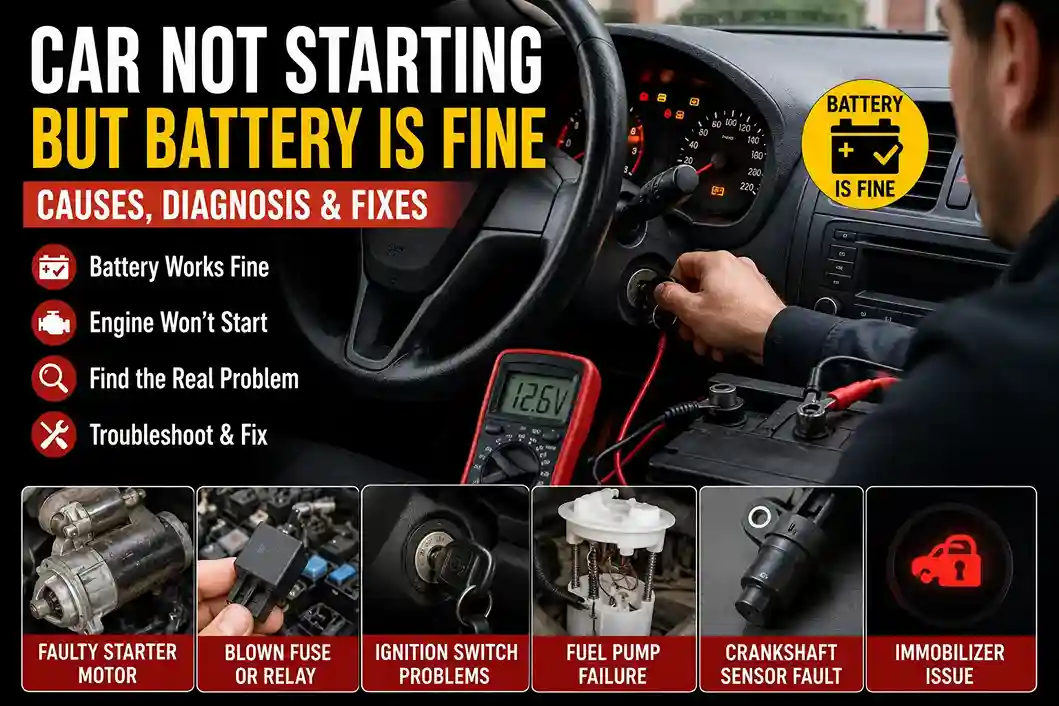
Car Not Starting But Battery Is Fine is one of the most frustrating situations drivers can experience. You turn the key or press the start button expecting the engine to come alive, but nothing happens—even though the battery appears to be fully charged and the dashboard lights are working.
Many people immediately assume the battery is the problem. However, if the headlights are bright, the dashboard powers up normally, and other electrical components function correctly, the issue is often caused by another component within the starting, ignition, fuel, or engine management system.
In real-world situations, the cause can range from a worn starter motor to a faulty ignition switch, damaged wiring, a blown fuse, or even an immobilizer problem. Fortunately, many of these issues can be identified through simple checks before visiting a mechanic.
If you’re already familiar with vehicle warning signs from our guides on Signs Your Car Battery Is Weak and Car Dashboard Warning Lights Explained, understanding why a car won’t start despite having a healthy battery is the next step toward effective troubleshooting.
This guide explains the most common causes, how to diagnose them safely, and when professional repair is necessary.
How Do You Know the Battery Is Fine?
Before investigating other causes, confirm that the battery is actually functioning properly.
Signs that the battery is likely not the issue include:
- Dashboard lights illuminate normally.
- Headlights remain bright.
- Power windows operate correctly.
- Horn sounds normal.
- Interior lights don’t dim significantly.
- Battery voltage measures approximately 12.6 volts (engine off).
If electrical accessories are weak or the lights dim considerably during starting attempts, the battery may still require inspection.
The National Institute for Automotive Service Excellence (ASE) recommends verifying battery condition before diagnosing other starting problems.
External Reference:
https://www.ase.com/
Car Not Starting But Battery Is Fine: Common Symptoms
Different symptoms often point to different problems.
For example, you may notice:
- Engine won’t crank at all.
- A single clicking sound.
- Repeated clicking noises.
- Starter spins but engine doesn’t fire.
- Dashboard lights remain on.
- Push-button start doesn’t respond.
- Engine cranks normally but won’t start.
Each symptom narrows down the list of possible causes.
Common Causes of a Car Not Starting with a Good Battery
1. Faulty Starter Motor
One of the most common causes is a failing starter motor.
The starter motor is responsible for turning the engine until combustion begins.
When it wears out, you may notice:
- Single clicking sound
- No engine cranking
- Intermittent starting
- Slow starter engagement
In many cases, all electrical systems continue working normally because the battery itself remains healthy.
2. Damaged Starter Solenoid
The starter solenoid acts as an electrical switch between the battery and starter motor.
If it fails:
- The starter receives no power.
- The engine does not crank.
- Clicking sounds may occur.
This component is often mistaken for a dead battery.
3. Ignition Switch Problems
The ignition switch sends power to the starting system.
A faulty switch may prevent the starter from receiving power even though:
- Dashboard lights work
- Radio operates
- Battery is fully charged
In real-world situations, worn ignition switches often cause intermittent no-start conditions.
4. Fuel Delivery Problems
A healthy battery cannot start an engine without fuel.
Possible fuel system issues include:
- Failed fuel pump
- Blocked fuel filter
- Faulty fuel pump relay
- Fuel pressure problems
If the engine cranks normally but refuses to start, fuel delivery becomes one of the first systems to inspect.
Drivers interested in maintaining engine performance should also read our guide on Why Car Loses Power While Accelerating, which explains how fuel-related issues can affect vehicle performance.
5. Blown Fuse or Faulty Relay
Modern vehicles contain numerous fuses protecting electrical systems.
A blown fuse affecting:
- Starter circuit
- Fuel pump
- Engine Control Module (ECM)
- Ignition system
can prevent starting even when the battery is perfectly healthy.
Fortunately, fuse inspection is often quick and inexpensive.
6. Immobilizer or Key Recognition Problems
Modern vehicles include anti-theft systems.
If the immobilizer fails to recognize the key:
- Engine may crank but not start.
- Push-button start may not respond.
- Security warning light may remain illuminated.
Try using the spare key if available.
Consult your owner’s manual for specific immobilizer procedures.
Can a Faulty Alternator Cause Starting Problems?
Yes—but not always immediately.
The alternator charges the battery while the engine runs.
If it fails:
- The battery gradually loses charge.
- Eventually, starting becomes impossible.
However, if the battery currently holds sufficient charge, another component may still be responsible.
Our guide on Signs Your Car Battery Is Weak explains how battery and charging system problems are often connected.
What If the Engine Cranks But Doesn’t Start?
This symptom usually indicates the starter motor is functioning correctly.
Attention should then shift toward:
- Fuel delivery
- Ignition system
- Spark plugs
- Engine sensors
- Engine timing
The National Highway Traffic Safety Administration (NHTSA) recommends paying attention to warning lights that may indicate engine management faults.
External Reference:
https://www.nhtsa.gov/
Step-by-Step Troubleshooting Checklist
If your battery appears healthy, try these basic checks.
Step 1
Verify battery terminals are tight and corrosion-free.
Step 2
Observe dashboard warning lights.
Warning indicators often provide valuable diagnostic clues.
Step 3
Listen carefully while attempting to start.
Different sounds indicate different faults:
- Single click
- Multiple clicks
- No sound
- Slow crank
- Normal crank
Step 4
Check fuel level.
Although it sounds obvious, inaccurate fuel gauges occasionally lead drivers to believe fuel remains when the tank is actually empty.
Step 5
Inspect relevant fuses.
Refer to your owner’s manual for fuse locations.
Step 6
Try the spare key.
If the immobilizer is preventing starting, another programmed key may solve the problem.
When Should You Stop Trying to Start the Car?
Repeatedly attempting to start the engine can sometimes worsen the problem.
Stop attempting if you notice:
- Burning smell
- Smoke
- Rapid clicking
- Starter overheating
- Battery cables becoming hot
At this point, professional diagnosis is recommended.
The Car Care Council advises addressing starting problems promptly to avoid additional component damage.
External Reference:
https://www.carcare.org/
Can Weather Affect Starting?
Yes.
Extreme weather can influence:
- Fuel delivery
- Starter performance
- Electrical connections
- Engine sensors
Although modern vehicles handle weather better than older models, environmental conditions still affect reliability.
Preventive Maintenance Tips
Many starting problems can be avoided through regular maintenance.
Drivers should:
- Service the starting system according to manufacturer recommendations.
- Replace worn batteries before failure.
- Inspect battery terminals periodically.
- Maintain proper engine oil levels.
Our article on Engine Oil Leakage Symptoms explains why maintaining adequate lubrication is essential for reliable engine operation.
7. Faulty Crankshaft Position Sensor
The crankshaft position sensor plays a crucial role in engine operation. It tells the Engine Control Unit (ECU) the exact position and speed of the crankshaft so that fuel injection and ignition timing occur at the right moment.
If this sensor fails, the engine may crank normally but refuse to start because the ECU cannot determine when to ignite the fuel-air mixture.
Common symptoms include:
- Engine cranks but won’t start
- Sudden engine stalling
- Check Engine Light
- Intermittent starting problems
Modern vehicles rely heavily on sensor data, so even a single faulty sensor can prevent the engine from starting.
8. Faulty Camshaft Position Sensor
The camshaft position sensor works alongside the crankshaft sensor.
A malfunction can cause:
- Difficult starting
- Rough engine operation
- Poor fuel delivery
- Engine misfires
- No-start conditions in some vehicles
Diagnostic scanning is usually required to confirm sensor-related issues.
9. Spark Plug or Ignition Coil Failure
Petrol engines require a strong spark to ignite the air-fuel mixture.
If spark plugs or ignition coils fail, the engine may crank but never start.
Possible symptoms include:
- Engine cranking without starting
- Rough idle before failure
- Misfiring
- Reduced performance
Regular servicing helps prevent ignition-related failures.
Our guide on Why Your Car Is Vibrating While Driving: Causes & Fixes explains how ignition problems can also contribute to engine vibration and poor performance.
10. Engine Control Unit (ECU) Problems
Although uncommon, the ECU itself can prevent a vehicle from starting.
Possible causes include:
- Water damage
- Electrical faults
- Software issues
- Wiring problems
Because ECU diagnosis requires specialized equipment, professional inspection is recommended.
Common Mistakes Drivers Make
Many starting problems become worse because of incorrect troubleshooting.
Assuming the Battery Is Always the Problem
Replacing a healthy battery rarely solves issues caused by the starter motor, ignition system, or fuel delivery.
Repeatedly Turning the Key
Continuously trying to start the vehicle can overheat the starter motor and place unnecessary strain on electrical components.
Ignoring Dashboard Warning Lights
Warning lights often provide valuable clues about the underlying issue.
If warning indicators remain illuminated, consult our guide on Car Dashboard Warning Lights Explained to understand what they may indicate before continuing to drive.
Delaying Professional Diagnosis
Intermittent starting problems rarely disappear on their own. Early diagnosis can prevent more expensive repairs.
Best Practices to Prevent Starting Problems
Routine maintenance remains the best defense against unexpected no-start situations.
To improve long-term reliability:
- Replace spark plugs according to the manufacturer’s schedule.
- Keep battery terminals clean and corrosion-free.
- Inspect the charging system during routine servicing.
- Replace worn starter components before complete failure.
- Keep fuel levels above extremely low levels whenever possible.
- Address dashboard warning lights promptly.
- Follow the recommended maintenance schedule in your owner’s manual.
Drivers who regularly inspect their vehicles are often able to detect minor issues before they become major repairs.
When Should You Call a Mechanic?
Professional assistance is recommended if:
- The engine will not crank despite a healthy battery.
- The starter clicks repeatedly.
- The engine cranks but never starts.
- Warning lights remain illuminated.
- Smoke or burning smells are present.
- Diagnostic trouble codes are stored.
The National Institute for Automotive Service Excellence (ASE) recommends using qualified technicians for diagnosing electronic engine management and starting system faults.
External Reference:
https://www.ase.com/
Can Regular Maintenance Prevent No-Start Problems?
In many cases, yes.
Routine inspections help identify:
- Loose battery connections
- Worn starter motors
- Weak ignition coils
- Fuel delivery issues
- Sensor faults
- Charging system problems
Preventive maintenance is usually far less expensive than emergency repairs.
Our guide on How Long Do Car Batteries Last in India explains how battery age and maintenance affect overall vehicle reliability.
Frequently Asked Questions
Why won’t my car start if the battery is good?
A healthy battery does not guarantee that other critical components are functioning. Problems with the starter motor, fuel pump, ignition switch, crankshaft sensor, ignition coils, or immobilizer system can all prevent the engine from starting.
Can a bad starter cause a no-start condition?
Yes. A faulty starter motor is one of the most common reasons a car fails to start despite having a fully charged battery.
Why does my car click but not start?
A single click often points to a faulty starter motor or starter solenoid, while repeated clicking may indicate insufficient power delivery or electrical connection issues.
Can low fuel pressure prevent starting?
Yes. Without adequate fuel pressure, the engine cannot receive enough fuel to start properly.
Is it safe to keep trying to start the engine?
No. Repeated starting attempts can overheat the starter motor, drain the battery, and potentially damage other electrical components.
Should I replace the battery first?
Not necessarily. Confirm battery condition before replacing it. If the battery tests healthy, the fault likely lies elsewhere in the starting, ignition, or fuel system.
Conclusion
Understanding Car Not Starting But Battery Is Fine helps drivers diagnose one of the most common and confusing vehicle problems. While a healthy battery rules out one possible cause, issues involving the starter motor, ignition switch, fuel delivery system, sensors, or engine electronics can still prevent the engine from starting.
By observing the symptoms carefully, performing basic checks, and following a systematic troubleshooting approach, many no-start issues can be identified before they become expensive repairs. Regular maintenance, timely replacement of worn components, and prompt attention to warning signs will significantly improve vehicle reliability.
If your Car Not Starting But Battery Is Fine problem persists after these basic checks, it’s best to seek professional diagnosis. Early intervention can save both time and money while helping you avoid unexpected breakdowns in the future.
Author: Carsinfos Editorial Team
Published: June 26th, 2026