
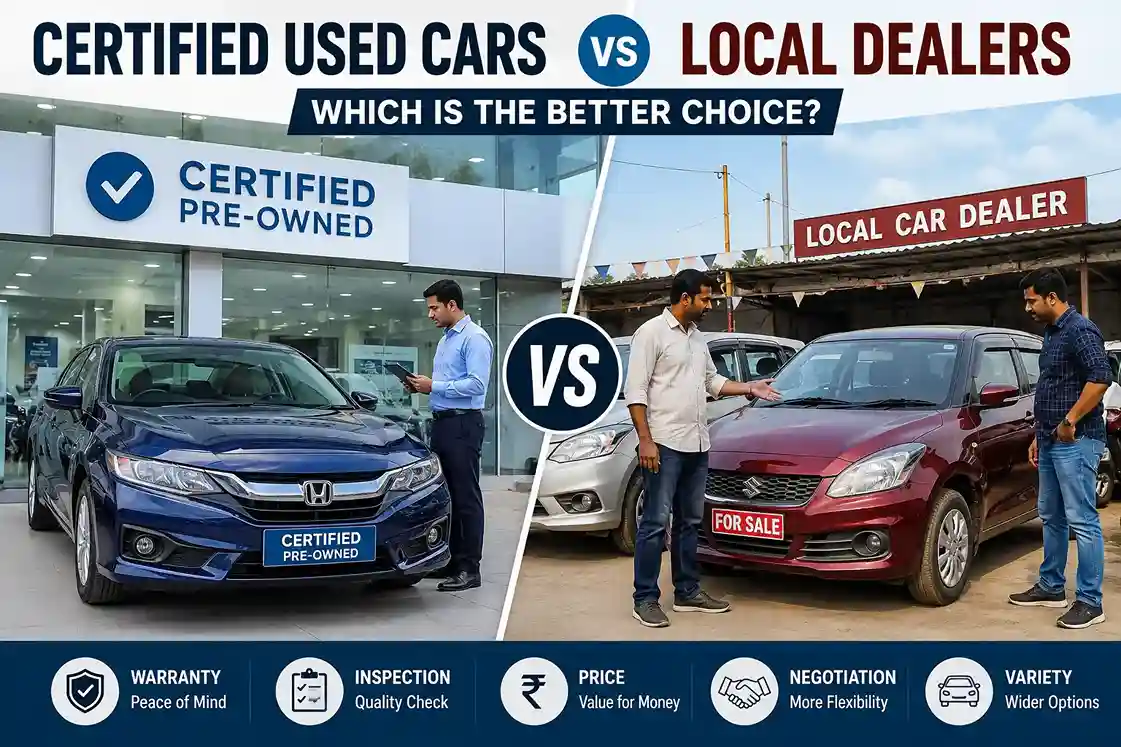
Certified Used Cars vs Local Dealers is a comparison many buyers make when shopping for a pre-owned vehicle in India. While both options can help you save money compared to buying a brand-new car, they offer very different experiences in terms of vehicle quality, warranty, pricing, transparency, and after-sales support.
Some buyers prefer certified used cars because they undergo inspections and often include warranties. Others choose local dealers because they usually offer lower prices and greater room for negotiation. Understanding the strengths and limitations of each option can help you avoid costly mistakes and choose a vehicle that suits your budget and expectations.
In real-world situations, the right choice depends on factors such as your experience with used cars, willingness to inspect the vehicle, budget, and long-term ownership plans.
Before purchasing any pre-owned vehicle, it’s also helpful to review our guide on How to Check a Used Car Before Buying in India, which explains the essential inspections every buyer should perform.
This article compares certified used cars and local dealers in detail so you can make a confident buying decision.
What Are Certified Used Cars?
Certified Used Cars (often called Certified Pre-Owned or CPO vehicles) are pre-owned vehicles that have been inspected, repaired if necessary, and approved by either the manufacturer or an authorized dealership.
These vehicles typically include:
- Multi-point inspection
- Verified service history
- Limited warranty
- Roadside assistance (on some models)
- Genuine replacement parts
- Quality certification
Because they meet specific standards, certified used cars usually cost more than similar vehicles sold through independent dealers.
Many manufacturers now operate official certified used car programs that provide additional buyer confidence.
According to the Society of Indian Automobile Manufacturers (SIAM), organized used-car sales continue to grow as buyers seek greater transparency and reliability.
External Reference:
https://www.siam.in/
What Are Local Used Car Dealers?
Local dealers are independent businesses that buy and sell pre-owned vehicles from individuals, auctions, fleet operators, and other sources.
Unlike manufacturer-certified programs, local dealers usually determine their own inspection and pricing standards.
Depending on the dealer, buyers may receive:
- Basic vehicle inspection
- Limited warranty (sometimes)
- Financing assistance
- Exchange offers
However, the quality of vehicles and customer service can vary significantly.
This makes careful inspection especially important.
Certified Used Cars vs Local Dealers: What’s the Difference?
Although both options sell used vehicles, the buying experience is quite different.
| Feature | Certified Used Cars | Local Dealers |
|---|---|---|
| Vehicle Inspection | Comprehensive | Varies |
| Warranty | Usually Included | Often Limited or None |
| Service History | Frequently Verified | May Be Incomplete |
| Manufacturer Support | Available | Usually Not Available |
| Vehicle Price | Higher | Often Lower |
| Negotiation | Limited | More Flexible |
| Peace of Mind | Higher | Depends on Dealer |
The choice often comes down to whether you prioritize lower cost or greater assurance.
Benefits of Buying a Certified Used Car
Thorough Vehicle Inspection
One of the biggest advantages is the inspection process.
Certified vehicles often undergo detailed multi-point inspections covering:
- Engine
- Transmission
- Suspension
- Brakes
- Electrical systems
- Interior
- Exterior
- Tires
Although inspection standards vary by manufacturer, the goal is to identify issues before the vehicle is offered for sale.
Warranty Protection
Many certified vehicles include a warranty that covers selected repairs for a specified period or mileage.
This can reduce unexpected ownership costs.
Buyers comparing long-term maintenance expenses may also find our guide on Engine Oil Leakage Symptoms useful for understanding early signs of engine-related issues.
Verified Vehicle History
Many certified programs verify:
- Ownership records
- Accident history
- Service records
- Odometer readings
This helps reduce the risk of purchasing vehicles with hidden problems.
The Ministry of Road Transport and Highways (MoRTH) provides vehicle registration information and digital services through the Parivahan portal.
External Reference:
https://parivahan.gov.in/
Better Financing Options
Manufacturer-authorized dealerships often provide attractive financing offers and easier loan approvals.
Interest rates may also be more competitive than informal financing arrangements.
Higher Buyer Confidence
Many buyers appreciate knowing the vehicle has been inspected according to manufacturer standards.
Although certification cannot eliminate every future repair, it reduces uncertainty.
Benefits of Buying from Local Dealers
Lower Purchase Price
Local dealers often sell similar vehicles for less than certified programs.
Lower overhead costs and greater pricing flexibility contribute to this difference.
For buyers with strict budgets, this can represent significant savings.
More Room for Negotiation
Unlike manufacturer dealerships, local dealers are often willing to negotiate more aggressively.
This can reduce the final purchase price or result in additional benefits such as:
- Free servicing
- Insurance assistance
- Accessory installation
- Registration support
Wider Variety of Vehicles
Independent dealers may carry multiple brands under one roof.
This allows buyers to compare:
- Hatchbacks
- Sedans
- SUVs
- Luxury cars
without visiting several dealerships.
If you’re still deciding which body style best suits your needs, our comparison of SUV vs Sedan for Indian Families can help narrow your options.
Faster Buying Process
Smaller dealerships sometimes complete documentation more quickly than larger authorized showrooms.
When Is a Certified Used Car Worth Paying More?
Paying a premium may make sense if:
- You’re buying your first used car.
- You value warranty coverage.
- You prefer verified service history.
- You want lower ownership risk.
- You intend to keep the vehicle for many years.
In real-world situations, buyers who prioritize peace of mind often consider the additional cost worthwhile.
When Does Buying from a Local Dealer Make Sense?
Local dealers may be a better option if:
- You’re working with a limited budget.
- You’re comfortable inspecting vehicles.
- You’re purchasing an older vehicle.
- You have access to a trusted mechanic.
- You’re willing to negotiate.
Before finalizing any purchase, our article on How to Check a Used Car Before Buying in India explains several important inspection steps that can help you avoid expensive surprises.
Factors Beyond the Seller
Whether buying from a certified program or a local dealer, always evaluate:
- Vehicle condition
- Service history
- Accident repairs
- Tire condition
- Suspension
- Brake performance
- Engine condition
- Test drive performance
The Consumer Affairs Department, Government of India also encourages buyers to verify documentation carefully before completing vehicle purchases.
External Reference:
https://consumeraffairs.nic.in/
Drawbacks of Buying a Certified Used Car
Although certified used cars provide greater peace of mind, they are not the perfect choice for every buyer.
Higher Purchase Price
The biggest disadvantage is cost.
Certified vehicles usually carry a premium because they include:
- Multi-point inspections
- Warranty coverage
- Vehicle reconditioning
- Manufacturer backing
In many cases, you may pay significantly more than a similar vehicle sold through a local dealer.
Limited Negotiation
Authorized dealerships generally have fixed pricing policies.
While small discounts may be available during promotions, buyers usually have less room for negotiation compared to independent dealers.
Limited Vehicle Availability
Certified programs often focus on relatively newer vehicles.
If you’re searching for an older model or a specific variant, your options may be limited.
Drawbacks of Buying from Local Dealers
Local dealerships can offer excellent value, but buyers should understand the potential risks.
Inconsistent Vehicle Quality
Inspection standards vary widely between dealers.
Some thoroughly inspect every vehicle, while others perform only basic checks.
Limited Warranty
Many local dealers sell vehicles “as-is” or provide only a short warranty period.
Unexpected repairs soon after purchase become the buyer’s responsibility.
Incomplete Service History
Some vehicles may not include comprehensive maintenance records.
Missing service history makes it harder to assess how well the car has been maintained.
Greater Risk of Hidden Problems
Without a detailed inspection, buyers may overlook issues such as:
- Accident damage
- Flood damage
- Odometer tampering
- Poor-quality repairs
- Engine or transmission problems
For this reason, our guide on How to Check a Used Car Before Buying in India is essential reading before making any purchase.
Which Option Is Better?
There is no single answer that suits every buyer.
Choose a Certified Used Car if:
- You want greater peace of mind.
- Warranty coverage is important.
- You prefer verified service records.
- You’re buying your first used vehicle.
- Long-term reliability is your priority.
Choose a Local Dealer if:
- Budget is your primary concern.
- You’re comfortable evaluating used cars.
- You have access to a trusted mechanic.
- You’re willing to spend time comparing vehicles.
- You want stronger negotiation opportunities.
In real-world situations, experienced buyers often find excellent value through reputable local dealers, while first-time buyers frequently appreciate the additional confidence provided by certified programs.
Common Mistakes Buyers Make
Buying Without a Test Drive
A test drive helps identify problems that may not be visible during inspection.
Pay attention to:
- Steering response
- Braking performance
- Engine noise
- Gear shifts
- Suspension comfort
Ignoring Vehicle History
Always request:
- Service records
- Ownership history
- Insurance claim history
- Accident information
The Parivahan portal can help verify vehicle registration information in India.
Reference:
https://parivahan.gov.in/
Focusing Only on Price
The cheapest vehicle is not always the best value.
Unexpected repairs can quickly eliminate any initial savings.
Skipping an Independent Inspection
Even if the dealer claims the vehicle is in excellent condition, a trusted mechanic can identify hidden issues before purchase.
Forgetting Ownership Costs
Remember to consider:
- Insurance
- Registration
- Fuel costs
- Maintenance
- Tire replacement
If you’re comparing running costs, our guide on Best Low Maintenance Cars in India 2026 can help identify vehicles with lower long-term ownership expenses.
Best Practices Before Buying Any Used Car
Regardless of where you purchase the vehicle:
- Verify service history.
- Confirm ownership documents.
- Match chassis and engine numbers.
- Inspect tires for uneven wear.
- Check for accident repairs.
- Test every electrical feature.
- Take a thorough test drive.
- Scan the vehicle for diagnostic trouble codes if possible.
- Compare market prices before negotiating.
If fuel efficiency is one of your priorities, you may also find our comparison of Best Mileage Cars in 2026: Top Fuel Efficient Cars in India useful during your decision-making process.
Frequently Asked Questions
Are certified used cars worth the extra money?
For many buyers, yes. The additional inspection, warranty, and verified history can reduce ownership risk and provide greater peace of mind.
Can local dealers sell good-quality cars?
Absolutely. Many independent dealers maintain excellent reputations and offer reliable vehicles. The key is choosing a reputable dealer and performing a thorough inspection.
Which option offers better value?
If your budget allows, certified used cars generally offer better overall security. If price is the deciding factor, a carefully inspected vehicle from a trusted local dealer can provide excellent value.
Should I always get a vehicle inspected?
Yes. Even certified vehicles benefit from an independent inspection if possible, while inspections are strongly recommended for cars purchased from local dealers.
Is financing available for used cars?
Yes. Both manufacturer-authorized dealerships and many local dealers offer financing options, although terms and interest rates may differ.
Final Verdict
When comparing Certified Used Cars vs Local Dealers, neither option is universally better. The right choice depends on your budget, experience, and willingness to assess vehicle condition.
Certified used cars generally offer greater confidence through inspections, warranty coverage, and verified service history, making them an excellent choice for buyers seeking lower ownership risk. Local dealers, on the other hand, often provide lower prices, greater negotiation flexibility, and a wider selection of vehicles.
Whatever option you choose, never rush the purchase. Inspect the vehicle carefully, verify its history, take a proper test drive, and compare multiple options before making a final decision. By following these best practices, you’ll be far more likely to purchase a reliable used car that provides good value for years to come.
Ultimately, understanding Certified Used Cars vs Local Dealers allows you to make a smarter buying decision, avoid common pitfalls, and enjoy greater confidence throughout your ownership experience.
Author: Carsinfos Editorial Team
Published: June 27th, 2026