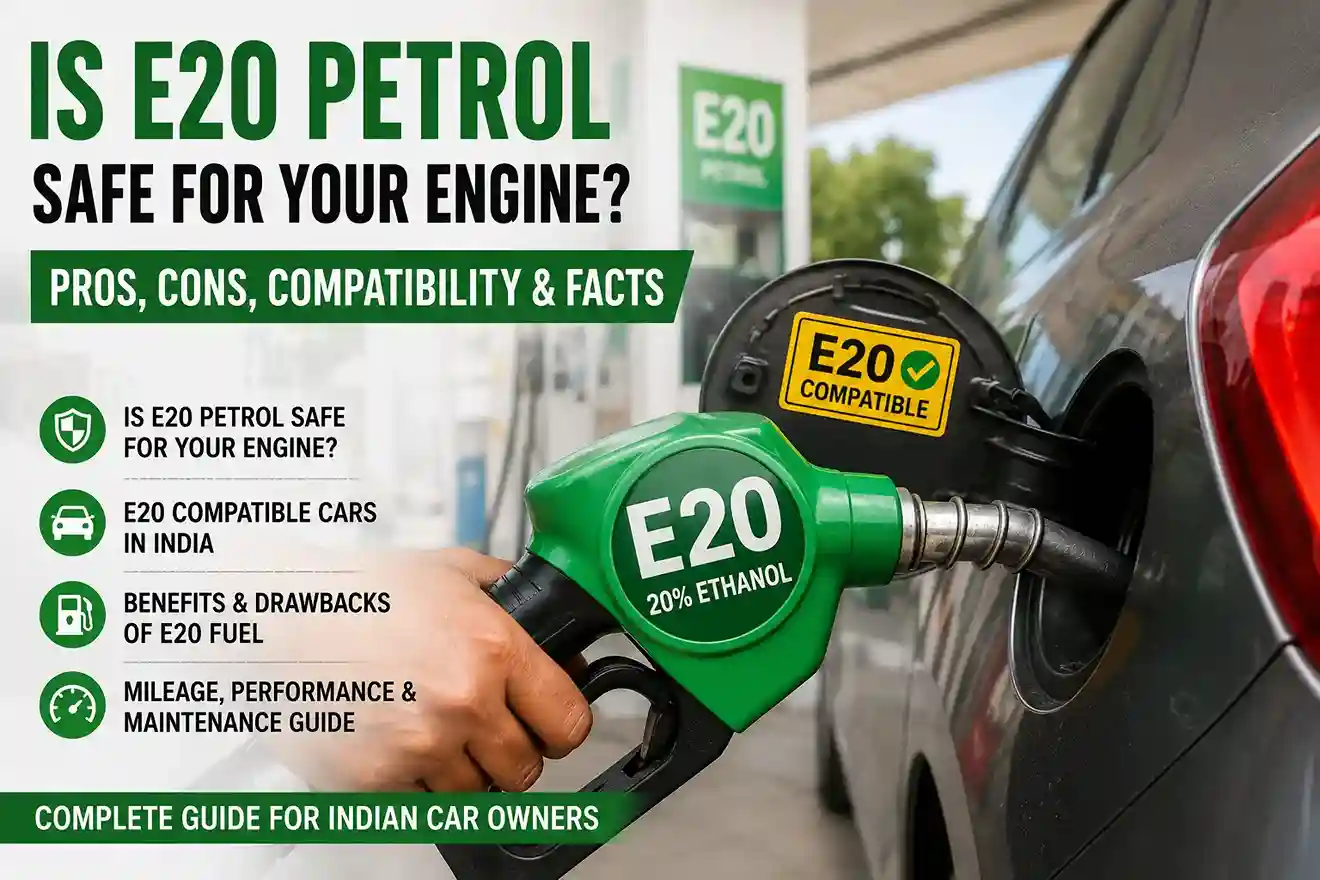
E20 petrol safe for your engine if your vehicle has been designed or officially approved by the manufacturer for E20 fuel. However, using E20 petrol in older vehicles that are not E20-compatible may lead to fuel system issues, reduced fuel efficiency, and accelerated wear of certain rubber and plastic components over time.
As India expands the availability of E20 fuel to reduce oil imports and emissions, many car owners are understandably asking whether it is safe to fill their vehicles with this new petrol blend. While E20 offers environmental benefits, its suitability depends on your vehicle’s age, engine design, and manufacturer recommendations.
Before filling your tank with E20 petrol, it’s important to understand how ethanol affects engines, fuel economy, maintenance, and long-term reliability.
If you’re comparing different fuel options before buying a new vehicle, you may also find our guide on Petrol vs Diesel Cars in India useful.
Quick Answer
Yes, E20 petrol is generally safe for engines that are specifically designed or certified to run on E20 fuel. Modern vehicles launched in recent years by many manufacturers support E20 without modifications. However, older vehicles that were not designed for higher ethanol blends may experience compatibility issues over time. Always check your owner’s manual or confirm compatibility with your vehicle manufacturer before regularly using E20 petrol.
Table of Contents
- What Is E20 Petrol?
- Why Is India Introducing E20 Fuel?
- Is E20 Petrol Safe for Your Engine?
- Which Cars Can Use E20 Petrol?
- Benefits of E20 Fuel
- Possible Disadvantages
- E20 vs Regular Petrol
- Fuel Economy Comparison
- Long-Term Engine Effects
- FAQs
What Is E20 Petrol?
E20 petrol is regular petrol blended with 20% ethanol and 80% gasoline.
Ethanol is an alcohol-based renewable fuel produced mainly from agricultural crops such as:
- Sugarcane
- Corn
- Maize
- Damaged food grains
- Other biomass sources
Compared with conventional petrol, ethanol burns cleaner and helps reduce dependence on imported crude oil.
The Government of India has introduced E20 fuel as part of its long-term strategy to increase renewable fuel usage and reduce emissions.
Why Is India Promoting E20 Fuel?
Several reasons have driven India’s transition toward E20 petrol:
- Reduced crude oil imports
- Lower greenhouse gas emissions
- Better energy security
- Increased demand for domestically produced biofuels
- Additional income opportunities for farmers
According to the Ministry of Petroleum & Natural Gas, increasing ethanol blending is part of India’s broader strategy to diversify energy sources and reduce dependence on imported fossil fuels.
Is E20 Petrol Safe for Your Engine?
For most modern E20-compatible vehicles, the answer is yes.
Manufacturers design these engines using fuel system components that can withstand higher ethanol concentrations.
These include:
- Ethanol-resistant fuel hoses
- Compatible fuel pumps
- Improved fuel injectors
- Corrosion-resistant materials
- Updated engine calibration
If your vehicle is officially approved for E20 fuel, you can generally use it without worrying about engine damage under normal operating conditions.
When Can E20 Become a Problem?
Problems usually arise when E20 petrol is used continuously in vehicles that were not designed for higher ethanol blends.
Possible issues include:
- Rubber seal deterioration
- Fuel hose degradation
- Corrosion inside the fuel system
- Reduced fuel efficiency
- Difficult cold starts
- Increased maintenance costs over many years
These effects usually develop gradually rather than immediately.
Which Cars Can Use E20 Petrol?
Many manufacturers have introduced E20-compatible petrol vehicles in India.
Generally, newer petrol models from brands such as:
- Maruti Suzuki
- Hyundai
- Tata Motors
- Mahindra
- Honda
- Toyota
- Kia
are increasingly being designed or updated for E20 compatibility.
However, compatibility varies by model year and engine, so owners should always verify the recommendation in the owner’s manual or through an authorized dealership before using E20 fuel regularly.
How to Check If Your Car Supports E20
You can usually confirm compatibility by:
- Reading the owner’s manual.
- Looking for an E20-compatible label near the fuel filler cap (if provided).
- Visiting the manufacturer’s official website.
- Contacting an authorized service centre.
- Asking your dealer using your vehicle’s VIN or model details.
Never assume compatibility based only on the vehicle brand.
Benefits of E20 Petrol
1. Lower Tailpipe Emissions
Ethanol contains oxygen, which helps promote more complete combustion.
This can contribute to reduced emissions of certain pollutants compared with conventional petrol.
2. Reduced Dependence on Imported Oil
India imports a significant portion of its crude oil requirements.
Increasing ethanol blending helps reduce this dependence over time.
3. Renewable Fuel Source
Unlike fossil fuels, ethanol is produced from renewable agricultural feedstocks.
4. Supports Domestic Agriculture
Greater ethanol production creates additional demand for agricultural crops used in biofuel production, providing economic opportunities within India’s farming sector.
5. Suitable for Modern Engines
Vehicles engineered for E20 can typically use the fuel without changes to normal driving habits or maintenance schedules.
Possible Disadvantages of E20 Petrol
Although E20 offers several benefits, there are also some considerations.
Slight Reduction in Fuel Economy
Ethanol contains less energy per litre than petrol.
As a result, some drivers may notice a small reduction in mileage compared with regular petrol.
If fuel efficiency is one of your priorities, you may also like our article on How to Improve Car Mileage in India.
Not Suitable for Some Older Vehicles
Older engines and fuel systems may not be designed for prolonged use with 20% ethanol blends.
Moisture Absorption
Ethanol absorbs moisture more readily than petrol, making proper fuel storage and maintenance more important.
Fuel System Wear
Over many years, incompatible materials may deteriorate faster when regularly exposed to higher ethanol concentrations.
E20 Petrol vs Regular Petrol
| Feature | E20 Petrol | Regular Petrol |
|---|---|---|
| Ethanol Content | 20% | Usually lower ethanol content (varies by fuel grade and region) |
| Renewable Content | Higher | Lower |
| Suitable for Older Cars | Not always | Generally Yes |
| Suitable for New E20-Compatible Cars | Yes | Yes |
| Emissions | Lower for certain pollutants | Higher |
| Fuel Economy | Slightly Lower | Slightly Higher |
| Environmental Impact | Better | Lower |
Real-World Example
Imagine you’ve purchased a new petrol SUV that is officially certified for E20 fuel. You can generally use E20 without changing your driving habits, while benefiting from lower emissions and supporting the use of renewable fuels.
Now consider a petrol hatchback that’s over a decade old and not approved for E20. Regular use of E20 in such a vehicle could increase the risk of fuel system wear over time. In this case, it’s best to follow the fuel recommendation in the owner’s manual rather than assuming E20 is suitable.
Does E20 Petrol Affect Fuel Economy?
One of the most common concerns among drivers is whether E20 petrol reduces mileage.
The answer is yes—but usually only slightly.
Ethanol contains less energy per litre than conventional petrol. Because of this, vehicles running on E20 fuel may experience a small reduction in fuel economy, particularly under city driving conditions where frequent acceleration and braking are common.
For most E20-compatible vehicles, the difference is generally modest and may not be noticeable during everyday driving.
Mileage can also vary depending on:
- Driving style
- Traffic conditions
- Vehicle load
- Engine condition
- Tyre pressure
- Air conditioning usage
If you’re trying to maximize fuel efficiency, our guide on How to Improve Car Mileage in India offers practical maintenance and driving tips.
Does E20 Petrol Damage the Engine Over Time?
For E20-compatible vehicles, there is no evidence that using E20 fuel according to the manufacturer’s recommendations causes abnormal engine damage.
Manufacturers design these vehicles with:
- Ethanol-resistant fuel lines
- Compatible fuel pumps
- Improved seals and gaskets
- Corrosion-resistant materials
- Engine control software calibrated for E20
However, continuously using E20 in vehicles that were not designed or approved for it may increase the likelihood of long-term fuel system wear, particularly in older vehicles with incompatible rubber, plastic, or metal components.
Following the fuel recommendation in your owner’s manual remains the safest approach.
E20 Petrol vs Regular Petrol: Long-Term Comparison
| Feature | E20 Petrol | Regular Petrol |
|---|---|---|
| Engine Safety (E20-Compatible Cars) | ✅ Safe | ✅ Safe |
| Engine Safety (Older Non-Compatible Cars) | ⚠️ May not be suitable | ✅ Generally suitable |
| Fuel Economy | Slightly Lower | Slightly Higher |
| Carbon Emissions | Lower for certain pollutants | Higher |
| Renewable Fuel Content | Higher | Lower |
| Fuel System Compatibility | Requires compatible components | Suitable for conventional systems |
Maintenance Tips When Using E20 Petrol
Using E20 fuel does not usually require additional maintenance in compatible vehicles, but these good practices can help keep your fuel system in good condition:
Monthly
- Check for fuel leaks.
- Watch for dashboard warning lights.
- Monitor engine performance.
Our guide on Car Dashboard Warning Lights Explained can help you understand warning indicators related to the engine and fuel system.
Every Service
Ask your technician to inspect:
- Fuel hoses
- Fuel injectors
- Fuel filter
- Fuel pump
- Spark plugs
Routine servicing becomes even more important if you drive frequently in dusty or high-temperature conditions.
Keep Your Fuel System Healthy
- Use fuel from reputable filling stations.
- Follow the manufacturer’s service schedule.
- Replace fuel filters when recommended.
- Avoid storing fuel for extended periods.
- Address engine warning lights promptly.
If you notice rough idling, reduced performance, or hesitation while accelerating, our guide on Why Your Car Loses Power While Accelerating explains other possible causes.
Common Myths vs Facts
| Myth | Fact |
|---|---|
| E20 immediately damages every engine. | ❌ E20 is generally safe for vehicles specifically designed or approved for E20. |
| All petrol cars can safely use E20. | ❌ Compatibility depends on the vehicle model and manufacturer recommendations. |
| E20 drastically reduces mileage. | ❌ Fuel economy may decrease slightly, but the difference is usually modest. |
| E20 requires special engine oil. | ❌ Follow the engine oil specification recommended by your manufacturer unless advised otherwise. |
| Switching to E20 will instantly improve performance. | ❌ Engine performance depends on many factors; E20 is primarily introduced to support renewable fuel use and lower certain emissions. |
Expert Advice
If you’re unsure whether your vehicle supports E20 fuel:
- Check the owner’s manual.
- Contact an authorised dealership.
- Verify your model’s compatibility before making E20 your regular fuel.
If your vehicle is older and not certified for E20, continue using the fuel recommended by the manufacturer until official guidance indicates otherwise.
Choosing the correct fuel is just one part of maintaining engine health. Regular servicing, timely oil changes, and routine inspections remain equally important.
External References
For reliable information about E20 fuel and vehicle compatibility, consult:
- Ministry of Petroleum and Natural Gas (India) for information on India’s ethanol blending programme.
- Society of Indian Automobile Manufacturers (SIAM) for industry updates and vehicle-related information.
- Maruti Suzuki India for model-specific fuel compatibility guidance.
- Honda Cars India for owner manuals and fuel recommendations.
Frequently Asked Questions
Is E20 petrol safe for all petrol cars?
No. E20 petrol is generally safe for vehicles that are designed or certified for E20. Owners of older vehicles should check their owner’s manual or consult the manufacturer before using E20 regularly.
How do I know if my car supports E20 fuel?
You can check your owner’s manual, look for information near the fuel filler cap (if provided), visit the manufacturer’s website, or contact an authorised dealership with your vehicle details.
Will E20 reduce my car’s mileage?
It may. Because ethanol contains less energy than petrol, some drivers may notice a small reduction in fuel economy, although the difference is typically modest in E20-compatible vehicles.
Can E20 damage older engines?
It may contribute to fuel-system wear over time in vehicles that were not designed for higher ethanol blends. Following the manufacturer’s fuel recommendation is the best way to avoid compatibility issues.
Is E20 better for the environment?
E20 can help reduce dependence on fossil fuels and may lower certain tailpipe emissions because it contains a higher proportion of renewable ethanol.
Should I switch to E20 if my car supports it?
If your manufacturer recommends or approves E20, you can generally use it with confidence. Continue following the prescribed maintenance schedule and fuel recommendations.
Can I mix E20 petrol with regular petrol?
In normal circumstances, occasional mixing is generally not a problem because both are petrol-based fuels. However, always follow your vehicle manufacturer’s recommendations regarding approved fuel grades.
Is E20 more expensive than regular petrol?
Fuel pricing depends on government policy, taxes, and market conditions. Check current prices at authorised fuel stations in your area.
Key Takeaways
- E20 petrol is generally safe for vehicles specifically designed or approved for E20.
- Older vehicles may not be fully compatible with higher ethanol blends.
- Fuel economy may decrease slightly because ethanol contains less energy than petrol.
- Always follow the fuel recommendation in your owner’s manual.
- Regular maintenance remains essential regardless of the fuel you use.
- If in doubt, confirm compatibility with your vehicle manufacturer or authorised dealer.
Conclusion
E20 petrol is safe for your engine when your vehicle is designed or certified to use it. Modern E20-compatible cars are engineered with fuel-system components and engine calibrations that can handle higher ethanol content without requiring changes to normal driving or maintenance practices.
For older vehicles, compatibility should never be assumed. Before regularly filling your tank with E20, check your owner’s manual or confirm your vehicle’s fuel recommendation with the manufacturer. By using the correct fuel and following the recommended service schedule, you can help maintain engine reliability while supporting India’s transition toward cleaner and more sustainable transportation.
Author: Carsinfos Editorial Team
Published: July 18th, 2026