
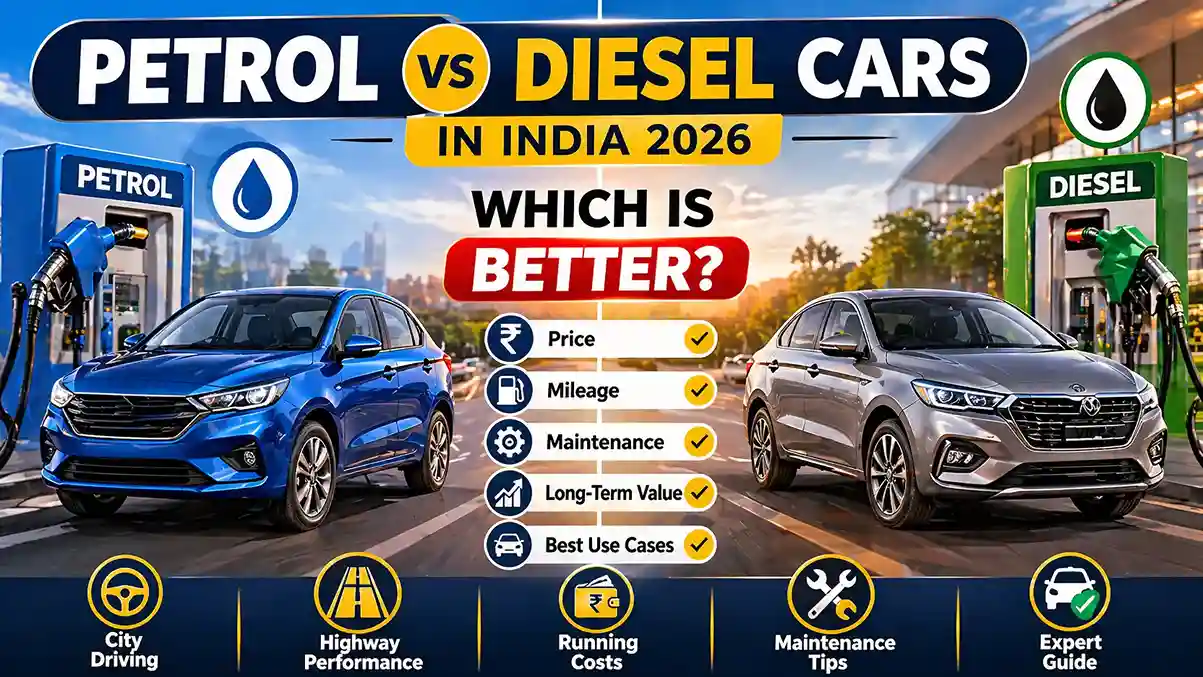
Choosing between petrol vs diesel cars in India is still one of the most important car-buying decisions in 2026 because the answer depends on how far you drive, where you drive, and how long you plan to keep the car. Fuel prices in India are revised daily at 6 a.m. by oil marketing companies, and current city prices continue to vary across locations, which means ownership cost can change meaningfully from one buyer to another. On 30 April 2026, for example, Delhi petrol was ₹94.77/l and diesel was ₹87.67/l, while Mumbai petrol was ₹103.54/l and diesel was ₹90.03/l.
Petrol vs Diesel Cars: The Short Answer
If your driving is mostly inside the city and your annual mileage is modest, petrol is usually the better and simpler choice. If you drive long distances, spend a lot of time on highways, or clock high yearly usage, diesel often makes more financial sense because the lower running cost can compensate for the higher upfront price. That is not just theory; Hyundai’s own 2026 Venue comparison says petrol is smoother and quieter for city travel, while diesel is better suited to long-distance use because of its higher torque and highway stability.
The important part is that this is not a one-size-fits-all answer. Petrol wins on ease, lower entry price, and relaxed urban use. Diesel wins when you are putting serious kilometres on the odometer and need better fuel economy over time. The right fuel is the one that matches your pattern of driving, not the one that sounds better in a brochure.
Why Petrol and Diesel Still Matter in 2026
Petrol and diesel are still relevant because India’s car market remains highly practical and cost-sensitive. Many buyers still want a car that can handle office traffic, school runs, and weekend highway travel without becoming too expensive to buy or run. Hyundai’s Venue petrol-vs-diesel guide explicitly frames the choice around lifestyle, running costs, and driving frequency, which is exactly how most Indian buyers should think about it. Tata’s Nexon lineup also shows how manufacturers continue to offer both petrol and diesel in the same model family because the two fuels serve different users.
That is why this debate remains relevant even as EVs and hybrids get more attention. Readers who want to compare all powertrain options can also look at CarsInfos’ best hybrid cars under ₹20 lakh and best electric cars in India pages, but petrol and diesel still make sense for buyers who want familiar refuelling, wide service support, and straightforward ownership.
Price Difference: Why Diesel Usually Costs More Up Front
Diesel variants typically cost more than petrol variants because the engine and emissions hardware are more expensive. Hyundai’s 2026 Venue comparison is a clear example: petrol variants start at ₹7,89,900, while diesel variants start at ₹9,69,900. Hyundai says the petrol range includes the 1.2L MPi and 1.0L Turbo GDi engines, while the diesel range uses the 1.5L CRDi unit with manual and automatic options.
Tata’s Nexon shows the same pattern of variant spread across fuels. Tata’s current Nexon page says the model starts at ₹7.36 lakh and goes up to ₹15.50 lakh, with petrol, diesel, and iCNG variants available. That means diesel is still very much part of the mainstream Indian market, but it usually sits in a slightly higher purchase-price lane than the equivalent petrol version.
Mileage Difference: Where Diesel Starts to Pull Ahead
Diesel’s biggest advantage is fuel economy, especially at sustained speeds and on highways. Tata’s Nexon blog lists certified mileage of up to 17.44 km/l for petrol and 24.08 km/l for diesel under ARAI conditions. Hyundai’s Venue comparison also says diesel is better for highway driving and long-distance travellers, while petrol is smoother for city use. Those two sources together explain why diesel can save money when the daily or yearly distance is high enough.
Here is a practical example using current Delhi fuel prices from 30 April 2026. At ₹94.77/l for petrol and ₹87.67/l for diesel, a buyer driving 15,000 km a year in a Tata Nexon-class vehicle would spend about ₹81,511 a year on petrol and about ₹54,612 a year on diesel, which is a savings of roughly ₹26,899 per year in favour of diesel. At 10,000 km a year, the difference is still about ₹17,933 per year. That is a real number, not a vague assumption, and it shows why diesel starts making more sense as annual usage rises.
Real-World Example: Hyundai Venue Petrol vs Diesel
Hyundai’s official 2026 guide for the Venue is one of the clearest manufacturer explanations of petrol vs diesel use cases. Hyundai says the Venue offers three engine choices: a 1.2L MPi petrol, a 1.0L Turbo GDi petrol, and a 1.5L CRDi diesel. It also says petrol suits city-based drivers and families with moderate daily travel, while diesel is ideal for long-distance travellers and people covering 1,000 km or more each month.
That makes the Venue a good reference point for buyers who are undecided. If you do mostly short city trips, petrol is the calmer, simpler route. If you regularly do highways, intercity trips, or hilly roads, diesel’s torque and efficiency become more valuable. Hyundai’s official price page also shows the diesel option positioned above the petrol variants, which reinforces the idea that diesel is a usage-based choice rather than a default purchase.
Real-World Example: Tata Nexon Petrol vs Diesel
Tata’s Nexon is another strong comparison case because it continues to offer both petrol and diesel powertrains in a mainstream under-₹15 lakh context. Tata’s current price page places the Nexon between ₹7.36 lakh and ₹15.50 lakh, and the brand’s own mileage information shows a clear efficiency gap between petrol and diesel. For many Indian buyers, that gap is the difference between “nice to have” and “worth paying for” once annual running starts crossing city-only usage.
The Nexon example also shows why long-term value cannot be judged by mileage alone. Petrol may be cheaper to enter, but diesel may cost less to run over time. The final winner depends on how quickly the fuel savings can offset the higher purchase price and whether the buyer really needs diesel’s highway advantage. That is why the same car can make sense for one buyer and not for another.
Maintenance Cost: Petrol Is Usually Simpler, Diesel Needs More Careful Planning
When buyers compare petrol vs diesel cars in India, maintenance is where the real-life difference starts to matter more than the brochure. Petrol cars are usually the simpler choice for light-to-moderate use because the ownership equation is easier to manage when you are not trying to extract maximum mileage from every litre. Diesel, on the other hand, is better treated as a high-usage investment: it makes sense when the fuel savings are large enough to matter over the years. That conclusion follows directly from the official mileage gaps and current fuel-price example above.
The best practical rule is to match maintenance expectations to usage. If the car will mostly do school runs, office commutes, and short city hops, petrol is easier to justify. If the car will regularly handle highways, long business travel, or outstation driving, diesel’s stronger running-cost advantage can outweigh its higher entry price and the need for more disciplined ownership. Hyundai’s Venue guide explicitly supports that same split between city-oriented petrol use and highway-oriented diesel use.
Long-Term Value: Which Fuel Type Makes More Sense?
Long-term value is where many buyers overthink the petrol vs diesel debate. The answer is actually simple: diesel usually wins if you drive enough kilometres every year; petrol usually wins if you do not. Using the Delhi example above, the diesel Nexon-class car saves about ₹26,899 a year at 15,000 km and about ₹17,933 a year at 10,000 km. That means the payback period becomes far more attractive for high-mileage users than for low-mileage urban users.
This is also why diesel still has a place in CarsInfos’ broader content cluster. Readers who are thinking about highway usage may also want to compare the site’s best SUVs under ₹15 lakh and best diesel cars under ₹15 lakh posts, because those articles help narrow the real-world use case faster than a generic fuel debate does.
Best Use Cases: Who Should Buy Petrol, and Who Should Buy Diesel?
Petrol is the better choice for city commuters, first-time buyers, and families that drive moderate distances each month. It suits buyers who want a lower entry price, a smoother everyday drive, and a simpler ownership experience. Hyundai’s official Venue guide says exactly that: petrol is best for city-based drivers and families with moderate travel, while the diesel option is better for long-distance drivers and people covering at least around 1,000 km a month.
Diesel is the better choice for highway travellers, frequent commuters, and users who rack up annual mileage quickly. The greater the distance, the more useful the diesel mileage advantage becomes. That is why diesel continues to show up in core model families like the Venue and Nexon, and why CarsInfos still has a dedicated best diesel cars under ₹15 lakh guide for buyers who know they are high-mileage users.
Should You Consider Petrol Instead of Diesel in 2026?
For many buyers, yes. Petrol has become the safer default because most urban users do not drive enough to fully recover the diesel premium. The current fuel-price spread and the mileage differences still favour diesel on paper, but the real decision depends on whether your annual running is high enough for the fuel savings to matter. If your use is mostly city-based, petrol often delivers the better ownership experience simply because it is easier to justify from day one.
If you are still unsure, it helps to compare this article with related CarsInfos guides on best automatic cars under ₹15 lakh and best electric cars under ₹15 lakh. That way, you are not only choosing petrol or diesel, but also checking whether an automatic or an EV is actually the smarter match for your daily routine.
Frequently Asked Questions
Which is better in India: petrol or diesel?
For low-mileage city users, petrol is usually better. For high-mileage users and highway drivers, diesel is usually better because the mileage advantage can create meaningful yearly savings.
Is diesel still worth buying in 2026?
Yes, but only for the right buyer. Diesel is still worth buying if you drive regularly, cover long distances, or want strong highway performance. For mostly city use, petrol is usually the cleaner choice.
Which fuel is cheaper to run?
Diesel is usually cheaper to run per kilometre because it returns better mileage. In the Tata Nexon example, diesel mileage is 24.08 km/l versus 17.44 km/l for petrol, and that gap becomes more valuable when annual driving rises.
Is petrol cheaper to maintain than diesel?
In practical ownership, petrol is usually easier to live with for moderate users because the overall buying and running equation is simpler. Diesel only starts making better long-term sense when the fuel savings from higher annual mileage are large enough to justify the higher upfront cost. That is an inference from the Venue and Nexon examples and the current fuel-price data.
Which is best for city driving?
Petrol. Hyundai’s own 2026 Venue comparison says petrol is the better fit for city-based drivers and families with moderate travel.
Which is best for highway driving?
Diesel. Hyundai says diesel is better suited to long-distance travellers, hill routes, and people covering high monthly mileage.
Should I choose petrol if I drive less than 10,000 km a year?
Most likely yes. In the Delhi example, the annual fuel saving at 10,000 km is about ₹17,933 in favour of diesel, which is helpful but may not always be enough to justify a higher upfront diesel price unless your usage is consistently high.
Final Verdict
The petrol vs diesel decision in India in 2026 is still a usage problem, not a brand problem. Petrol is the better all-round choice for city buyers, low-mileage owners, and people who want a simpler purchase decision. Diesel is the better long-term choice for highway users and high-mileage drivers who can actually use the fuel savings. Hyundai’s Venue and Tata’s Nexon both show the same pattern clearly: petrol is smoother and easier for daily urban use, while diesel earns its keep when the kilometres start piling up.
Author: Carsinfos Editorial Team
Published: April 30th, 2026