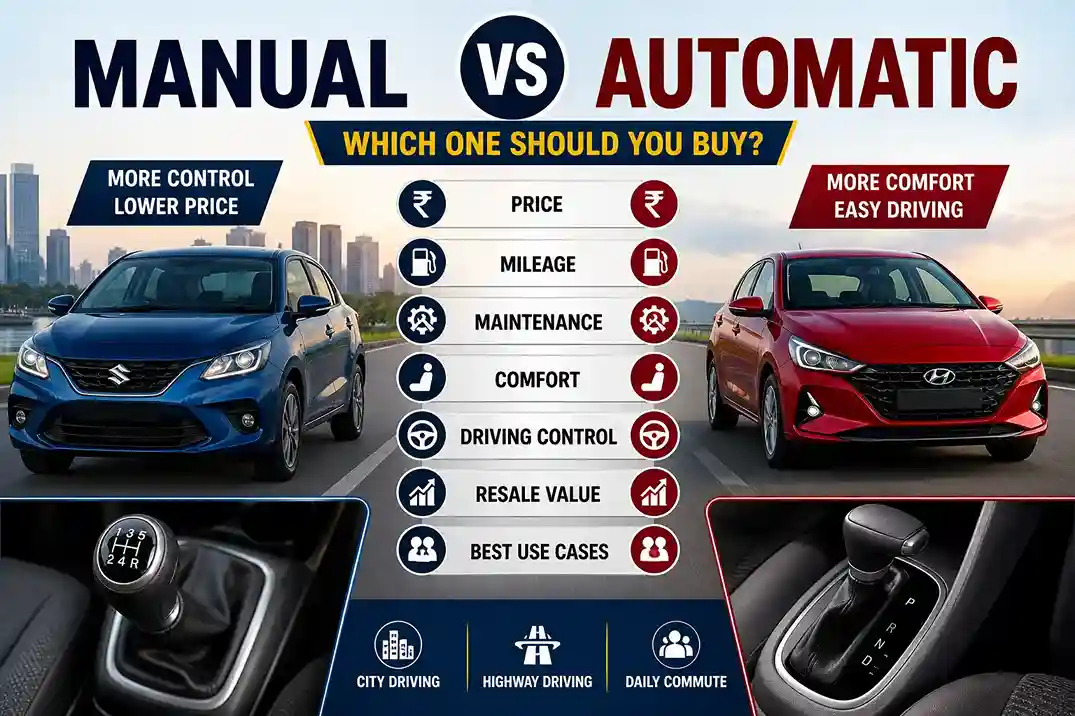
Choosing between manual vs automatic cars is still one of the most important buying decisions for Indian car buyers in 2026. A manual car gives the driver direct control and usually a lower purchase price, while an automatic car removes clutch work and makes daily driving easier, especially in traffic. Hyundai’s recent India blog says automatic cars are gaining acceptance because of congestion, longer commutes, and the convenience they bring to urban driving, while Maruti Suzuki defines automatic transmission as a fully automated gearbox that shifts gears without manual intervention.
Manual vs automatic cars: the simple difference
A manual car requires the driver to shift gears and operate the clutch, which gives more direct control over the engine and road feel. Maruti Suzuki’s automatic-technology pages make the contrast clear by describing automatic systems as gearboxes that handle gear changes on their own, while manual transmission remains the driver-controlled option. Hyundai’s 2026 automatic-transmission guide similarly explains that automatic systems are designed to reduce driver effort and improve comfort in traffic.
In simple terms, manual is about control and usually lower upfront cost, while automatic is about ease and convenience. That one sentence captures most of the buying decision for Indian buyers, especially in cities where stop-go traffic can make clutch-heavy driving tiring over time. This is an inference based on the way Maruti and Hyundai describe transmission behavior and the use cases they highlight.
Why manual cars still make sense in India
Manual cars still matter because they usually cost less to buy and are often preferred by drivers who enjoy active control. Honda’s City page shows that the model is offered with both manual and CVT automatic transmissions, and the manual version is still a key part of the lineup. Honda’s Amaze page also offers both manual and CVT choices, which shows that manufacturers continue to support manual buyers even in modern family cars.
For buyers who drive mostly on open roads, enjoy a more involved driving style, or want the lowest possible entry price, manual remains a rational choice. That is especially true in value-focused categories, where readers often compare manual-friendly models in best cars under ₹10 lakh and best sedan cars under ₹10 lakh before deciding whether paying extra for an automatic is worth it.
Why automatic cars are rising fast
Automatic cars are becoming more popular because daily commuting has become harder in many Indian cities. Hyundai’s current blog says automatic transmission cars are a practical choice for buyers across India because of traffic congestion, longer commute times, and changing driving preferences. Hyundai also notes that automatic systems can support a more relaxed driving experience and help reduce effort in stop-and-go traffic.
This matters because the automatic segment is no longer limited to expensive cars. Maruti’s automatic lineup includes AGS, AT, and other automated options across popular models, while Hyundai offers IVT, AT, DCT, and AMT-style solutions in different vehicle categories. That breadth means a buyer can now choose an automatic hatchback, sedan, SUV, or family car without leaving the budget segment entirely.
Price comparison: manual usually wins on upfront cost
The biggest advantage of a manual car is usually the lower purchase price. Hyundai’s Venue pricing shows a clear gap between petrol and diesel variants, and its official transmission pages show that different gearboxes are tied to different trim and engine combinations. In practical terms, automatics usually cost more because of the transmission hardware and the convenience it adds.
You can see the same pattern in many mainstream Indian cars. The Hyundai City page shows both manual and CVT options, and the automatic version is positioned as the convenience upgrade. The Honda Amaze and Honda City both follow this same pricing logic, where the smoother automatic variants sit beside cheaper manual trims.
Mileage: manual can be efficient, but automatics have improved a lot
Manual cars have traditionally been seen as the mileage-friendly option, but that gap has narrowed. Maruti Suzuki’s Dzire page shows 24.79 km/l for the manual and 25.71 km/l for AGS, which is a good reminder that modern automatics can be very efficient. Honda’s City page also shows 18.4 km/l for the CVT and 17.77 km/l for the manual, proving that the automatic is not automatically worse on fuel efficiency.
This is one of the most important changes in the manual vs automatic cars debate. Older advice used to say “manual always gives better mileage,” but modern transmission tuning has changed that assumption. In some models, an automatic can match or even slightly beat the manual in official efficiency figures. That is why buyers should compare the exact car, not just the gearbox label.
Maintenance and long-term ownership
Manual cars are still often easier to understand and may feel simpler to own over the long term because the gearbox design is familiar and the driving process is straightforward. Automatic cars, however, have improved significantly, and manufacturers now offer systems like AGS, CVT, IVT, DCT, and conventional AT units across the market. Maruti’s AGS page says the shifting and clutch control are electronically automated, while Hyundai explains how different automatic types are tuned for city comfort, smoothness, or quicker shifts.
For long-term ownership, the real question is not “which transmission is cheaper to maintain?” but “which transmission matches your driving pattern?” If you drive a lot in city traffic, an automatic may reduce fatigue enough to justify its extra cost. If you drive long distances less frequently and care more about purchase price, a manual can still make more sense. That is an inference drawn from how manufacturers position these transmission types and the use cases they highlight.
Comfort and driving ease
This is where automatic cars usually win. Hyundai says automatic transmission cars are better suited to stop-and-go traffic because they reduce the need for frequent clutch use, and Maruti’s automatic description also emphasizes that automatic gearboxes free the driver from manual shifting. That matters a lot for buyers who spend an hour or more every day in dense city traffic.
If your commute includes crowded signals, bumper-to-bumper lanes, or repeated low-speed crawling, automatic driving quickly starts feeling less like a luxury and more like a practical upgrade. Readers who are already comparing urban-friendly options can pair this article with Best Automatic Cars Under ₹15 Lakh in India 2026 and Best Cars Under ₹15 Lakh in India to see which body style and transmission combination suits them best.
Highway driving: manual vs automatic
On highways, both manual and automatic can work well, but they feel different. Manual gives the driver more control during overtakes, descents, and steep climbs, while automatic reduces fatigue on long journeys and can make cruising more relaxed. Hyundai’s transmission guidance and long-drive content consistently present automatics as comfort-oriented options, while manuals are framed as more involved and direct.
Honda’s City page is a good example here because it offers both manual and CVT versions, and the brand positions the CVT as a smooth, efficient choice for relaxed driving. For a buyer who regularly travels on highways with family, the right answer may depend more on comfort preference than on the transmission label itself.
Best use cases for manual cars
Manual is the better choice if you are a budget-conscious buyer, a driving enthusiast, or someone who mostly drives on open roads rather than in heavy city traffic. It is also a sensible option if you want to keep the buying cost as low as possible. CarsInfos readers looking at entry-level models in best cars under ₹10 lakh and best sedan cars under ₹10 lakh are often the same buyers who benefit most from sticking to manual.
Manual can also be useful for drivers who like the connection between engine speed and gear choice. In practice, that means more involvement on winding roads, more control in some hill conditions, and a more traditional driving experience. This is not a universal benefit, but it is a real preference for many buyers.
Best use cases for automatic cars
Automatic is the better choice if you drive in traffic every day, if comfort matters more than engagement, or if you are a first-time buyer who wants a simpler learning curve. Hyundai’s 2026 blog explicitly links automatic popularity to urban traffic and longer commutes, and that is exactly the kind of real-world use case where automatics make the most sense.
Automatic cars also fit families well because they reduce fatigue for the primary driver and make the car easier for multiple household members to use. That is why cars like the Dzire AGS, Honda Amaze CVT, and Honda City CVT remain strong family-friendly automatic choices in India.
A practical buying rule for 2026
If your annual running is modest and most of your driving is inside the city, choose automatic if comfort matters to you, or manual if budget is your top priority. If you drive longer distances regularly, both can work, but manual may save money upfront while automatic may save effort every single day. Hyundai’s and Maruti’s official material supports this idea because both brands describe automatics as convenience-focused systems and manuals as driver-controlled transmissions.
A good way to decide is to compare the exact car, not just the gearbox. For example, a Dzire manual and Dzire AGS are both sensible, but the automatic’s convenience may be worth the small trade-off for city buyers. Likewise, the City manual and City CVT both have strong cases depending on whether you value control or smoothness more.
Frequently Asked Questions
Which is better: manual or automatic?
There is no single winner. Manual is usually better for buyers who want lower upfront cost and more control, while automatic is better for buyers who want easier city driving and more comfort. That conclusion follows from the way Maruti and Hyundai describe each transmission type.
Is automatic more expensive than manual?
Usually yes, because automatic transmission adds convenience hardware and tuning. You can see this through the way automatics are positioned in models like the Hyundai Venue, Honda City, and Honda Amaze, where manual and automatic versions sit in different price and variant combinations.
Does manual give better mileage?
Not always. Maruti’s Dzire and Honda’s City both show automatic variants matching or slightly outperforming manual figures in official mileage claims, which means buyers should compare the exact model rather than relying on old assumptions.
Is automatic good for beginners?
Yes. Automatic cars are easier to learn because they remove clutch work and reduce gear-shifting effort, which is one reason they are becoming more popular in India. Hyundai’s blog specifically highlights traffic convenience and reduced driver effort as key benefits.
Which is better for city driving?
Automatic. The biggest advantage is comfort in stop-and-go traffic, where manual clutch work can get tiring quickly.
Which is better for highway driving?
Both can work well, but manual gives more direct control while automatic reduces fatigue on long trips. The better choice depends on whether you value involvement or relaxation more.
Which gearbox is best for families?
Automatic is usually the easier family choice because multiple drivers can use it with less effort. Models like the Honda Amaze CVT and Honda City CVT are good examples of family-friendly automatic sedans.
Final verdict
The manual vs automatic cars decision is really a decision about how you drive every day. Manual is still a smart choice if you want a lower purchase price, a more engaged drive, and a traditional ownership style. Automatic is the better choice if you face heavy traffic, want easier driving, or share the car with different family members. Current Indian market examples from Maruti, Honda, and Hyundai show that both transmissions are mature, practical, and widely available across hatchbacks, sedans, SUVs, and family cars.
Author: Carsinfos Editorial Team
Published: May 1st, 2026