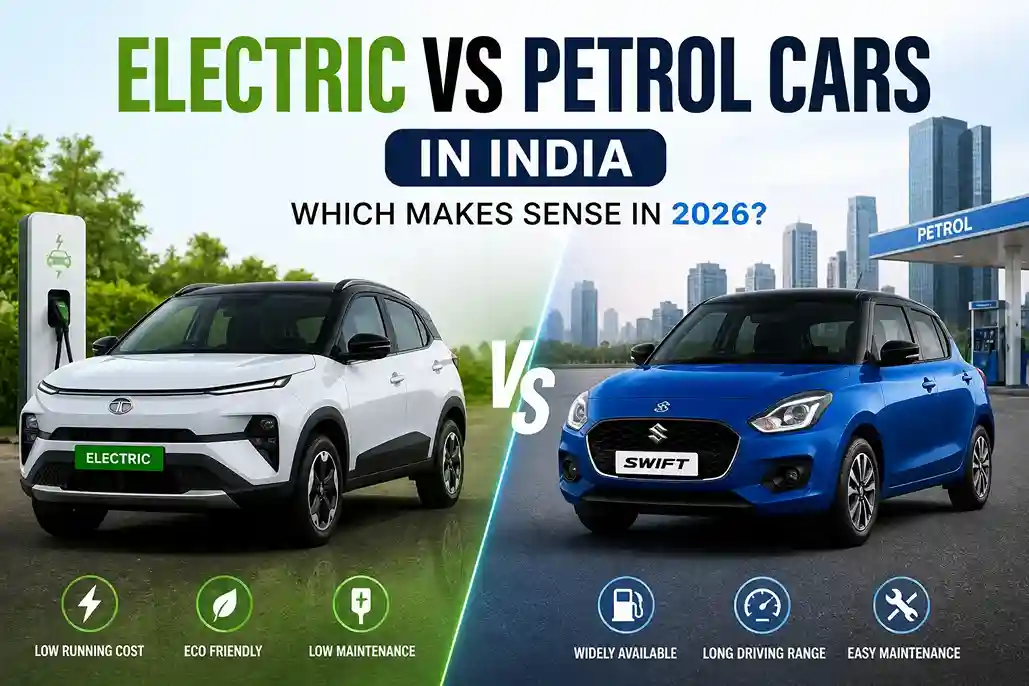
Electric cars are no longer a “future” choice in India. Tata Motors said in late 2025 that it had crossed 250,000 EV sales in India, which shows that EVs are now part of the mainstream market rather than a niche experiment. At the same time, petrol cars remain the default choice for millions of buyers because they are familiar, easy to refuel, and available across every budget band. That is exactly why the electric vs petrol cars in India debate matters so much in 2026.
Quick answer: which one makes sense in 2026?
If your driving is mostly within the city and you can charge at home or at work, an EV can make a lot of sense. If you want the lowest entry price, easy refuelling, and the least planning for long trips, petrol usually remains the simpler choice. That is the short version of the decision, and it is supported by how manufacturers position their current EV and petrol models in India.
What changed in 2026?
The biggest shift is that EVs now have enough range, charging speed, and feature content to be realistic daily drivers. Tata’s Punch EV page says the model starts at ₹9.69 lakh, uses a 40 kWh battery, delivers 468 km ARAI range, and supports 20–80% fast charging in 26 minutes. Tata’s EV press release also says the Punch.ev offers about 355 km of real-world range for comfortable intercity travel and comes with express charging and a lifetime battery warranty.
Petrol cars, meanwhile, still win on simplicity and starting price. The petrol Tata Punch starts at ₹5.64 lakh, which means the EV version is about ₹4.05 lakh more at the entry point. That price gap is important because it is the first thing many buyers feel before they even think about fuel savings.
Real-world example: Tata Punch EV vs Tata Punch petrol
This is one of the cleanest comparisons because it is the same car family with two very different ownership stories. The Punch EV is the more expensive choice up front, but it gives you a high-voltage battery, claimed 468 km ARAI range, and fast charging support. The petrol Punch begins much lower, at ₹5.64 lakh, and works like a conventional ICE car that can be refuelled anywhere petrol is sold.
If you do short daily commutes, the EV’s charging convenience can be attractive, especially when you can plug in at home overnight. If you do not have reliable charging access, the petrol version is easier to live with because it does not require route planning around chargers. That is why the same model can make perfect sense for one buyer and feel inconvenient for another. Tata’s own product pages make that split very visible.
Petrol still has clear advantages
Petrol cars still make sense for buyers who want the smallest upfront commitment and the broadest usability. Hyundai’s Venue lineup shows why: the current Venue starts at ₹7.99 lakh and offers multiple petrol choices, including the 1.2L Kappa MPi petrol and 1.0L turbo petrol, alongside diesel in some trims. That makes petrol an easy fit for buyers who want a familiar engine type with a wide range of variants and price points.
Petrol is also the safer choice for people who drive unpredictably. If your weekly schedule changes, if you do frequent outstation trips, or if you live in a building where charging is difficult, petrol reduces friction. IndianOil says petrol and diesel prices are updated daily at 6 a.m., so fuel costs can move over time, but the everyday act of refuelling remains simple and universal. Reuters also reported in early May 2026 that domestic retail fuel prices had remained unchanged for four years, which shows why many buyers still treat petrol as a stable, known ownership pattern even when global oil markets are volatile.
Electric cars win on city convenience and newer technology
The strongest EV argument is not just running cost. It is the whole ownership experience in the city. EVs are quiet, smooth, and easy to drive because there is no gear changing in the traditional sense, and charging at home can fit naturally into overnight parking routines. CarsInfos’ EV coverage describes modern electric cars as zero-tailpipe-emission vehicles with advanced battery tech and smooth driving performance, which is exactly why many buyers now consider them practical daily cars rather than second vehicles only.
The Tata Punch EV is a good example of how far the segment has come. A buyer who wants a compact SUV can now get a model with 468 km ARAI range, fast charging, connected features, and a lifetime battery warranty from a mainstream brand. That kind of package did not feel normal for the mass market only a few years ago, but it is now part of the mainstream EV conversation in India.
Which one is better for city driving?
For city driving, EVs usually make more sense if charging is easy. You start with a battery every morning, you avoid fuel station visits, and you get a calm, low-stress drive in traffic. That is why many urban buyers now shortlist EVs first and petrol cars second when they are shopping for daily commuting. Hyundai’s current product messaging around the Venue and Tata’s Punch EV pages both reflect that split between relaxed city use and broader cross-country flexibility.
A simple rule works well here: if your car spends most of its life in the city, charging is available, and daily distance is predictable, EV is often the more satisfying choice. If your commute is mixed, your parking is uncertain, or your route changes often, petrol remains the lower-friction solution. That is an inference based on current manufacturer positioning and the charging and range details available for mainstream EVs.
Which one is better for highway and intercity travel?
For highways and intercity travel, petrol is still the easier option for most people because it offers simpler refuelling and fewer planning constraints. EVs can absolutely handle intercity trips, but the trip must be planned around charging time and charger availability. Tata’s own press release says the Punch.ev offers about 355 km of real-world range for comfortable intercity travel, which is encouraging, but the need to stop and recharge still matters on longer journeys.
That is why buyers who do frequent highway runs often stick with petrol unless they are very comfortable planning their routes. Petrol cars like the Hyundai Venue are still attractive because they offer multiple engine choices and a familiar driving and refuelling experience. For many families, that convenience outweighs the long-term appeal of battery driving.
Cost of ownership: what really matters
The real ownership question is not only “what is cheaper to buy?” It is also “what fits my life?” Petrol cars usually win on entry price, while EVs can repay some of their higher upfront cost through charging convenience and potentially lower routine energy spend. But that payoff depends on how many kilometres you drive, whether you can charge at home, and how long you intend to keep the car. The gap between the Punch EV’s ₹9.69 lakh starting price and the petrol Punch’s ₹5.64 lakh starting price shows how important that first decision is.
If you want a family SUV under the same budget, CarsInfos already has helpful comparison posts such as Best Cars Under ₹15 Lakh in India and 10 Best SUVs Under ₹15 Lakh in India. Those guides are useful because they show what the same money buys in petrol form versus EV form, which makes the running-cost argument much easier to understand.
Best use cases: Electric vs petrol cars?
Choose EV if:
- you mostly drive in the city,
- you have home or office charging,
- you want a smoother and quieter daily drive,
- you like newer tech and are comfortable planning charging stops.
Choose petrol if:
- you want the lowest upfront cost,
- you drive mixed routes or frequent highways,
- you do not want to depend on charging infrastructure,
- you want a car that is simple to refuel anywhere.
What about resale and battery worry?
Battery anxiety is one of the most common EV concerns, but it is getting smaller as brands add stronger battery warranties and more detailed charging support. Tata’s Punch.ev press release specifically mentions a lifetime battery warranty, which helps address one of the biggest long-term concerns buyers still have about EV ownership. That does not remove the need to check service history, but it does make the ownership equation more reassuring than it used to be.
Petrol cars still benefit from a very mature market and familiar service ecosystem. That does not automatically make them better, but it does make them easier for cautious buyers to understand. If you are not ready to think about charging schedules, battery range, or wall boxes, petrol still feels like the simpler path in 2026. That conclusion follows from the current product positioning of mainstream EVs and petrol cars in India.
Frequently Asked Questions
Which is cheaper to buy, electric or petrol?
Petrol is usually cheaper to buy upfront. The Tata Punch example makes that very clear: the petrol Punch starts at ₹5.64 lakh, while the Punch EV starts at ₹9.69 lakh.
Which is cheaper to run in daily use?
That depends on where and how you charge. EVs can be cheaper to operate in many city-use cases, but the real answer depends on your electricity tariff, charging pattern, and annual kilometres. Current EVs like the Punch.ev are designed with home and fast-charging support, which is why they are attractive for predictable daily driving.
Is an EV good for highway travel?
Yes, but with planning. Tata says the Punch.ev can do about 355 km in real-world use and supports fast charging, but long trips still require charging stops and route planning.
Is petrol still the better choice for most buyers?
For buyers who want the simplest ownership experience, yes. Petrol still wins when charging is not convenient, when you want the lowest entry price, or when your driving pattern is mixed and unpredictable.
What is the best EV under ₹15 lakh right now?
CarsInfos currently lists the Tata Punch EV as the strongest all-round option in that budget, thanks to its price, range, and practical charging support.
Should a first-time buyer choose EV or petrol in 2026?
If charging is easy and city driving dominates, EV can be a smart first choice. If you want less complexity and a lower initial budget, petrol is still the safer and simpler buy.
Final verdict
In 2026, electric cars make the most sense for city buyers who can charge at home, want a quieter daily drive, and are comfortable paying more up front for a newer ownership model. Petrol cars make the most sense for buyers who want a lower purchase price, simple refuelling, and fewer planning requirements for long trips. The Punch EV vs Punch petrol comparison shows the trade-off clearly: EV gives you range, fast charging, and battery-tech confidence, while petrol gives you a much lower starting price and the easiest ownership routine.
Author: Carsinfos Editorial Team
Published: May 2nd, 2026