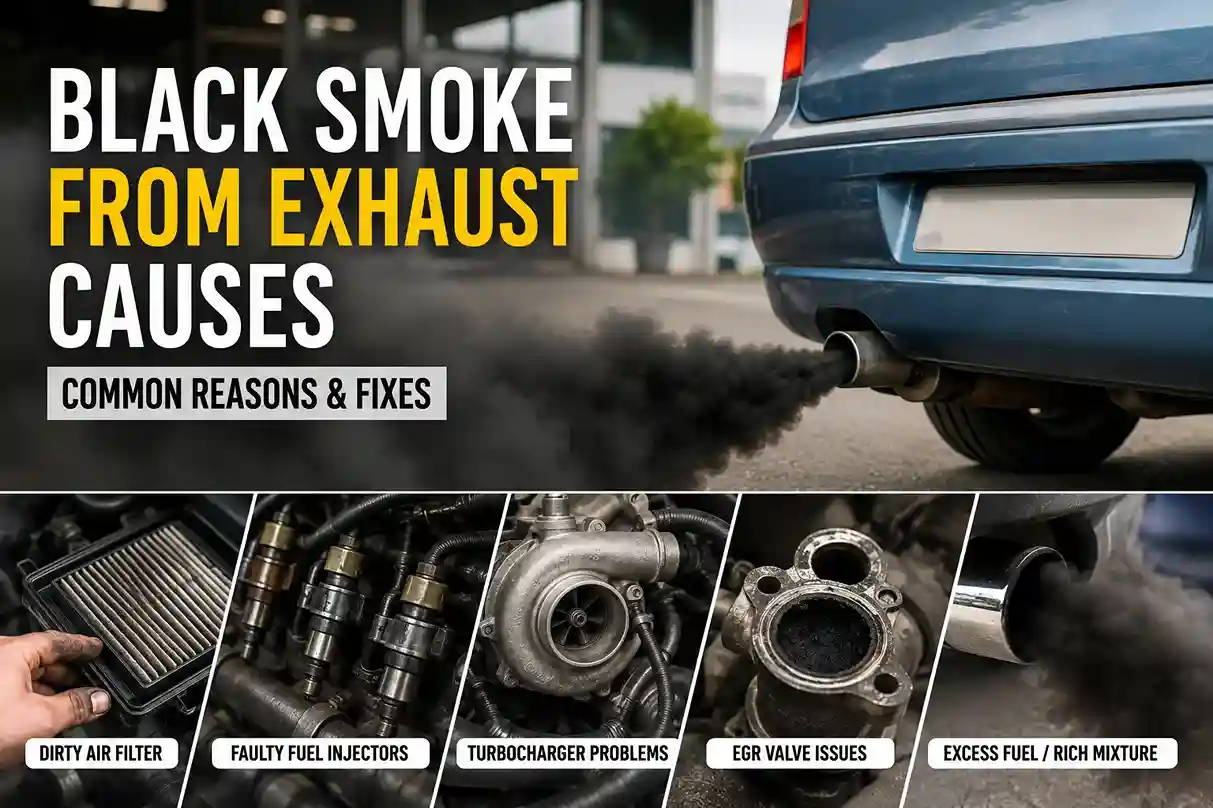
Black Smoke From Exhaust Causes is an important topic for every car owner because black exhaust smoke usually indicates that the engine is burning more fuel than it should. While a small amount of dark smoke may occasionally appear during hard acceleration in some diesel vehicles, continuous black smoke is often a sign of an underlying mechanical or fuel system problem that should not be ignored.
Ignoring black smoke can reduce fuel efficiency, increase harmful emissions, damage engine components, and eventually lead to costly repairs. Fortunately, many of the common causes can be diagnosed and corrected before serious damage occurs.
In real-world situations, drivers often notice black smoke while accelerating, climbing steep roads, or carrying heavy loads. Others may observe increased fuel consumption and reduced engine performance at the same time.
If you’ve also experienced sluggish acceleration, our guides on Why Your Car Is Losing Power While Accelerating and Car Engine Knocking Sound Causes and Fixes explain how engine performance problems can sometimes occur alongside excessive exhaust smoke.
This guide explains the most common Black Smoke From Exhaust Causes, warning signs, diagnostic methods, repair options, and preventive maintenance tips.
What Does Black Smoke From the Exhaust Mean?
Black smoke usually indicates that the engine is receiving too much fuel or too little air, resulting in incomplete combustion.
Instead of burning all the fuel efficiently, unburned fuel particles leave the engine through the exhaust, producing dark smoke.
Both petrol and diesel engines can produce black smoke, although the causes may differ slightly.
How Normal Combustion Works
For efficient combustion, the engine requires the correct balance of:
- Air
- Fuel
- Compression
- Ignition (petrol engines)
- Proper injection timing
When this balance is disrupted, combustion becomes incomplete, causing excessive soot and black exhaust smoke.
Maintaining the proper air-fuel ratio is essential for engine efficiency, emissions control, and fuel economy.
Common Black Smoke From Exhaust Causes
1. Dirty Air Filter
A clogged air filter restricts airflow into the engine.
When less air enters the combustion chamber, the engine burns a richer fuel mixture, producing black smoke.
Signs
- Reduced acceleration
- Higher fuel consumption
- Rough engine performance
- Black exhaust during acceleration
Fix
Replace the air filter according to the manufacturer’s maintenance schedule.
2. Faulty Fuel Injectors
Fuel injectors deliver precisely measured amounts of fuel.
If an injector sticks open or leaks, excessive fuel enters the cylinder.
Signs
- Rough idle
- Black smoke
- Increased fuel consumption
- Engine hesitation
Professional injector cleaning or replacement may be required.
3. Faulty Mass Air Flow (MAF) Sensor
The MAF sensor measures incoming air.
Incorrect readings cause the Engine Control Unit (ECU) to inject the wrong amount of fuel.
Too much fuel results in black smoke.
4. Oxygen Sensor Problems
The oxygen sensor monitors exhaust gases and helps the ECU maintain the correct air-fuel mixture.
A faulty oxygen sensor may cause the engine to run excessively rich.
5. Turbocharger Problems (Diesel Engines)
Turbochargers force additional air into the engine.
If the turbo fails or boost pressure decreases, insufficient air enters the cylinders, causing incomplete combustion.
Drivers may also notice:
- Reduced power
- Whistling noises
- Increased smoke
- Poor fuel economy
6. Clogged Air Intake System
Restrictions inside the intake system reduce airflow.
Possible causes include:
- Dirty intake ducts
- Blocked intake manifold
- Carbon buildup
Less air means richer combustion.
7. Faulty EGR Valve
The Exhaust Gas Recirculation (EGR) system reduces emissions.
If the valve becomes stuck, combustion efficiency decreases.
In some cases, excessive carbon deposits contribute to black smoke.
8. Incorrect Fuel Pressure
A faulty fuel pressure regulator may deliver excessive fuel.
The resulting rich mixture often produces noticeable black exhaust smoke.
9. Engine Control Module (ECM) Issues
Although less common, software or sensor communication problems may cause incorrect fuel delivery.
Professional diagnostics are often necessary.
Warning Signs That Often Accompany Black Smoke
Black smoke rarely appears by itself.
Additional symptoms may include:
- Poor acceleration
- Increased fuel consumption
- Rough idle
- Check Engine Light
- Reduced engine power
- Strong fuel smell
- Engine hesitation
Recognizing these warning signs early helps prevent more serious engine problems.
Is It Safe to Continue Driving?
It depends on the severity of the problem.
You may cautiously continue driving if:
- Smoke appears only briefly.
- Vehicle performance remains normal.
- No warning lights appear.
Stop driving and seek inspection if:
- Black smoke becomes continuous.
- Engine performance drops significantly.
- Check Engine Light illuminates.
- Fuel consumption increases rapidly.
- The engine begins overheating.
Ignoring continuous black smoke may damage emission control components such as the catalytic converter or diesel particulate filter.
According to the U.S. Environmental Protection Agency (EPA), properly maintained engines produce lower emissions and operate more efficiently.
External Reference:
Petrol vs Diesel Black Smoke
Petrol Engines
Common causes include:
- Faulty injectors
- Dirty air filter
- Oxygen sensor failure
- MAF sensor problems
- Rich fuel mixture
Diesel Engines
Diesel engines are slightly more likely to produce black smoke because of:
- Turbocharger faults
- Injector problems
- EGR issues
- Dirty air filter
- Excessive fuel delivery
Modern diesel engines with properly functioning emission systems should not continuously emit visible black smoke.
How Mechanics Diagnose Black Smoke
Professional diagnosis often includes:
- OBD-II fault code scanning
- Air filter inspection
- Fuel injector testing
- MAF sensor testing
- Oxygen sensor testing
- Turbocharger inspection
- Fuel pressure testing
Modern diagnostic tools help identify sensor faults more accurately than guessing based solely on symptoms.
If you’re maintaining overall engine health, our article on Engine Oil Leakage Symptoms explains another common issue that should be addressed early to prevent long-term engine damage.
The National Institute for Automotive Service Excellence (ASE) recommends professional diagnosis when persistent engine performance problems or abnormal exhaust emissions occur.
External Reference:
Why Prompt Repairs Matter
Ignoring black smoke can eventually lead to:
- Higher fuel costs
- Carbon buildup
- Catalytic converter damage
- Diesel particulate filter blockage
- Reduced engine life
- Increased repair costs
Repairing the underlying issue early is almost always less expensive than replacing damaged emission-control components.
Our guide on How Often Should You Change Engine Oil in India also highlights the importance of routine maintenance in keeping the engine operating efficiently.
Fixes for Common Black Smoke Problems
Once the underlying cause has been identified, repairing the issue promptly can restore engine performance, improve fuel efficiency, and reduce harmful emissions.
Replace a Dirty Air Filter
One of the simplest and least expensive fixes is replacing a clogged air filter.
A clean air filter allows the engine to receive sufficient airflow, helping maintain the correct air-fuel mixture and reducing black smoke.
Most manufacturers recommend inspecting the air filter during scheduled maintenance and replacing it when necessary.
Clean or Replace Faulty Fuel Injectors
Fuel injectors that leak or become clogged can disrupt fuel delivery.
Professional injector cleaning may restore proper operation, while severely worn injectors may require replacement.
Replacing faulty injectors often improves:
- Fuel economy
- Engine performance
- Exhaust emissions
- Starting reliability
Repair or Replace the Mass Air Flow (MAF) Sensor
If the MAF sensor provides incorrect airflow readings, the engine control unit may inject more fuel than necessary.
Cleaning or replacing a faulty sensor can restore the proper air-fuel ratio and eliminate excessive black smoke.
Replace Faulty Oxygen Sensors
Oxygen sensors play an important role in regulating fuel delivery.
A damaged sensor can cause the engine to run too rich, increasing fuel consumption and producing black exhaust smoke.
Replacing worn oxygen sensors according to the manufacturer’s recommendations helps maintain efficient combustion.
Repair Turbocharger Problems
For turbocharged diesel vehicles, damaged turbochargers or leaking boost hoses reduce the amount of air entering the engine.
Repairs may involve:
- Replacing damaged hoses
- Repairing the turbocharger
- Cleaning intake components
- Inspecting intercooler connections
Proper turbocharger performance restores power while reducing exhaust smoke.
Clean the EGR System
Carbon deposits inside the Exhaust Gas Recirculation (EGR) valve may affect combustion.
Cleaning or replacing the EGR valve helps restore proper airflow and reduce soot production.
Maintain the Fuel System
Using high-quality fuel and following scheduled maintenance helps reduce deposits inside the fuel system.
Periodic inspection of fuel filters and injectors contributes to cleaner combustion and smoother engine performance.
Common Mistakes Drivers Make
Many owners unintentionally worsen the problem by delaying maintenance or misdiagnosing the cause.
Ignoring Black Smoke
Some drivers assume black smoke is “normal,” especially in older diesel vehicles.
Continuous black smoke is not normal and should always be investigated.
Delaying Air Filter Replacement
A heavily clogged air filter restricts airflow and forces the engine to run with a richer fuel mixture.
Replacing the filter at recommended intervals is a simple way to help prevent excessive smoke.
Using Poor-Quality Fuel
Low-quality fuel may contribute to injector deposits and inefficient combustion.
Choosing fuel from reputable filling stations helps reduce the likelihood of fuel-related engine problems.
Ignoring the Check Engine Light
Black smoke accompanied by a Check Engine Light often indicates a fault that requires diagnostic testing.
Ignoring warning lights may lead to additional engine or emission system damage.
Our guide on Car Dashboard Warning Lights Explained explains the dashboard indicators that every driver should understand.
Skipping Regular Maintenance
Routine maintenance remains one of the most effective ways to prevent engine problems.
Neglecting scheduled servicing increases the risk of injector faults, sensor failures, clogged filters, and other issues that contribute to black smoke.
Best Practices to Prevent Black Smoke
Preventive maintenance helps keep your engine operating efficiently.
Recommended practices include:
- Replace the air filter according to the service schedule.
- Use high-quality fuel from reputable fuel stations.
- Change engine oil at recommended intervals.
- Inspect fuel injectors periodically.
- Address dashboard warning lights promptly.
- Keep the intake system clean.
- Follow the manufacturer’s maintenance schedule.
Drivers who maintain their vehicles regularly often experience better fuel economy, smoother performance, and lower repair costs.
Environmental Impact of Black Smoke
Black exhaust smoke contains soot and unburned fuel particles that contribute to air pollution.
A properly maintained engine:
- Produces fewer emissions
- Burns fuel more efficiently
- Improves fuel economy
- Reduces environmental impact
According to the U.S. Environmental Protection Agency (EPA), maintaining emission-related components helps reduce harmful pollutants and improve vehicle efficiency.
External Reference:
Frequently Asked Questions
Is black smoke from the exhaust always serious?
Not always, but continuous black smoke usually indicates that the engine is burning too much fuel or receiving insufficient air. Persistent smoke should be inspected promptly.
Can a dirty air filter cause black smoke?
Yes. A clogged air filter restricts airflow, creating a rich air-fuel mixture that can produce black exhaust smoke.
Does black smoke reduce fuel economy?
Yes. Engines producing black smoke typically burn more fuel than necessary, resulting in lower fuel efficiency and increased operating costs.
Can faulty injectors cause black smoke?
Yes. Leaking or malfunctioning fuel injectors may deliver excessive fuel, causing incomplete combustion and visible black smoke.
Is black smoke more common in diesel vehicles?
Older diesel engines are generally more prone to visible black smoke, particularly when components such as the turbocharger, injectors, or EGR system develop faults. Modern diesel vehicles with properly functioning emission systems should produce little or no visible black smoke during normal operation.
Can I continue driving if my car emits black smoke?
If black smoke is continuous or accompanied by reduced performance, warning lights, or overheating, have the vehicle inspected as soon as possible. Continuing to drive may damage emission-control components and increase repair costs.
Conclusion
Understanding Black Smoke From Exhaust Causes helps drivers recognize one of the clearest warning signs of inefficient engine combustion. Whether the issue stems from a clogged air filter, faulty fuel injectors, sensor problems, turbocharger faults, or excessive fuel delivery, identifying and repairing the underlying cause early helps restore engine performance, improve fuel efficiency, and reduce harmful emissions.
Routine maintenance—including timely air filter replacement, regular oil changes, quality fuel, and prompt attention to warning lights—plays a major role in preventing excessive exhaust smoke. Ignoring persistent black smoke can lead to higher fuel costs, damage to emission-control components, and more expensive repairs over time.
By understanding Black Smoke From Exhaust Causes, following your manufacturer’s maintenance schedule, and addressing engine problems promptly, you can keep your vehicle running cleaner, more efficiently, and more reliably while extending the life of both the engine and its emission-control system.
For additional maintenance advice, you may also find our guide on Why Your Car Is Overheating: Common Reasons & Fixes useful, as overheating and combustion issues can sometimes occur together.
Author: Carsinfos Editorial Team
Published: July 2nd, 2026