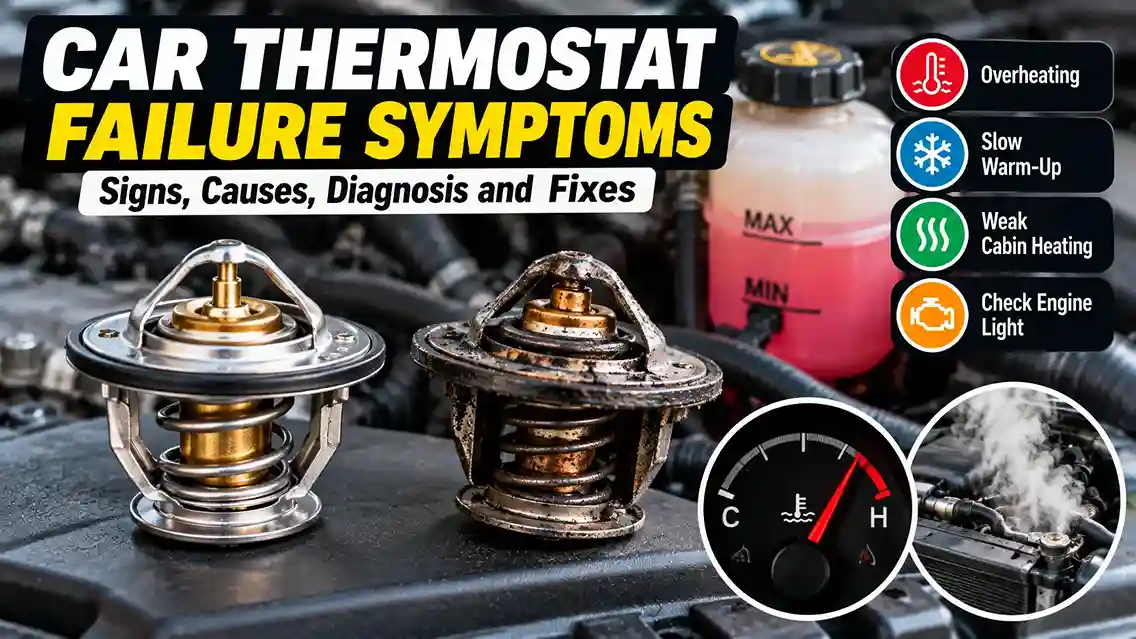
Car Thermostat Failure Symptoms can be easy to miss because a failing thermostat does not always cause immediate overheating. One vehicle may suddenly run hot, while another may take unusually long to reach normal operating temperature. You may also notice poor cabin heating, fluctuating temperature readings, reduced fuel economy, or a check engine light.
The thermostat is a small valve inside the engine cooling system, but its job is important. It helps control when coolant flows through the radiator so the engine can reach and maintain its intended operating temperature. A thermostat stuck closed can restrict cooling and cause overheating, while one stuck open can keep the engine running too cool.
Understanding the symptoms helps you distinguish a thermostat problem from other cooling-system faults and avoid replacing parts unnecessarily.
What Does a Car Thermostat Do?
A thermostat is essentially a temperature-controlled valve. When the engine is cold, the thermostat restricts coolant flow to the radiator so the engine can warm up more quickly. As the coolant reaches the thermostat’s designed operating temperature, the valve opens and allows more coolant to flow through the radiator.
An educational U.S. Department of Defense/NAVEDTRA training manual explains that the thermostat restricts coolant circulation through the radiator while the engine is cold and opens as the engine reaches the required temperature. This U.S. government technical explanation of thermostat operation provides a useful illustration of the basic principle.
The thermostat therefore has two competing jobs: help the engine warm up efficiently and prevent excessive heat buildup once the engine is hot.
It works together with the water pump, radiator, cooling fan, coolant and temperature sensors. A problem anywhere in that system can sometimes feel like a thermostat failure.
Car Thermostat Failure Symptoms to Watch For
There is no single symptom that proves the thermostat has failed. The most useful approach is to look at the overall pattern.
1. Engine overheating
The most serious symptom occurs when the thermostat becomes stuck closed or does not open sufficiently.
Coolant may continue circulating within the engine, but insufficient coolant reaches the radiator to release heat. As engine temperature continues to rise, the temperature gauge can move toward the hot or red zone.
AAA identifies thermostat failure as one of the potential causes of engine overheating and notes that a thermostat can fail in a position that restricts the coolant flow needed for cooling. AAA’s guide to common car overheating causes explains how thermostat faults fit into the wider cooling system.
If your temperature gauge is actually entering the red zone, treat it as an overheating problem rather than waiting to confirm the thermostat yourself. Our guide to Why Your Car Is Overheating: Common Reasons & Fixes covers what to do when engine temperature rises.
2. Engine takes too long to warm up
A thermostat stuck open can cause the opposite problem.
Because coolant is allowed to flow through the radiator too early, the engine may take longer than normal to reach its intended operating temperature.
In real-world situations, you might notice this during a morning commute. The car runs for several kilometres, but the temperature gauge remains noticeably lower than it normally does.
This can be particularly noticeable in cooler weather, although the exact symptom depends on the vehicle and its cooling-system design.
3. Temperature gauge keeps fluctuating
A temperature gauge that repeatedly moves up and down instead of settling into its normal range can be a clue.
A thermostat that is sticking rather than completely failing may open and close inconsistently. That can create temperature changes instead of a stable operating temperature.
However, fluctuating readings can also be caused by low coolant, trapped air, a faulty coolant-temperature sensor or another cooling-system problem.
That is why a temperature fluctuation should be treated as a diagnostic clue, not a diagnosis by itself.
4. Cabin heater is unusually weak
The heater inside a conventional petrol or diesel car uses hot engine coolant to provide cabin heat.
If the engine is not reaching its intended temperature because the thermostat is stuck open, the cabin heater may take much longer to produce warm air or may never become as hot as usual.
For example, you may notice that the blower is working normally but the air remains only mildly warm even after a longer drive.
This symptom is particularly useful because it can appear before a driver notices any serious engine problem.
5. Poor fuel economy
An engine is designed to operate within a particular temperature range. If it consistently runs cooler than intended, the engine-management system may alter fuel and ignition strategies.
That does not mean a thermostat problem automatically causes a dramatic mileage drop. Fuel consumption depends on many factors, including traffic, tyre pressure, driving style, air-conditioning use and engine condition.
If your fuel economy has changed noticeably, our guide on How to Improve Car Mileage in India provides a broader checklist before you blame one component.
6. Check engine light appears
Modern vehicles monitor coolant temperature through sensors and engine-control systems. A thermostat problem can sometimes contribute to a fault code when the engine does not reach or maintain the expected temperature.
A check engine light does not mean “replace the thermostat.”
For example, a temperature-related diagnostic code could be associated with the thermostat, coolant-temperature sensor, wiring, coolant level, or another issue.
Before replacing anything, scan the vehicle and interpret the code in context. Our OBD2 Error Codes Explained guide can help explain why a diagnostic code is a starting point rather than a complete diagnosis.
What Happens When the Thermostat Gets Stuck Closed?
A thermostat stuck closed is the failure most owners worry about because it can lead to overheating.
The basic sequence looks like this:
Engine warms up → thermostat should open → coolant should flow through radiator → radiator removes heat
When the valve does not open properly, the last two steps are restricted.
As the engine produces more heat, coolant temperature can rise rapidly.
You may notice the problem first during:
- Heavy traffic
- Long uphill drives
- Hot weather
- High-speed driving
- Towing or carrying heavy loads
The exact pattern depends on the vehicle, but continued overheating should never be treated as a minor inconvenience.
NHTSA-published vehicle documentation warns that continued operation during an overheating condition can increase the chance of vehicle or engine damage and advises drivers to stop safely and address the problem rather than continuing to drive. NHTSA-published overheating safety guidance
What Happens When the Thermostat Gets Stuck Open?
A thermostat stuck open generally creates a different pattern.
Coolant flows through the radiator even while the engine is still warming up. The result can be slow warm-up and an engine that consistently operates below its intended temperature.
Possible signs include:
- Temperature gauge stays unusually low
- Heater takes a long time to become warm
- Fuel economy may decline
- Engine takes longer to reach normal operating temperature
- A temperature-related diagnostic code may appear
A stuck-open thermostat is generally less dramatic than an immediately overheating engine, but it should still be investigated.
A vehicle is designed around a specific operating range, so consistently running too cool is not the same as healthy operation.
Thermostat Failure vs Radiator Problem
It is easy to confuse these problems because both can contribute to abnormal engine temperature.
A thermostat controls when coolant is allowed to flow through the radiator.
The radiator removes heat from the coolant after the coolant reaches it.
That distinction is important.
If the radiator is blocked, leaking or damaged, coolant may reach it but fail to release heat efficiently. Our Radiator Problems Explained guide covers common radiator leaks, blockage, damaged fins and other cooling-system issues.
A thermostat problem, meanwhile, can prevent the cooling system from operating correctly in the first place.
This is why replacing the radiator when the real fault is the thermostat can leave you with the same overheating problem and a larger repair bill.
Other Problems That Can Look Like Thermostat Failure
Several components can produce similar symptoms.
Low coolant
A low coolant level can cause overheating, temperature fluctuations and poor heater performance.
Check the coolant level only when the engine is cool and use the correct procedure for your vehicle. Our How to Check Car Engine Coolant Level at Home in India guide provides a practical walkthrough.
Cooling fan failure
A faulty electric cooling fan can cause overheating, particularly when the vehicle is stationary or moving slowly.
Water pump problem
The water pump circulates coolant. A failing pump can reduce coolant circulation and produce overheating symptoms.
Coolant-temperature sensor problem
A faulty sensor can report incorrect temperatures to the engine-management system or dashboard.
Air trapped in the cooling system
Air pockets can interfere with coolant circulation and produce unusual temperature readings.
Radiator blockage
A blocked radiator can reduce heat transfer even when the thermostat is functioning correctly.
Because these problems overlap, proper diagnosis is much more useful than replacing the first component that seems suspicious.
How Is a Bad Thermostat Diagnosed?
A mechanic usually considers the vehicle’s symptoms, temperature data and cooling-system behavior together.
Depending on the vehicle, diagnosis may include:
- Checking coolant level and condition
- Scanning diagnostic trouble codes
- Monitoring coolant temperature through a scan tool
- Inspecting hoses and the cooling system
- Checking for leaks
- Assessing coolant circulation
- Removing and testing the thermostat when necessary
On older vehicles, technicians sometimes compare temperature behavior in different parts of the cooling system as the engine warms. Modern vehicles can provide additional information through electronic temperature data.
The goal is to determine whether the thermostat is actually failing rather than simply assuming it.
Can You Test a Thermostat at Home?
A basic visual inspection is possible, but accurately confirming thermostat operation is more difficult without tools.
You can observe:
- Whether the engine reaches normal temperature
- Whether the temperature gauge behaves unusually
- Whether the cabin heater works normally
- Whether coolant is visibly leaking
- Whether warning lights appear
Do not open a hot radiator cap to investigate.
Pressurized cooling systems can release extremely hot coolant and steam. NHTSA-published vehicle instructions warn against removing cooling-system caps while the engine is hot. NHTSA overheating safety information is worth reviewing before performing any under-hood cooling-system checks.
For many owners, a scan tool and professional temperature diagnosis are safer and more useful than trying to remove the thermostat unnecessarily.
Common Mistakes When Dealing With Thermostat Problems
Continuing to drive an overheating car
This is the biggest mistake.
If the temperature warning appears or the gauge reaches the hot zone, stop safely and allow the vehicle to cool rather than continuing to drive.
Replacing the thermostat without diagnosing the cause
The thermostat may not be the failed part.
Low coolant, a fan problem, water-pump failure, radiator restriction and sensor issues can all create overlapping symptoms.
Opening the radiator cap while hot
Never do this casually. Hot coolant is pressurized and can cause severe burns.
Choosing a thermostat solely by price
The replacement component needs to match the engine’s specification and intended operating temperature.
Ignoring a recurring temperature warning
A problem that temporarily disappears is still a problem worth investigating.
Our Car Dashboard Warning Lights Explained guide explains why temperature warnings should not be dismissed simply because the vehicle still seems driveable.
Best Practices After Thermostat Replacement
If the thermostat is confirmed to be faulty, replacement is only part of the job.
The cooling system may need to be refilled and properly bled according to the vehicle manufacturer’s procedure.
Afterward, the technician should verify that:
- The engine reaches normal operating temperature
- There are no coolant leaks
- The cooling fan operates correctly when required
- The temperature remains stable
- Cabin heating works normally
- No warning lights return
Using the manufacturer’s specified coolant is also important. Do not choose coolant purely by its color.
The engine’s broader maintenance condition matters as well. Keeping up with How Often Should You Change Engine Oil in India can help maintain overall engine health, even though engine oil and the thermostat are separate maintenance items.
How Much Does Thermostat Replacement Cost?
Thermostat replacement cost varies widely depending on the vehicle, thermostat design, labour rates, coolant requirements and accessibility.
For some cars, the thermostat is inexpensive and easy to access. On others, accessing it can require significant labour.
A complete repair estimate may include:
- Thermostat
- Gasket or seal
- Coolant
- Labour
- Cooling-system bleeding
- Additional parts if another fault is discovered
When a workshop recommends replacement, ask whether the thermostat was actually tested or whether it is being replaced based only on symptoms.
That simple question can make the difference between a targeted repair and unnecessary parts replacement.
FAQ: Car Thermostat Failure Symptoms
What are the most common car thermostat failure symptoms?
Common signs include overheating, unusually slow engine warm-up, a temperature gauge that fluctuates, weak cabin heating, possible fuel-economy changes, and temperature-related check engine codes.
How do I know if my thermostat is stuck open?
A stuck-open thermostat may cause the engine to warm up unusually slowly, the temperature gauge to remain lower than normal, and the cabin heater to take longer to produce hot air.
How do I know if my thermostat is stuck closed?
A stuck-closed thermostat can cause the engine temperature to rise excessively because coolant flow through the radiator is restricted. Overheating is the main concern.
Can a bad thermostat cause overheating?
Yes. A thermostat that does not open properly can restrict coolant flow to the radiator and contribute to overheating.
Can a bad thermostat reduce fuel economy?
It can contribute to reduced efficiency when the engine consistently operates outside its intended temperature range, particularly when a thermostat is stuck open. However, poor mileage has many possible causes.
Can I drive with a bad thermostat?
Driving with a thermostat stuck open may produce less severe symptoms, but driving with an overheating engine is unsafe and can lead to expensive damage. The actual condition should be diagnosed promptly.
How long does a car thermostat usually last?
There is no universal replacement interval. Thermostats are generally replaced when they fail or when the manufacturer specifies replacement as part of a particular repair or maintenance procedure.
Should I replace the thermostat whenever I replace coolant?
Not automatically. Coolant replacement and thermostat replacement are separate maintenance decisions unless the manufacturer’s service procedure specifically combines them.
Conclusion
Understanding Car Thermostat Failure Symptoms can help you catch a cooling-system problem before it turns into a much larger repair. A thermostat stuck closed can contribute to overheating, while one stuck open can cause slow warm-up and poor cabin heating. Temperature fluctuations, unusual gauge behavior and temperature-related warning codes can also provide useful clues.
However, these symptoms are not exclusive to the thermostat. Radiator restrictions, low coolant, cooling-fan faults, water-pump problems and temperature-sensor issues can produce similar behavior. That is why diagnosis matters before replacing parts.
Pay attention to changes in your temperature gauge, never ignore an overheating warning, and never open a hot pressurized cooling system. When a thermostat is genuinely faulty, replacing the correct part and properly restoring the coolant system can return the engine to its intended operating temperature and help prevent further cooling-system trouble.
Author: Carsinfos Editorial Team
Published: Sep 27th, 2026