
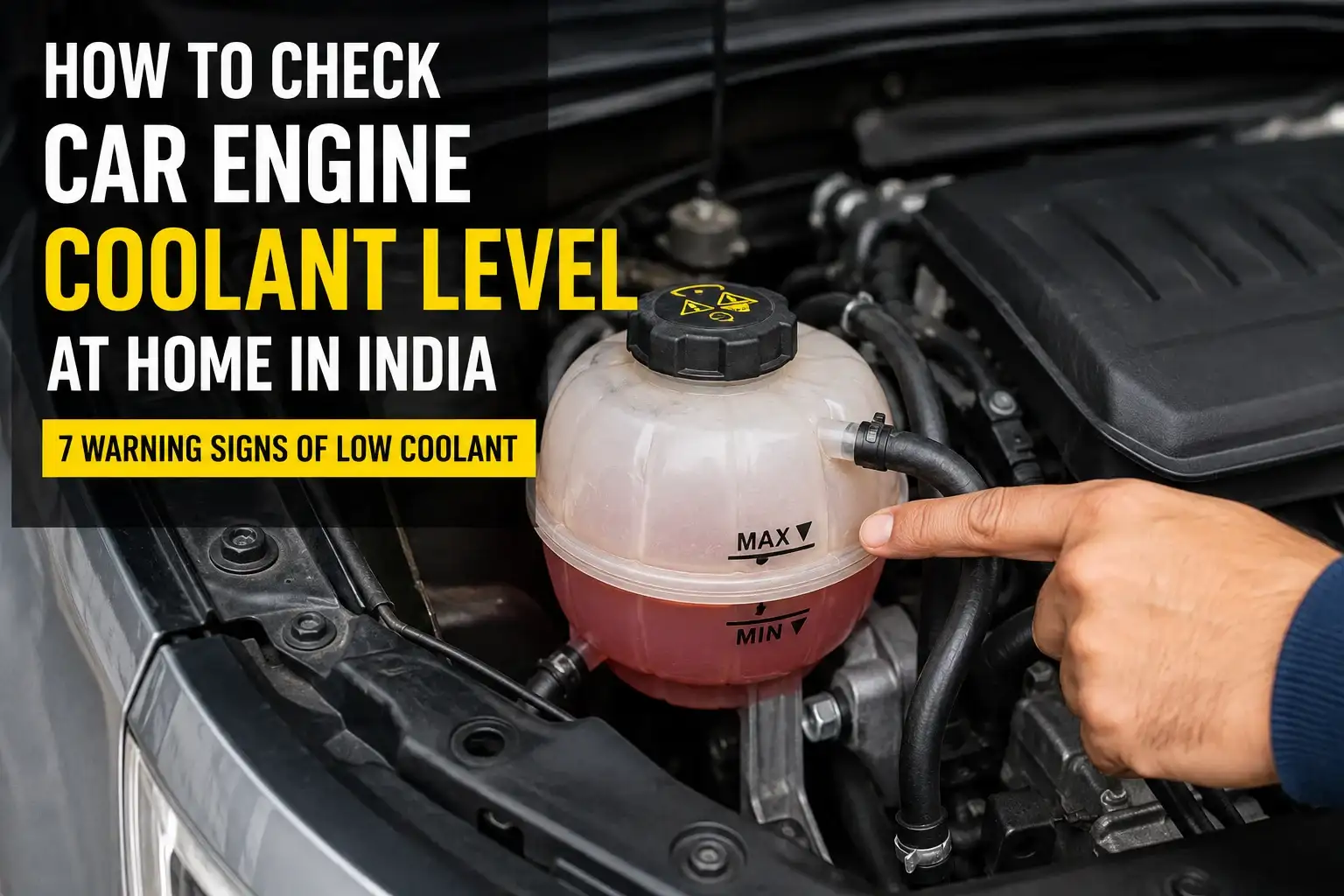
How to Check Car Engine Coolant Level at Home in India is one of those maintenance skills that can save you from a much bigger repair bill later. Coolant keeps the engine at a safe operating temperature, and when the level drops too low, overheating becomes much more likely. AAA says low coolant is one of the most common reasons a car overheats, and Toyota’s owner-manual guidance says a low coolant warning should be acted on promptly by adding coolant to the reservoir as soon as possible.
In real-world situations, low coolant does not always announce itself loudly at first. Sometimes the temperature gauge rises only a little, sometimes you notice a sweet smell, and sometimes the only clue is a warning light on the dash. That is why it helps to know the warning signs early and to keep a regular eye on related maintenance items like car dashboard warning lights explained, how to check car tyre pressure at home in India, and signs your car battery is weak. CarsInfos already covers those ownership basics, and this coolant guide fits neatly into that same home-maintenance routine.
Why coolant matters more than many drivers realize
Coolant is not just “engine water.” It is the fluid that helps absorb heat from the engine and move that heat away so the car can run safely. AAA explains that a cooling-system problem, including low coolant, is one of the main reasons engines overheat, and Toyota’s coolant guidance says a warning light may appear when coolant level is low and should be addressed quickly.
A common mistake people make is waiting until steam comes out of the bonnet before taking the problem seriously. By that stage, the car may already be hot enough to risk engine damage. The safer habit is to notice the early signs and check the coolant before the situation becomes urgent.
7 warning signs of low coolant
1) The temperature gauge starts climbing
One of the clearest signs of low coolant is a temperature gauge that moves toward the hot zone or red zone. AAA says an overheating engine often shows a rising temperature gauge, and NHTSA technical service documents also treat coolant-temperature warnings as a serious overheat condition that needs attention.
2) Steam comes from under the bonnet
Steam from the engine bay is a classic overheating symptom. AAA’s overheating guidance says if steam is billowing from the car and the temperature gauge is reading hot, the driver should pull over safely and shut the engine off.
3) You smell something sweet or notice a hissing sound
A sweet smell can point to coolant vapor, and AAA’s warning-sign guidance says a hissing sound often points to a coolant leak. In practical situations, this is the kind of clue drivers notice only once they slow down or stop, which is why it is worth paying attention to unfamiliar smells near the bonnet or around the car after parking.
4) You see coolant puddles under the car
If you find green, pink, orange, or otherwise colored liquid under the car, that can be a sign of a leak. AAA says leaking coolant can come from hoses, the radiator, the water pump, or other parts of the cooling system, and another AAA guide notes that a slow leak can gradually lower coolant levels over time.
5) The heater or defroster behaves differently
Not every low-coolant clue shows up as an obvious engine problem. AAA’s cooling-system articles explain that heater hoses and the heater core are part of the coolant circulation path, and a leak or fault there can affect cabin heating and visibility-related functions like windshield defogging. In real-world situations, a weak heater in the winter or a defroster that does not feel as effective can be an early clue that the cooling system needs attention.
6) The coolant warning light appears on the dashboard
Some cars have a specific coolant or temperature warning light. Toyota’s owner manual says a low engine coolant level warning means coolant should be added to the reservoir as soon as possible. If you already follow car dashboard warning lights explained, this is one of the signals that should never be ignored.
7) The engine feels weak or starts reducing power
When an engine overheats, performance can suffer. AAA’s maintenance articles note that overheating can lead to reduced engine power and serious engine risk if ignored. If you also notice worsening fuel economy or sluggishness, it is worth reviewing why your car mileage is decreasing suddenly and how to improve car mileage in India because a poorly maintained cooling system and poor engine health often show up together.
How to check car engine coolant level at home in India
Step 1: Park safely and let the engine cool
Never open a hot radiator cap. AAA advises drivers to wait until it is safe, because an overheating engine can spray hot fluid or steam. Toyota manuals also treat coolant warnings seriously and direct drivers to respond through the reservoir rather than taking unsafe shortcuts.
Step 2: Find the coolant reservoir
Most modern cars have a translucent coolant reservoir near the engine bay. AAA’s maintenance guide says the reservoir is usually next to the radiator and should be checked when the engine is off and cool. This is the simplest place to see whether the level is between the minimum and maximum marks.
Step 3: Check the level against the MIN and MAX marks
Look at the side of the reservoir and compare the fluid level with the molded markings. If the level is below MIN, the system may be low and needs attention. Toyota’s low-coolant warning guidance says coolant should be added into the reservoir as soon as possible.
Step 4: Inspect the coolant condition
Coolant should not look muddy, oily, or full of debris. If the fluid looks contaminated, that can point to a larger cooling-system issue rather than simple evaporation. Toyota’s coolant-maintenance guidance also notes that coolant should be changed at the manufacturer’s recommended interval, not just when the level looks low.
Step 5: Look for leaks around hoses and the radiator
If the level keeps dropping, the issue may be a leak rather than normal consumption. AAA says low coolant levels can come from leaks in hoses, the radiator, or the water pump, and cracked or clogged hoses can also contribute to overheating. If you already maintain your car through guides like how often should you change engine oil in India and how to check car brake pads at home in India, adding a quick coolant check to your routine is a smart next step.
Common mistakes people make
A common mistake people make is topping up coolant and then forgetting to find the leak. Another is opening the radiator cap while the engine is still hot. AAA’s overheating advice is very clear that overheating should be handled safely first, then diagnosed properly afterward. A third mistake is treating the coolant warning as “not urgent” because the car still drives for the moment. That can be a costly assumption.
Another mistake is using the wrong fluid or ignoring the manufacturer’s service interval. Toyota’s coolant guidance says coolant should be changed according to the service schedule, and its owner manuals caution drivers to follow warning messages and maintenance instructions carefully.
Best practices for coolant checks
The best habit is to check coolant when the engine is cold and to do it as part of a wider monthly maintenance routine. That routine can include tyre pressure checks, battery checks, brake checks, and a quick scan of the dashboard. CarsInfos already has helpful guides for how to check car tyre pressure at home in India, signs your car battery is weak, and car dashboard warning lights explained, and coolant care belongs in the same maintenance bucket.
If your car is already showing warning signs, do not wait for a complete breakdown. Pull over safely if the gauge is hot, check the reservoir only when the engine has cooled, and schedule a mechanic if the level keeps dropping or the car overheats again. AAA’s overheating guidance and Toyota’s coolant warnings both point in the same direction: act early, not late.
Frequently asked questions
1) How often should I check coolant at home?
A monthly check is a sensible habit for most drivers, and you should check sooner if the temperature gauge rises, the warning light appears, or you notice a leak or strange smell. AAA’s maintenance guidance supports routine coolant checks as part of preventive care.
2) Can I open the coolant reservoir when the engine is hot?
No. AAA says overheating systems can release steam or hot fluid, so you should wait until the engine is cool before checking anything in the cooling system.
3) What does a coolant warning light mean?
Toyota’s owner manual says the low engine coolant level warning means the reservoir needs coolant added as soon as possible. If the temperature warning is involved, the vehicle may be overheating and should be treated as urgent.
4) Is low coolant the same as an overheating engine?
Not exactly, but they are closely connected. AAA says low coolant is one of the most common causes of overheating, and cooling-system leaks or failures can lead to heat buildup very quickly.
5) What should I do if coolant keeps dropping?
That usually suggests a leak, a faulty hose, or another cooling-system problem. AAA says recurring coolant loss should be inspected because hoses, the radiator, or the water pump may be involved.
Conclusion
Knowing How to Check Car Engine Coolant Level at Home in India can prevent overheating, engine damage, and avoidable repair bills. The most important warning signs are a rising temperature gauge, steam, a sweet smell, coolant puddles, unusual heater behavior, a coolant warning light, and repeated performance loss. AAA and Toyota both make the same core point: check the cooling system early, check it safely, and do not ignore warning lights.
Author: Carsinfos Editorial Team
Published: May 17th, 2026