Fast Charging vs Slow Charging EV is one of the most common questions among current and future electric vehicle owners. Charging technology plays a major role in the overall EV ownership experience, influencing convenience, battery health, charging costs, and long-term vehicle performance.
While fast charging can quickly add driving range during long trips, slow charging is often preferred for daily use because it places less stress on the battery and is usually more economical. Understanding when to use each charging method can help you maximize battery life while meeting your everyday driving needs.
In real-world situations, someone who commutes 40–60 km daily may rarely need public fast chargers, whereas frequent highway travelers may rely on DC fast charging during long-distance journeys.
If you’re new to electric vehicles, you may also find our guides on EV Battery Life in India and EV Battery Replacement Cost in India helpful for understanding long-term EV ownership costs.
This guide explains the differences between fast charging and slow charging, their advantages, disadvantages, and how to choose the right charging method for your driving habits.
What Is EV Charging?
Electric vehicles store energy in rechargeable battery packs that must be charged using an external power source.
Charging speed depends on several factors, including:
- Charger type
- Battery capacity
- Vehicle charging capability
- Battery temperature
- State of charge
- Power supply
Not every EV supports the same charging speeds, so understanding your vehicle’s specifications is essential before selecting a charging solution.
What Is Slow Charging?
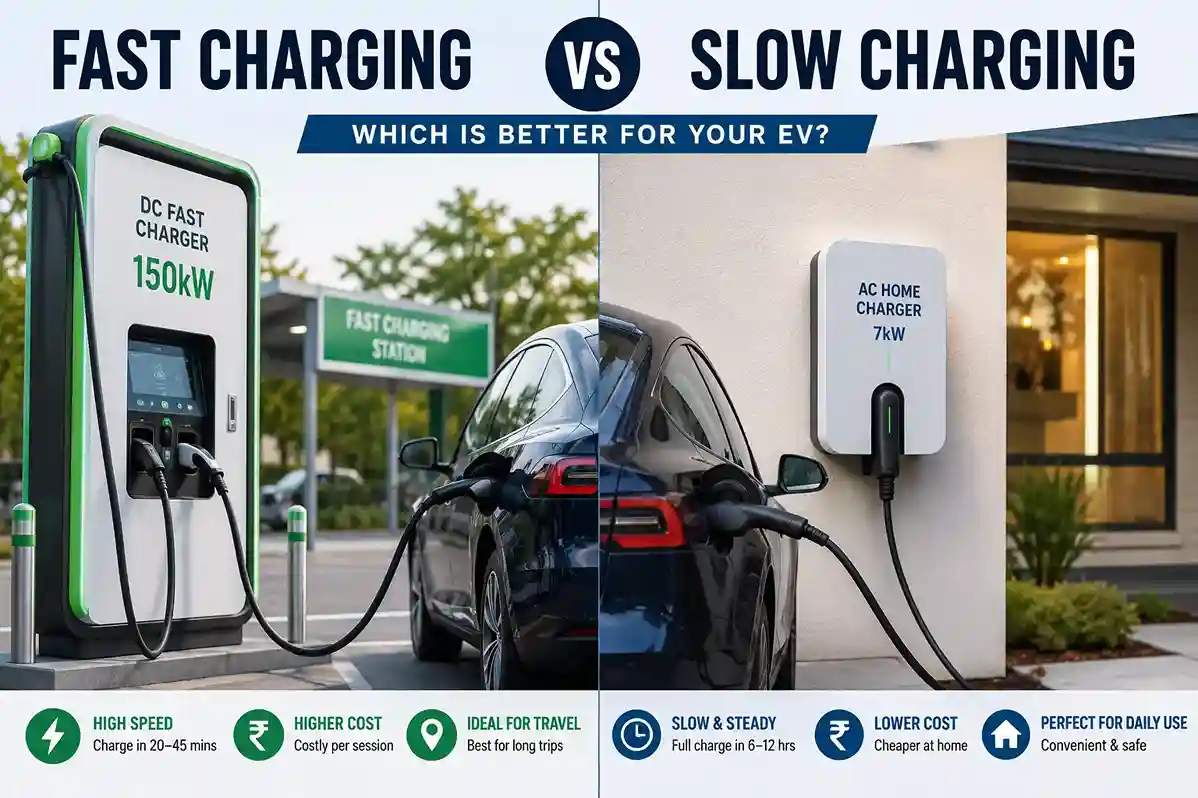
Slow charging typically refers to AC (Alternating Current) charging using home chargers or standard wall-mounted charging units.
Typical charging power ranges include:
- 2.3 kW
- 3.3 kW
- 7.2 kW
- 11 kW
- 22 kW (supported by some vehicles)
Most EV owners use slow charging overnight because it provides sufficient charging time without interrupting daily routines.
How Slow Charging Works
When using an AC charger:
- Electricity flows from the charger to the vehicle.
- The vehicle’s onboard charger converts AC power into DC power.
- The battery stores the energy.
Because the onboard charger limits charging speed, charging takes several hours.
What Is Fast Charging?
Fast charging generally refers to DC (Direct Current) charging, which bypasses the vehicle’s onboard charger.
Instead, the charging station supplies DC electricity directly to the battery.
Common DC fast charging speeds include:
- 30 kW
- 50 kW
- 60 kW
- 120 kW
- 150 kW
- 250 kW or higher (supported by select vehicles)
Many modern EVs can charge from 20% to 80% in approximately 20–45 minutes, depending on battery size and charger capacity.
Fast Charging vs Slow Charging EV: Key Differences
| Feature | Slow Charging | Fast Charging |
|---|---|---|
| Current Type | AC | DC |
| Charging Speed | Slower | Much Faster |
| Typical Use | Home Charging | Highways & Public Stations |
| Installation Cost | Lower | Higher |
| Convenience | Overnight | Quick Top-Ups |
| Battery Stress | Lower | Higher |
| Cost Per Session | Usually Lower | Often Higher |
Understanding these differences helps drivers choose the right charging method for different situations.
Advantages of Slow Charging
Better for Daily Charging
Slow charging works well for drivers who leave their vehicle parked overnight.
For example, charging an EV at home while sleeping often provides enough range for the next day’s commute.
Lower Charging Costs
Home electricity rates are generally lower than public DC fast charging prices.
This makes slow charging more economical over time.
Less Heat Generation
Charging at lower power generates less heat inside the battery.
Battery temperature plays an important role in long-term battery performance.
Drivers interested in battery longevity should also read our guide on EV Battery Life in India, which explains how charging habits affect battery degradation.
Convenient Home Charging
Many owners appreciate the convenience of charging their vehicle overnight without visiting a charging station.
Advantages of Fast Charging
Saves Time
The biggest advantage is speed.
Instead of waiting several hours, many EVs can recover hundreds of kilometers of driving range in less than an hour.
Ideal for Long-Distance Travel
Highway charging stations allow drivers to continue longer journeys without extended stops.
In real-world situations, fast charging becomes particularly valuable during road trips.
Emergency Charging
Fast charging is useful when unexpected travel leaves little time for overnight charging.
Expanding Charging Infrastructure
Public charging networks continue to expand throughout India.
The Bureau of Energy Efficiency (BEE) provides information related to electric mobility and energy-efficient transportation initiatives.
External Reference:
Does Fast Charging Damage EV Batteries?
This is one of the biggest misconceptions about electric vehicles.
Modern EVs include advanced Battery Management Systems (BMS) that regulate:
- Charging speed
- Battery temperature
- Voltage
- Current
These systems help protect battery health during charging.
However, frequent DC fast charging may contribute to slightly faster battery degradation compared to regular AC charging over many years.
Battery management technology continues improving with each generation of EVs.
The International Energy Agency (IEA) notes that advances in battery chemistry and thermal management continue improving battery durability.
External Reference:
Which Charging Method Is Better for Daily Use?
For most owners, slow charging remains the preferred daily charging method.
Reasons include:
- Lower cost
- Convenience
- Reduced battery stress
- Overnight charging
- Home availability
Fast charging works best as a supplement rather than a replacement for home charging.
Factors That Affect Charging Speed
Charging speed depends on more than the charger itself.
Important factors include:
Battery Size
Larger batteries generally require more time to charge fully.
State of Charge
Charging slows significantly as batteries approach full capacity.
Most fast chargers deliver maximum power between approximately 20% and 80%.
Battery Temperature
Extreme heat or cold may reduce charging speed to protect battery health.
Vehicle Charging Capability
Some EVs support only 50 kW charging, while others can accept more than 150 kW.
Using a higher-powered charger does not necessarily increase charging speed if the vehicle cannot accept additional power.
Charging Costs
Charging costs vary depending on:
- Home electricity tariff
- Public charging provider
- Fast charger pricing
- Time of day
- State electricity regulations
If you’re comparing overall EV ownership costs, our article on EV Charging Cost vs Petrol Cost Per KM in India 2026 explains how charging expenses compare with conventional fuel costs.
The Ministry of Power, Government of India publishes policies and updates related to EV charging infrastructure.
External Reference:
Disadvantages of Fast Charging
Although DC fast charging offers excellent convenience, it isn’t the perfect solution for every situation.
Higher Charging Costs
Public DC fast chargers generally cost more per charging session than home charging.
Frequent use can noticeably increase the running cost of an electric vehicle.
Limited Availability
While India’s charging infrastructure continues to grow, fast chargers are still less common than conventional fuel stations, particularly in smaller towns and rural areas.
Planning longer journeys remains important.
Slightly Higher Battery Stress
Fast charging generates more heat than AC charging.
Modern Battery Management Systems (BMS) are designed to protect the battery, but repeated DC fast charging over many years may contribute to slightly faster battery degradation compared to regular slow charging.
Disadvantages of Slow Charging
Slow charging also has limitations.
Longer Charging Time
The biggest disadvantage is convenience.
A full charge may require anywhere from 6 to 12 hours depending on battery capacity and charger output.
Not Ideal for Emergency Charging
If you suddenly need to travel a long distance, overnight charging may not provide sufficient range.
Home Installation Costs
Installing a dedicated home charging unit may require:
- Professional installation
- Electrical upgrades
- Dedicated wiring
- Safety inspections
Although this is usually a one-time expense, it should be considered when purchasing an EV.
Fast Charging vs Slow Charging EV: Which One Should You Choose?
The best option depends on your driving habits.
Choose Slow Charging If You:
- Drive mainly within the city.
- Have access to home charging.
- Charge overnight.
- Want lower charging costs.
- Prioritize long-term battery care.
Choose Fast Charging If You:
- Frequently travel long distances.
- Need quick charging during road trips.
- Have limited time between journeys.
- Depend on public charging infrastructure.
For many EV owners, the ideal approach is to use slow charging for everyday driving and fast charging only when necessary.
Common EV Charging Mistakes
Many first-time EV owners unintentionally reduce charging efficiency through poor charging habits.
Charging to 100% Every Day
Unless recommended by the manufacturer or required for long-distance travel, keeping the battery between approximately 20% and 80% for daily use is often considered beneficial for long-term battery health.
Always follow the recommendations in your vehicle owner’s manual.
Frequently Using Fast Charging Without Need
Fast charging is convenient, but relying on it every day may increase charging costs and expose the battery to more heat cycles.
Ignoring Battery Temperature
Charging immediately after aggressive driving or during extremely hot weather may temporarily reduce charging speed as the battery management system regulates temperature.
Using Damaged Charging Equipment
Always inspect charging cables and connectors for damage before use.
Faulty charging equipment can affect charging performance and safety.
Ignoring Software Updates
Manufacturers regularly release software updates that improve charging efficiency and battery management.
Keeping your EV software up to date can enhance overall charging performance.
Best Practices for EV Charging
To maximize battery life and charging efficiency:
- Use home AC charging for routine daily charging.
- Reserve DC fast charging primarily for long trips.
- Follow the manufacturer’s recommended charging limits.
- Keep charging ports clean and protected.
- Park in shaded areas during extremely hot weather whenever possible.
- Install certified home charging equipment.
- Schedule regular vehicle servicing.
- Monitor battery health using the vehicle’s information system.
Drivers who follow these practices often experience better long-term battery performance and more predictable charging times.
If you’re planning to purchase an EV, our guide on Electric vs Petrol Cars in India 2026 can help you compare ownership costs and everyday usability.
Does Charging Speed Affect Battery Warranty?
Most manufacturers design their batteries to support both AC and DC charging.
Battery warranties generally remain valid regardless of charging method, provided the vehicle is used according to the manufacturer’s guidelines.
Always review your warranty documentation for any model-specific conditions.
Information about EV charging standards and infrastructure is available through the Bureau of Indian Standards (BIS) and other government agencies responsible for technical standards.
External Reference:
Frequently Asked Questions
Is fast charging safe for EV batteries?
Yes. Modern electric vehicles use advanced Battery Management Systems (BMS) that monitor temperature, voltage, and current to help protect the battery during charging.
Does slow charging improve battery life?
Regular AC charging generally generates less heat than DC fast charging and is commonly recommended for everyday charging. Following the manufacturer’s charging recommendations remains the most important factor.
Can I use fast charging every day?
You can, but many manufacturers recommend using fast charging primarily when needed and relying on home AC charging for routine daily charging.
Which charging method is cheaper?
Home slow charging is usually less expensive than public DC fast charging, although costs vary by electricity tariff and charging provider.
Which charging method is better for long trips?
Fast charging is the preferred option because it significantly reduces charging time during highway travel.
Can every EV use fast charging?
No. Charging capability depends on the vehicle. Some models support only AC charging or lower DC charging speeds, while others can accept much higher charging power.
Conclusion
Understanding Fast Charging vs Slow Charging EV helps owners choose the most suitable charging method for their driving habits and long-term ownership goals. Fast charging offers exceptional convenience for road trips and urgent charging needs, while slow charging remains the preferred choice for everyday use because it is generally more economical and well-suited to overnight charging.
Rather than viewing one option as universally better, most EV owners benefit from using both strategically—slow charging at home for routine driving and fast charging during long journeys or when time is limited.
By following manufacturer recommendations, using appropriate charging equipment, and adopting good charging habits, you can maximize battery performance, improve charging efficiency, and enjoy a reliable electric vehicle ownership experience for years to come. Ultimately, understanding Fast Charging vs Slow Charging EV enables you to make informed decisions that balance convenience, cost, and long-term battery health.
Author: Carsinfos Editorial Team
Published: June 28th, 2026