
When people compare EVs and petrol cars, the sticker price grabs attention first. The number that matters long after delivery day is the EV Charging Cost vs Petrol Cost Per KM in India 2026. That is the real ownership question: how much does the car cost every time you drive one kilometre? India’s official petrol-price data shows that prices still vary by city and state, and PPAC’s Delhi retail price table showed petrol at ₹94.77/litre in early 2026, while IOCL said retail prices remained unchanged on 1 May 2026. On the EV side, NITI Aayog’s e-AMRIT portal says home electricity for charging ranges from ₹4/kWh to ₹11.82/kWh depending on state and tariff category, so the answer is not one fixed number.
That is why this comparison is more useful than a simple “EV is cheaper” headline. The savings depend on where you live, whether you charge at home, how efficient your car is, and how much you drive on highways versus in the city. If you are already comparing Electric vs Petrol Cars in India 2026 or trying to understand Petrol vs Hybrid Cars: Which Saves More Money in India?, this article gives you the per-kilometre math that sits underneath those bigger buying decisions.
EV Charging Cost vs Petrol Cost Per KM in India 2026: the simple formula
The formula is straightforward. For petrol, divide fuel price per litre by your car’s mileage in km/l. For EVs, multiply electricity cost per kWh by the energy used per kilometre. NITI Aayog’s e-AMRIT journey-cost tools are built around the same idea: compare charging cost, petrol or diesel cost, and total savings over a trip.
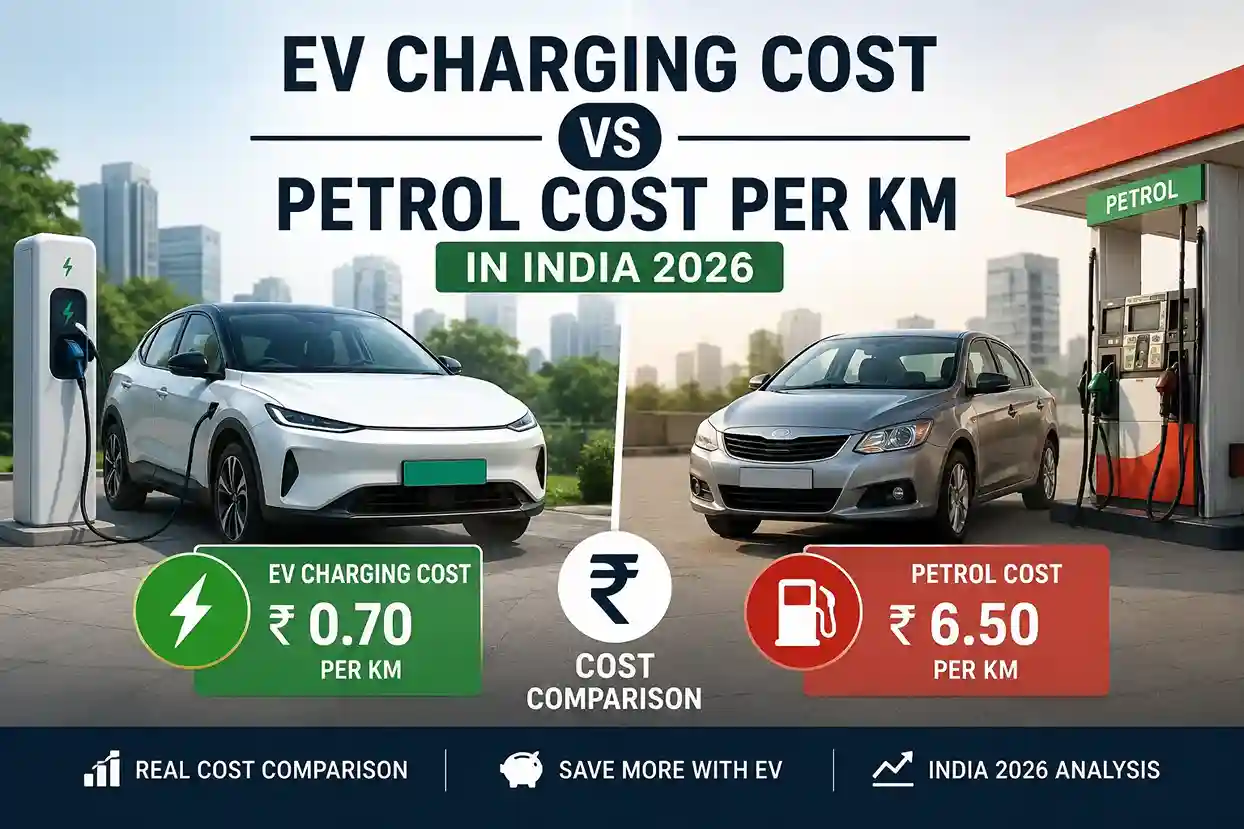
To keep the comparison practical, let us use the Delhi petrol reference price of ₹94.77/litre from PPAC and calculate three common petrol-mileage examples. At that price, a car that returns 15 km/l costs about ₹6.32/km, 20 km/l costs about ₹4.74/km, and 25 km/l costs about ₹3.79/km. That means even a fairly efficient petrol car still spends several rupees per kilometre before maintenance or depreciation are added.
What EV home charging looks like in real numbers
For home charging, e-AMRIT says Indian home electricity costs can range from ₹4/kWh to ₹11.82/kWh. If you use a simple example EV that consumes 15 kWh per 100 km, the cost works out to about ₹0.60/km at the low tariff and ₹1.77/km at the high tariff. If the car uses 18 kWh per 100 km, the cost is roughly ₹0.72/km to ₹2.13/km. Those are still well below the petrol examples above, even before you factor in that many EV owners charge part of the time at home and part of the time elsewhere.
In real-world situations, this is why people with home chargers often feel the biggest savings immediately. A daily 40-km commute that costs around ₹190 in a 20 km/l petrol car would cost far less in a home-charged EV running at a typical 15 kWh/100 km example. If you are still deciding whether that ownership style suits you, Best Electric Cars Under 15 Lakh in India 2026 is a good next step because the per-km advantage only matters if the car itself fits your usage.
Why home charging usually wins
The biggest advantage of EVs is not just that electricity is cheaper than petrol; it is that home charging is predictable. e-AMRIT’s tools explicitly ask whether charging happens at home or at a public place, and the portal explains that tariffs differ by state and that electricity for public EV charging stations is governed through state-set service charges and regulatory rules. In other words, there is no single national “EV charging price” the way many people imagine.
That distinction matters because home charging is usually the cheapest part of EV ownership, while public charging can be more variable. e-AMRIT’s public-charging calculator asks users to input their own cost per kWh rather than giving one universal public tariff, which is a strong clue that real-world charging prices are location-dependent. So if you have home charging, the cost-per-km gap versus petrol is usually widest; if you rely mainly on public chargers, the gap narrows.
When petrol can still make sense
Petrol cars still make sense if you do not have a reliable place to charge at home, if your apartment parking is not EV-ready, or if you drive long distances where charging stops would be inconvenient. The per-km math also changes when you compare petrol against hybrids rather than only against EVs. That is why Hybrid vs Electric Cars in India 2026 and Petrol vs Hybrid Cars: Which Saves More Money in India? are useful companion reads for buyers who want lower running costs but are not ready to go fully electric.
If you mostly drive on highways, a petrol car with good mileage can still be a sensible compromise. For example, at ₹94.77/litre, a 25 km/l car costs about ₹3.79/km, which is higher than a home-charged EV example but still lower than many less efficient petrol vehicles. That is why cost-per-km is not only about fuel type; it is also about the specific car you choose. If your driving style is mileage-focused, How to Improve Car Mileage in India is worth reading alongside the price comparison.
Common mistakes buyers make
One common mistake is comparing an EV’s city efficiency with a petrol SUV’s highway efficiency and calling that a fair test. Another is assuming all EV charging costs are the same. e-AMRIT clearly says electricity tariffs vary by state, and its public charging tool requires the user to enter the real local price. A third mistake is forgetting that the whole ownership picture matters: charging access, daily mileage, route mix, and the vehicle type itself all shape the final per-kilometre cost.
Another mistake is ignoring the purchase category entirely and focusing only on running costs. A compact EV and a large petrol SUV may have very different costs to own, but they also solve very different problems. If you are still at the shortlist stage, Best Electric Cars Under 15 Lakh in India 2026 and Best Cars for Long Drives in India 2026 help separate “cheap to run” from “right for my life.”
Best practices before you decide
The smartest way to compare EV charging cost vs petrol cost per km is to use your own driving pattern. Check your monthly kilometres, your actual home tariff, and the sort of mileage your petrol car would realistically return in your traffic. Then compare that to a realistic EV consumption figure, not just the brochure range. e-AMRIT’s tools exist for exactly this kind of personalized calculation, and the portal’s guidance makes it clear that home and public charging should be evaluated separately.
If you already know your charging access will be good, the EV side becomes much easier to justify. If you are still undecided, it helps to compare the running-cost math against the practical fit of the vehicle class. That is why articles like Electric vs Petrol Cars in India 2026 and Why Your Car Mileage Is Decreasing Suddenly are useful together: one helps you choose the powertrain, and the other helps you avoid misreading the numbers later.
FAQ
Is EV charging always cheaper than petrol in India?
At home, usually yes. Using e-AMRIT’s home tariff range of ₹4–₹11.82/kWh and a typical EV consumption example of 15–18 kWh/100 km, the cost works out to roughly ₹0.60–₹2.13/km, which is generally below petrol examples at current prices. But public charging can narrow the gap because tariffs are state-dependent and vary by charger location.
What petrol mileage should I use for comparison?
Use your real-world mileage, not the brochure figure. At a Delhi petrol price of ₹94.77/litre, the cost per km changes sharply with mileage: ₹6.32/km at 15 km/l, ₹4.74/km at 20 km/l, and ₹3.79/km at 25 km/l.
Does public charging remove the EV cost advantage?
Not completely, but it can reduce it. e-AMRIT’s public-charging calculator asks for the user’s own tariff input, and the official charging guidance says state governments set service charges, which means public charging is not one fixed national price.
Should I choose a hybrid instead if I cannot charge at home?
A hybrid can be a smart middle ground when home charging is not convenient. That is why it is worth comparing with Best Hybrid Cars Under 20 Lakh in India and Petrol vs Hybrid Cars: Which Saves More Money in India?.
Conclusion
The cleanest summary of EV Charging Cost vs Petrol Cost Per KM in India 2026 is this: if you can charge at home, EVs usually win very clearly on running cost. Using current official reference points, a petrol car at ₹94.77/litre costs about ₹3.79–₹6.32/km at 25–15 km/l, while a home-charged EV example at 15–18 kWh/100 km and ₹4–₹11.82/kWh costs about ₹0.60–₹2.13/km. That is a big gap, and it is why e-AMRIT’s calculators are built around total savings and journey cost rather than just sticker price.
For most buyers, the deciding factor is not whether EVs are cheaper in theory; it is whether your real-life charging setup lets you capture that saving in practice. If you are still comparing broader ownership choices, Electric vs Petrol Cars in India 2026 and Petrol vs Hybrid Cars: Which Saves More Money in India? are the two best places to go next.
Author: Carsinfos Editorial Team
Published: May 29th, 2026