
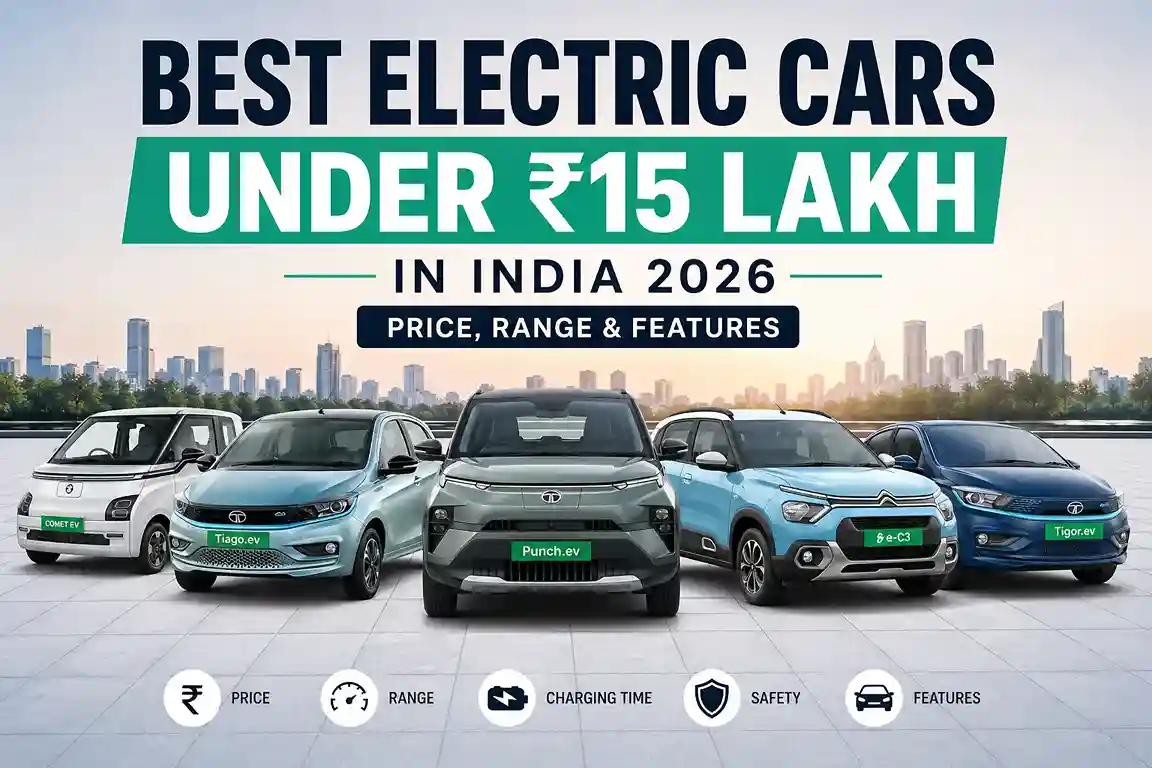
Electric cars in India have moved well beyond “future technology” and become a practical choice for daily driving. Today, buyers looking for the best electric cars under ₹15 lakh in India can choose from compact city EVs, hatchbacks, sedans, and compact SUV-style options that cover real-world needs like office commutes, school runs, and weekend city travel. For readers already comparing budget car categories, CarsInfos also has strong related coverage on cars under ₹10 lakh, best cars under ₹15 lakh, and the broader electric cars section, which makes this topic a natural fit for the site’s current content structure.
The good news is that this segment is no longer limited to one type of buyer. Some EVs now work well for tight urban traffic, some suit families who want more space and a smoother ride, and some offer premium features without crossing the ₹15 lakh mark. In the current CarsInfos content map, the site already covers EVs, hatchbacks, sedans, SUVs, and hybrid choices, so this article builds directly on that cluster and keeps the internal linking pattern consistent with existing guides like best SUVs under ₹10 lakh, best SUVs under ₹15 lakh, best family cars under ₹10 lakh, and best hybrid cars under ₹20 lakh.
Best Electric Cars Under ₹15 Lakh in India 2026
1) Tata Punch EV
The Tata Punch EV is one of the strongest all-round choices in this budget because it combines SUV-like stance, daily usability, and a practical charging/range package. Tata’s official page lists the Punch EV starting at ₹9.69 lakh, with a 40 kWh battery and an ARAI range of 468 km, which is a very attractive figure for buyers who want an EV that can handle office use during the week and occasional outstation travel with less range anxiety. Tata also highlights 20–80% fast charging in 26 minutes, which matters a lot in real ownership because time saved at a charger often matters more than brochure numbers.
For a buyer who wants one car for mixed use, this is easy to recommend. It fits city families, young professionals, and first-time EV owners who want something elevated but still priced sensibly. If you are already reading around compact SUV options, this model also connects neatly with the site’s SUV coverage, including the best SUVs under ₹10 lakh guide, because it sits right between the budget-crossover world and the newer EV market.
2) Tata Tiago EV
The Tata Tiago EV remains one of the easiest EV recommendations for buyers who care most about affordability and low-stress ownership. Tata’s official pricing page shows the Tiago EV starting at ₹7.99 lakh, and Tata’s product page says it offers up to 293 km of range. That makes it a strong fit for people whose daily driving is mostly urban, predictable, and relatively short. It is not trying to be the biggest EV on the road; it is trying to be the simplest one to live with.
In practical terms, this is the kind of EV that makes sense for a daily office commute, grocery runs, campus use, and second-car duty in a family garage. If a reader is comparing petrol hatchbacks with an EV entry point, the Tiago EV often becomes the natural bridge because it lives in the same budget conversation as cars covered in the site’s best cars under ₹10 lakh and best cars under ₹5 lakh categories, but adds electric running cost advantages.
3) MG Comet EV
The MG Comet EV is the most urban-focused model on this list, and that is exactly why many buyers will like it. MG’s official page shows pricing starting at ₹4.99 lakh, a 17.3 kWh battery, a 230 km range, and a 4-seater layout. It is designed for compact city life, easy parking, and short daily travel rather than high-speed touring. MG also highlights a 4.2 m turning radius, which is a genuine advantage in crowded Indian city traffic, tight apartment basements, and narrow parking spaces.
This is the right choice for users who want the lowest possible entry cost into EV ownership and do not need a large cabin. Real-world examples are simple: a college commute, a city office route, a small family’s second car, or a local business vehicle for frequent intra-city movement. For readers who still want to stay under a modest budget rather than move up to larger EVs, this model sits well beside the site’s lower-budget guides such as best cars under ₹7 lakh and best cars under ₹10 lakh.
4) Citroën ë-C3
The Citroën ë-C3 is a very interesting option for buyers who want a roomier, more comfort-oriented EV without entering premium-price territory. Citroën’s official India page lists it from ₹12.13 lakh and says the model offers a 320 km ARAI range. The same page also highlights fast charging from 10% to 80% in 57 minutes on the DC fast charger setup, which gives it a more practical long-trip profile than many people expect from a sub-₹15 lakh EV.
What makes the ë-C3 stand out is that it feels like a comfort-first city car for real families rather than a bare-bones electric commuter. It suits buyers who want a quieter cabin, good space, and the confidence of a mainstream brand EV without stretching into upper-budget territory. For readers comparing it with other family-friendly cars, the model naturally sits between the site’s budget SUV content and its broader best family cars under ₹10 lakh angle, even though its exact price sits above that older bracket.
5) Tata Tigor EV
The Tata Tigor EV is a smart pick for buyers who still like the classic sedan body style and want a practical EV that feels familiar. Tata’s official EV pages show the Tigor EV starting at ₹12.49 lakh, and Tata describes it as an electric sedan with up to 315 km of range. That combination makes it especially appealing to buyers who want an efficient family car with a traditional boot, a more settled highway stance than a small hatchback, and the convenience of automatic EV driving.
This is a strong choice for users who still prefer sedans over compact SUVs, especially in cities where a lower, more car-like driving position feels easier than a taller crossover. It also fits neatly into the site’s existing price-bucket ecosystem, because readers who have looked at the best cars under ₹15 lakh guide can now narrow down to an EV sedan without losing the budget discipline.
6) MG Windsor EV
The MG Windsor EV deserves attention because it brings a more premium-feeling cabin and a strong spec sheet while still starting below ₹15 lakh in its standard pricing structure. MG’s official page lists the Windsor EV Excite from ₹14,09,800, with 6 airbags, a 10.1-inch infotainment display, wireless Android Auto and Apple CarPlay, and an electric parking brake. MG’s newsroom also says the model offers a 38 kWh battery with 332 km of range, while the PRO version reaches 449 km, and it notes a BaaS starting price of ₹9.99 lakh plus a per-km battery rental model.
This car is a good fit for buyers who want a more upscale daily EV and are comfortable comparing standard purchase pricing with MG’s battery-rental approach. In real-world use, it is a compelling choice for urban families who value comfort, tech, and a calm drive over outright performance. It also pairs well with the site’s broader premium-budget content, such as the best cars under ₹20 lakh and best hybrid cars under ₹20 lakh pages, because it sits right at the edge of the higher-value EV conversation.
Which electric car under ₹15 lakh is best for different buyers?
If the priority is balanced value, the Tata Punch EV is the safest recommendation because it has the strongest mix of price, range, fast charging, and SUV-like practicality. If the priority is the lowest entry cost, the MG Comet EV is hard to ignore. If the priority is maximum budget EV value for a hatchback buyer, the Tata Tiago EV is the most straightforward answer. If the buyer wants a sedan, the Tata Tigor EV is the natural pick. If the buyer wants comfort and a more premium cabin feel, the Citroën ë-C3 and MG Windsor EV become the most interesting options.
For a buyer deciding between EV and non-EV, the decision usually comes down to usage pattern. If the car will mostly do urban work and home charging is possible, an EV under ₹15 lakh becomes a sensible purchase instead of a novelty buy. If the buyer is still comparing against conventional fuel cars, the site’s best cars under ₹15 lakh and best SUVs under ₹15 lakh guides are useful comparison points because they show what else the same money can buy today.
Buying tips before choosing the best electric car under ₹15 lakh
The smartest way to choose is to start with your real driving pattern. A buyer with 20–40 km of daily use and reliable home charging can comfortably look at compact EVs like the Tiago EV or Comet EV. A buyer who wants more space, higher road presence, and less range anxiety should focus on the Punch EV or the ë-C3. A buyer who wants sedan practicality should consider the Tigor EV, while a comfort-first shopper who likes premium features should study the Windsor EV carefully, especially because of its BaaS pricing structure.
It also helps to compare charging access, not just battery size. A model with slightly lower range but easy home charging can be more useful than a bigger-range car that feels inconvenient to refill in daily life. That is why the best electric cars under ₹15 lakh in India are not all “the same kind of car”; they are different answers for different usage patterns, which is exactly what makes this budget band so interesting in 2026.
Frequently Asked Questions
Which is the best electric car under ₹15 lakh in India?
For most buyers, the Tata Punch EV is the best overall electric car under ₹15 lakh because it offers a strong mix of price, range, fast charging, and SUV-style practicality. If the buyer wants the cheapest entry, the MG Comet EV is the easiest to recommend.
Which electric car under ₹15 lakh has the best range?
Among the models covered here, Tata’s official Punch EV page highlights 468 km ARAI range, while MG’s Windsor EV newsroom page states 449 km for the PRO variant. That makes them the strongest range-focused options in this list, though the right choice still depends on budget and usage.
Is the MG Comet EV good for family use?
It can work well as a compact city car for a small household, but it is a 4-seater and is best suited to short urban trips rather than long family highway journeys. That makes it more ideal as a second car or a city-only EV.
Is the Tata Tigor EV better than the Tiago EV?
The Tata Tigor EV is better if you want a sedan body style and a more traditional family-car feel, while the Tiago EV is better if you want a lower starting price and a hatchback format. Both are practical, but they serve slightly different needs.
Is the Citroën ë-C3 worth buying in 2026?
Yes, it can be a very good choice for buyers who want a roomy, comfort-focused EV with a 320 km ARAI range and fast charging support. It is especially attractive for families that want a practical city EV with a more spacious feel.
Should I consider the MG Windsor EV under ₹15 lakh?
Yes, especially if you want more premium features and are comfortable evaluating both outright purchase pricing and MG’s BaaS model. The standard Excite variant starts at ₹14,09,800, while MG also offers lower upfront pricing through the battery-rental structure.
Final verdict
If you want the best overall electric car under ₹15 lakh in India, the Tata Punch EV is the most complete recommendation for 2026. If your budget is tighter, the MG Comet EV and Tata Tiago EV are the best entry points. If you want a sedan, the Tata Tigor EV is the right fit. If you want comfort and more premium appeal, the Citroën ë-C3 and MG Windsor EV are the strongest alternatives.
Author: Carsinfos Editorial Team
Published: April 27th, 2026