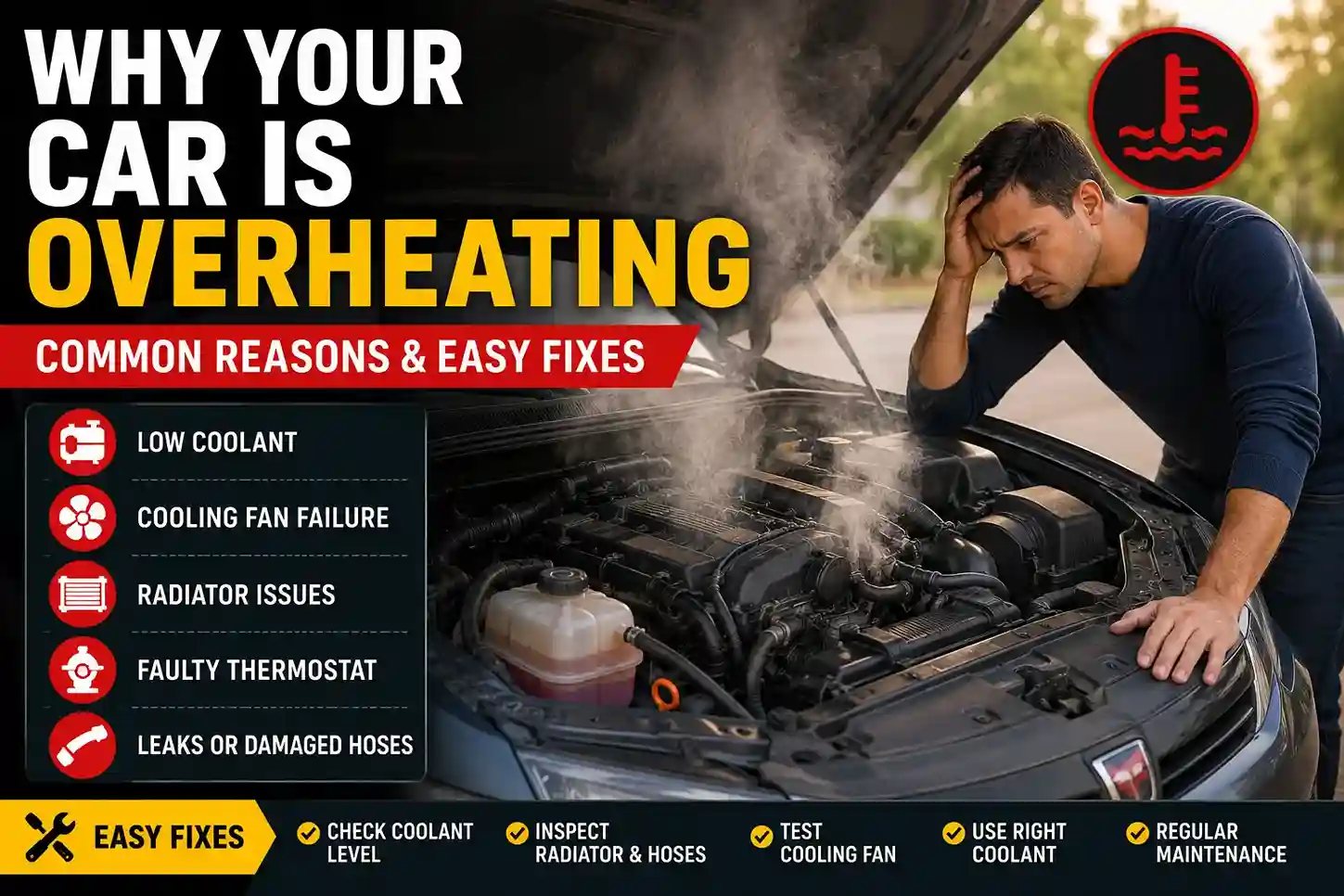
If Why Your Car Is Overheating: Common Reasons & Easy Fixes is the problem you are dealing with right now, the first thing to know is that you should not keep driving casually and hope it goes away. Modern owner manuals are very clear on this point: if the temperature warning appears, pull over safely, let the engine cool, and do not open the radiator cap while the engine is hot. Honda’s overheating guidance and Toyota’s overheating instructions both warn that continuing to drive can damage the engine, and both advise turning off the vehicle safely and checking the cooling system only after it has cooled down. If your dashboard also shows other alerts, it is worth reading Car Dashboard Warning Lights Explained so you can tell the difference between a temperature warning and another unrelated issue.
Why Your Car Is Overheating: the most common causes
The most common cause is low coolant, usually because of a leak somewhere in the system. Honda and Subaru both say that once the engine has cooled, the coolant level should be checked and the cooling system inspected for leaks. Toyota’s manual also tells drivers to visually check the radiator, hoses, coolant filler cap, radiator cap, drain cock, and water pump when overheating is suspected. That is a useful reminder that overheating is often not “one broken thing,” but a chain of cooling-system problems that starts small and becomes serious if ignored. If you already keep an eye on routine maintenance, the same habit that helps with Check Car Engine Coolant Level at Home in India will help you catch the issue earlier.
Another common cause is a cooling fan that is not working properly. Honda’s overheating instructions specifically tell drivers to check whether the cooling fan is operating, and Subaru’s manual says that if the fan is not turning, the engine should be switched off and checked by a dealer. On some cars, especially in slow traffic or on hot days, a failed fan makes overheating show up first while idling rather than at speed. That is why a car that overheats only in traffic is still telling you something serious about the cooling system.
A third possibility is a clogged radiator, worn hoses, weak radiator cap, or water pump problem. Toyota’s owner manuals explicitly tell drivers to inspect the radiator, hoses, coolant cap, radiator cap, drain cock, and water pump after an overheating episode. That list matters because each of those parts plays a different role: the radiator sheds heat, hoses move coolant, the cap maintains pressure, and the water pump circulates fluid. When one of them fails, the temperature climbs much faster than many drivers expect. Routine care such as How Often Should You Change Engine Oil in India also matters here, because neglected maintenance often goes hand in hand with neglected cooling-system checks.
What to do immediately when the temperature rises
The safest first move is to pull over, switch on the hazard lights, and stop driving as soon as it is safe. Honda’s guide says to park in a safe place, turn off accessories, and either keep the engine running or shut it off depending on whether steam is present. Toyota’s guidance similarly says to stop the vehicle in a safe place and turn off the air conditioning system before stopping the engine. Subaru’s manuals also recommend moving to a safe location and avoiding further strain on the engine. In practice, this means the car is telling you to stop treating the overheating warning as a minor annoyance.
If there is steam or spray, do not open the hood immediately and definitely do not open the radiator cap. Honda warns that steam from an overheated engine can scald you badly and that opening the cap while hot can spray boiling coolant outward. Toyota and Subaru also caution against opening hot cooling-system parts too early. This is one of the most important safety rules in car maintenance: a hot cooling system is pressurized, and that pressure is exactly why the liquid can erupt when the cap is removed.
Easy fixes you can try after the engine cools
Once the engine has cooled enough to work safely, start with the coolant level. Honda says to inspect the reserve tank and top up to the MAX mark if the level is low. Subaru’s manuals also instruct drivers to check the reserve tank once the engine is fully cooled and add coolant if it is below the LOW mark. If there is no coolant in the reserve tank, the next step is a proper inspection for leaks or a visit to a workshop. If you want a practical step-by-step refresher, keep Check Car Engine Coolant Level at Home in India open while you inspect the reservoir.
After that, look for obvious leaks or damaged hoses. Toyota’s manuals explicitly mention the radiator, hoses, coolant filler cap, drain cock, and water pump because those are common inspection points after overheating. A loose clamp, cracked hose, or damaged cap can cause coolant loss even if the engine looked fine a week earlier. If the car has been showing other signs of stress such as a weak battery warning or erratic electrical behavior, it is also worth reading Signs Your Car Battery Is Weak because an electric cooling fan depends on healthy electrical supply in many vehicles.
It also helps to think about how the car has been driven recently. Subaru notes that in hot weather and uphill driving, the air conditioner may turn off automatically to protect the engine from overheating, and it advises switching off the A/C and stopping at a safe place if the temperature gauge approaches the overheat zone. That is a useful reminder for Indian driving conditions, where long climbs, summer heat, and slow traffic can all raise thermal load. If the AC has also been underperforming, Car AC Not Cooling Common Reasons Easy Fixes can help you separate an AC problem from an engine cooling problem.
Common mistakes that make overheating worse
One mistake is trying to “nurse” the car home after the warning appears. Honda’s manual explicitly warns that continuing to drive with the overheat message can damage the engine. Another mistake is opening the radiator cap too early. It is a dangerous habit because the system may still be hot and pressurized. A third mistake is pouring water randomly into the system and assuming that counts as a fix; Honda says water should be treated as an emergency measure only, and the system should be flushed with the proper antifreeze afterward.
Another common mistake is ignoring the role of routine maintenance. Overheating often shows up after months of small neglect rather than one dramatic failure. If coolant service, oil changes, and inspection intervals have been skipped, the cooling system is more likely to fail under stress. That is why articles like How to Improve Car Mileage in India and Why Your Car Mileage Is Decreasing Suddenly can be useful reading: they often reveal the same maintenance habits that affect heat management as well as fuel economy.
When the car should go straight to a workshop
Some overheating issues are not DIY problems. If the cooling fan does not run, if the coolant disappears repeatedly, if the warning returns after topping up, or if you see signs of a coolant leak, the car needs a proper repair. Honda says to contact a dealer if the warning reappears after the engine has cooled. Toyota and Subaru also stress checking the system for leaks and damaged components rather than continuing to drive. In real-world situations, repeated overheating is often a sign of a failing radiator cap, thermostat, water pump, hose, fan motor, or a deeper engine issue that needs proper diagnosis.
If the overheating starts during long traffic jams or on hot days, it is also smart to pay attention to other symptoms at the same time. A rough idle, slipping accessory drive, or reduced electrical load can point to a broader mechanical issue. That is one reason regular checks around tire condition, engine loading, and heat stress are helpful; even a guide like How to Check Car Tyre Pressure at Home in India matters because underinflated tyres create extra drag and make the car work harder than it should.
FAQ
Why does my car overheat only in traffic?
That often points to a cooling fan issue or poor airflow through the radiator. Honda and Subaru both emphasize checking fan operation first because the fan becomes especially important when the car is moving slowly or idling.
Can I drive if the temperature warning comes on for a short time?
It is safer not to. Honda says continuing to drive with the overheat warning may damage the engine, and Toyota tells drivers to stop in a safe place and switch off the A/C.
Should I open the radiator cap to check the coolant?
No, not while the engine is hot. Honda and Toyota both warn that opening a hot radiator cap can release boiling coolant and steam. Wait until the system has cooled fully first.
Is topping up water enough?
Only as a temporary emergency step. Honda says water can be used only as a short-term measure and the system should later be flushed and filled with the proper coolant mixture.
Conclusion
The answer to Why Your Car Is Overheating: Common Reasons & Easy Fixes usually comes down to a cooling-system fault that should be taken seriously, not guessed at. Low coolant, leaking hoses, a weak cap, a dead fan, or a radiator or water-pump issue can all push temperatures upward quickly. The safest response is always the same: stop in a safe place, let the engine cool, avoid opening hot cooling parts, and inspect the coolant system only when it is safe to do so. Honda, Toyota, and Subaru all give the same core advice because overheating can damage the engine and can also injure you if handled carelessly. If you want to keep the rest of the car in good shape while you diagnose the heat problem, reading How to Check Car Brake Pads at Home in India and How to Check Car Tyre Pressure at Home in India is a good next step, because good maintenance habits usually prevent more than one problem at a time.
Author: Carsinfos Editorial Team
Published: May 24th, 2026