
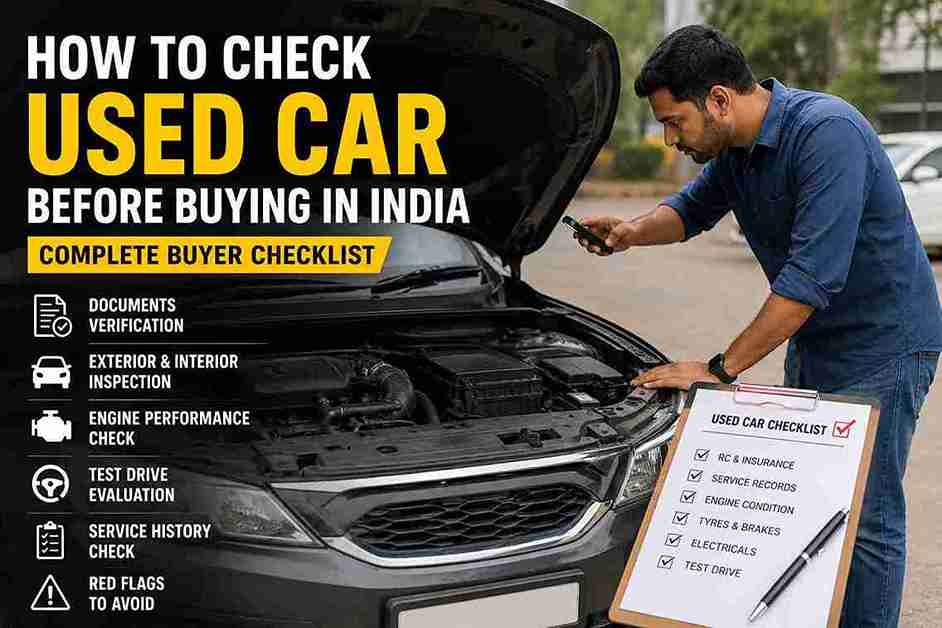
Buying a used car can be a smart decision, but only if you inspect it carefully before money changes hands. The best deals are not always the cheapest cars on the listing; they are the cars with clean paperwork, honest history, and no hidden repair bills waiting in the background. That is why a proper How to Check Used Car Before Buying in India checklist matters so much. A used car should be judged on condition, documentation, service history, and real-world drivability, not just on how shiny it looks in photos. If you are already comparing ownership costs and everyday maintenance topics like How Often Should You Change Engine Oil in India or How to Improve Car Mileage in India, the same practical mindset will help you avoid a bad used-car purchase. Consumer Reports also recommends a detailed inspection and, when possible, an experienced mechanic’s review before you commit.
How to Check Used Car Before Buying in India: Start with Paperwork First
The first mistake many buyers make is checking the car first and the documents later. In a used-car deal, paperwork comes before emotions. Ask for the Registration Certificate, insurance policy, Pollution Under Control certificate, service history, and any loan closure proof if the car was financed. In India, vehicle ownership transfer is handled through the Parivahan/VAHAN system, and the portal clearly lists transfer of ownership as one of its core services. VAHAN also notes that transfer of ownership applications are initiated by the seller using the TO option before the buyer continues the process.
A clean RC should match the chassis number, engine number, registration number, and seller identity. If any of those details look inconsistent, pause immediately. In real-world situations, a “great deal” can turn into a legal headache if the seller is not the registered owner or if the ownership chain is not clear. That is one reason a used car should be approached as carefully as a long-term ownership decision, not a quick bargain hunt. Articles like Signs Your Car Battery Is Weak and Car Dashboard Warning Lights Explained are useful later, but the first filter is always legal and documentary clarity.
Check the car’s identity and recall status
Once the documents look clean, verify the car’s identity. Match the VIN/chassis number on the car with the RC and the seller’s paperwork. This sounds basic, but it prevents trouble with swapped panels, duplicate records, or unclear ownership. It is also smart to check whether the vehicle has any outstanding recalls. NHTSA’s recalls page lets you check by VIN or by make and model, and it shows whether a vehicle needs recall repairs. That kind of check is valuable because a hidden safety issue is not something you want to discover after purchase.
If the seller hesitates when you ask for the VIN, that is a red flag. A legitimate seller should be comfortable with identity verification. For example, a good seller will let you inspect the car’s identification plates, service invoices, insurance history, and registration record without delay. If they do not, walk away.
Inspect the exterior carefully
Do a slow walk-around in daylight, not in a basement parking lot at night. You are looking for mismatched paint, uneven panel gaps, repair marks, rust, cracked lamps, damaged glass, and signs of accident repairs. Consumer Reports recommends looking for scratches, dents, mismatched panels, and paint defects during used-car pickup inspection, and that same logic applies before you buy.
Check the tyres too, because they often reveal how the car has been driven and maintained. Uneven tyre wear can point to poor alignment, suspension trouble, or neglected tyre rotation. NHTSA’s tire guidance says to inspect tread, sidewalls, cuts, punctures, bulges, and age, and to check your spare as well. If you already read How to Check Car Tyre Pressure at Home in India, use the same habit here: tyres tell you a lot about ownership quality.
Look inside the cabin like a buyer, not a passenger
Sit in every seat. Test every switch. Open and close all windows. Check the AC, infotainment, horn, indicators, central locking, wipers, sun visors, seat adjusters, and interior lights. A used car may look perfect outside and still have a dozen annoying faults inside. Make sure seat belts retract properly and that dashboard warning lights come on and then disappear during ignition. If you want a deeper understanding of what those warning lights mean, keep Car Dashboard Warning Lights Explained open in another tab while you inspect.
Also check for damp smells, water stains, and carpet moisture. Those can point to leaks, flood exposure, or poor sealing. In real-world situations, water damage is one of the most expensive hidden problems because it often affects electronics, wiring, and interior materials long after the sale.
Open the bonnet and inspect the engine bay
You do not need to be a mechanic to spot obvious issues. Look for oil seepage, coolant stains, disconnected hoses, corrosion on terminals, loose wiring, and poorly fitted aftermarket parts. Check engine oil level and condition, coolant level, brake fluid, and battery condition. If the car has not been serviced regularly, you may also notice dirty fluid reservoirs or neglected components. Consumer Reports’ maintenance guidance highlights routine items such as oil changes, coolant service, brake pads, and tire rotation as essential ownership basics, and a neglected engine bay often reflects neglected maintenance overall.
This is also a good moment to compare the seller’s service records with mileage and age. A car that claims to be well maintained should have a believable paper trail. If the service book is missing, or the mileage jumps around in the invoices, treat that seriously. Buyers who already care about maintenance topics like How Often Should You Change Engine Oil in India usually spot these patterns faster.
Take a proper test drive
Never buy a used car without driving it yourself. A test drive should include slow traffic, a few turns, braking, acceleration, and if possible a short open-road stretch. Listen for suspension knocks, wheel vibration, brake squeal, clutch slip, steering pull, engine hesitation, and gearbox roughness. Consumer Reports advises buyers to use a structured inspection approach before buying, and the test drive is where many hidden defects reveal themselves.
Pay attention to the following:
- Does the engine start quickly when cold?
- Does the idle feel smooth?
- Does the steering return naturally after a turn?
- Do the brakes feel firm or spongy?
- Does the car drift to one side?
- Does the gearbox shift cleanly?
If the seller refuses a proper drive or keeps interrupting it, that is not a good sign. A healthy car should not need excuses.
Check service history and wear items
A used car is only as good as its maintenance history. Ask for invoices, service-center records, oil-change dates, brake work, tyre replacements, battery changes, and any accident repairs. If the car has been serviced on schedule, that should be easy to prove. If the seller gives only vague verbal promises, assume the car has not been cared for as well as claimed.
This is also where practical ownership thinking matters. A car with a clean history but worn tyres, weak battery, or overdue fluids can still be a poor deal unless the price reflects the needed repairs. Related articles like Why Your Car Mileage Is Decreasing Suddenly and How to Improve Car Mileage in India are useful reminders that maintenance affects both reliability and running costs.
Common mistakes buyers make
The most common mistake is falling in love with the car too early. Shiny paint, low mileage claims, and a friendly seller can hide a lot. Another mistake is skipping a mechanic inspection because “the car looks fine.” Consumer Reports repeatedly recommends a detailed inspection process, and that advice is especially valuable with used cars where hidden damage is common.
Other mistakes include:
- ignoring tyre age and wear,
- forgetting recall checks,
- trusting only the odometer reading,
- buying without a written sale agreement,
- and not confirming RC transfer steps in advance.
If the car will be used by family members, think beyond the purchase itself. A safer, cleaner, better-maintained used car is often a better choice than a newer-looking one with unknown history. That is the same mindset behind choosing practical cars in guides like Best Family Cars Under 10 Lakh in India.
Best practices before you pay
The best practice is simple: verify everything in daylight, on paper, and through a test drive. Use a checklist, not memory. Bring a trusted mechanic if the car is expensive or if anything feels off. Check the VIN, confirm the seller’s name, verify service history, inspect tyres, test every feature, and review recall status before paying any booking amount.
Then handle the ownership transfer properly. Parivahan/VAHAN is the official route for transfer of ownership in India, and its services are designed for exactly this process. If the seller says transfer can be “done later,” treat that as a warning. Ownership should be resolved cleanly and promptly.
FAQ
What is the most important thing to check in a used car?
The most important things are paperwork, accident history, engine condition, tyres, and a proper test drive. A clean-looking car with bad documents is still a bad deal.
Should I always take a mechanic for used car inspection?
Yes, if the car is expensive or if you are unsure. Consumer Reports recommends a detailed inspection, and a mechanic can spot accident repair, worn suspension parts, and hidden leaks more reliably than most buyers.
Can I check recall status before buying a used car?
Yes. NHTSA’s recall tool lets you check by VIN or by vehicle details so you can see whether the car has any outstanding recall repairs.
Is RC transfer necessary immediately after buying?
Yes. The ownership transfer should be handled through the official Parivahan/VAHAN process rather than delayed informally. VAHAN’s own guidance makes transfer of ownership part of the core vehicle service flow.
Conclusion
A good used car is not just the one with the lowest price; it is the one with clean documents, honest history, healthy mechanicals, and no surprise repairs waiting after purchase. If you follow a structured How to Check Used Car Before Buying in India process, you reduce risk and improve the odds of getting real value for your money. Start with paperwork, verify identity, inspect the body and tyres, check the engine bay, take a proper test drive, and confirm the ownership transfer path before paying. That careful approach is what separates a smart used-car purchase from an expensive mistake. For more ownership basics, it also helps to keep guides like How to Check Car Brake Pads at Home in India and Signs Your Car Battery Is Weak close by, because the best buyers think beyond the sale and plan for the whole ownership journey.
Author: Carsinfos Editorial Team
Published: May 22nd, 2026