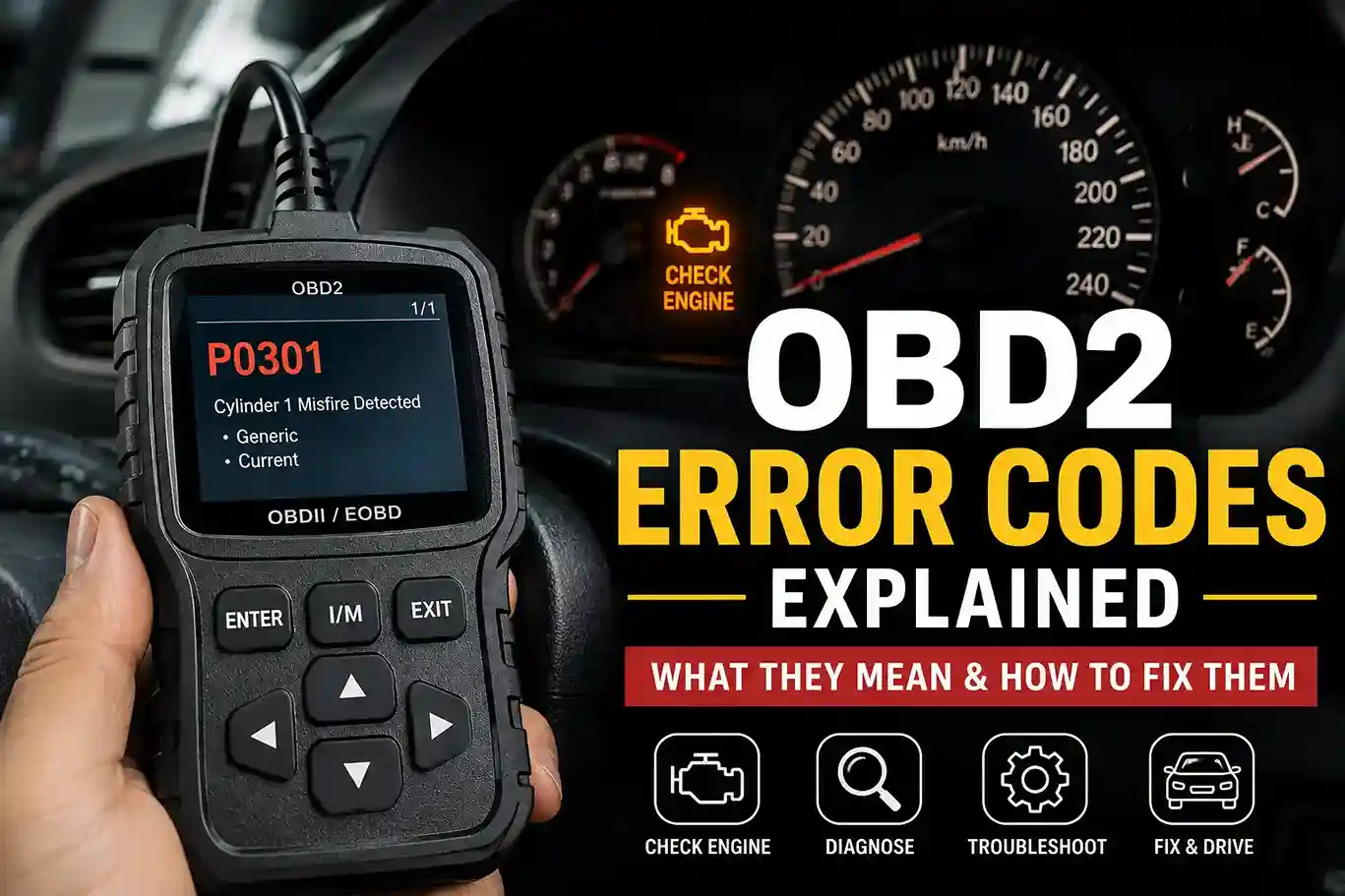
Few dashboard warnings create as much anxiety for drivers as the check engine light. It can appear without warning, sometimes when the vehicle seems to be running perfectly fine. This is where understanding OBD2 Error Codes Explained becomes incredibly useful. Instead of guessing what’s wrong with your vehicle, OBD2 codes provide valuable clues that help identify potential issues before they become expensive repairs.
Modern vehicles are equipped with onboard diagnostic systems that continuously monitor engine performance, emissions, sensors, and critical components. When the system detects a problem, it generates a specific trouble code that technicians and vehicle owners can read using an OBD2 scanner.
Whether you’re troubleshooting a check engine light, considering buying a scanner, or simply want to better understand your vehicle, learning how OBD2 error codes work can save time, money, and unnecessary stress. If you’re already interested in understanding vehicle maintenance through guides like Check Engine Light Explained and Alternator Failure Symptoms, understanding OBD2 diagnostics is the next logical step.
What Is OBD2?
OBD2 stands for On-Board Diagnostics II, a standardized vehicle diagnostic system used in most modern vehicles.
The system became mandatory for many passenger vehicles and allows technicians to access information from a vehicle’s electronic control modules. According to the U.S. Environmental Protection Agency’s OBD requirements overview, OBD systems help monitor emissions-related components and identify malfunctions.
In simple terms, OBD2 acts as your vehicle’s self-monitoring system.
When something isn’t operating correctly, the system records a diagnostic trouble code (DTC) and may illuminate the check engine light.
Why OBD2 Error Codes Matter
Many vehicle problems start small.
For example:
- A loose fuel cap
- An aging oxygen sensor
- A misfiring spark plug
- A weak battery connection
Initially, these issues may not cause noticeable symptoms. However, the vehicle’s computer can often detect abnormalities before drivers notice any performance changes.
In real-world situations, identifying a problem early can prevent more expensive repairs later.
That’s why understanding OBD2 codes can be valuable even for non-mechanical vehicle owners.
How OBD2 Error Codes Are Structured
Every OBD2 code follows a standard format:
Example: P0301
The code contains five characters:
First Character
The first letter identifies the system.
- P = Powertrain (engine and transmission)
- B = Body
- C = Chassis
- U = Network and communication systems
Second Character
The second digit identifies whether the code is generic or manufacturer-specific.
- 0 = Generic code
- 1 = Manufacturer-specific code
Third Character
This digit identifies the subsystem involved.
Examples include:
- Fuel system
- Ignition system
- Emissions system
Fourth and Fifth Characters
These digits identify the specific fault.
Understanding this structure helps drivers better interpret scanner results instead of viewing them as random numbers.
How to Read OBD2 Error Codes
Reading OBD2 codes is easier than many people realize.
You’ll need:
- An OBD2 scanner
- A Bluetooth OBD adapter
- A smartphone diagnostic app
Most vehicles manufactured in recent decades have an OBD2 port located beneath the dashboard.
Once connected:
- Turn the ignition on.
- Connect the scanner.
- Read stored trouble codes.
- Research code descriptions.
- Diagnose the root cause.
The National Highway Traffic Safety Administration (NHTSA) recommends addressing warning lights promptly rather than ignoring them.
Common OBD2 Error Codes Explained
P0300 – Random or Multiple Cylinder Misfire
This is one of the most common OBD2 codes.
Possible causes include:
- Worn spark plugs
- Faulty ignition coils
- Fuel delivery problems
- Vacuum leaks
Symptoms may include:
- Rough idling
- Poor acceleration
- Reduced fuel economy
For a deeper understanding of ignition-related issues, see our guide on Engine Misfire Causes.
P0301 to P0308 – Cylinder-Specific Misfires
These codes identify which cylinder is misfiring.
Examples:
- P0301 = Cylinder 1 misfire
- P0302 = Cylinder 2 misfire
- P0303 = Cylinder 3 misfire
These codes help technicians narrow down the diagnosis more quickly.
P0420 – Catalyst System Efficiency Below Threshold
This code typically relates to the catalytic converter.
Potential causes include:
- Failing catalytic converter
- Faulty oxygen sensors
- Exhaust leaks
In real-world situations, many vehicle owners mistakenly replace oxygen sensors first when the catalytic converter is actually failing.
P0171 – System Too Lean
A lean condition means the engine is receiving too much air or too little fuel.
Possible causes:
- Vacuum leaks
- Dirty mass airflow sensor
- Weak fuel pump
- Clogged fuel injectors
Fuel delivery issues can eventually affect performance and emissions.
P0455 – Large EVAP Leak Detected
One surprisingly common cause is:
- Loose fuel cap
Other possibilities include:
- Damaged EVAP hoses
- Faulty purge valves
The U.S. EPA’s evaporative emissions information explains how EVAP systems help reduce fuel vapor emissions.
P0135 – Oxygen Sensor Heater Circuit Malfunction
Oxygen sensors help manage fuel-air mixtures.
When sensor heaters fail:
- Fuel economy may decrease
- Emissions may increase
- Check engine light remains illuminated
P0500 – Vehicle Speed Sensor Malfunction
This code may affect:
- Speedometer operation
- Transmission shifting
- Cruise control functionality
Speed sensor failures often create multiple secondary symptoms.
P0700 – Transmission Control System Malfunction
This code indicates a transmission-related fault has been stored.
Further diagnosis is usually required because P0700 serves as a general transmission warning.
What Happens When You Ignore OBD2 Codes?
Many drivers continue driving for weeks or months after a warning light appears.
This can be risky.
Ignoring codes may lead to:
- Reduced fuel economy
- Increased emissions
- Engine damage
- Catalytic converter failure
- Expensive repairs
For example, unresolved misfires can eventually damage catalytic converters, resulting in significantly higher repair costs.
Common Mistakes Drivers Make
Assuming the Code Identifies the Failed Part
This is perhaps the most common misunderstanding.
A code indicates where the system detected a problem—not necessarily which component failed.
For example:
A P0171 lean condition may result from:
- Vacuum leaks
- Fuel delivery issues
- Sensor inaccuracies
Replacing parts without proper diagnosis often wastes money.
Clearing Codes Without Repairs
Some drivers clear codes hoping the problem disappears.
While the warning light may temporarily turn off, the underlying issue usually remains.
Ignoring Intermittent Codes
Even occasional warning lights deserve attention.
Intermittent faults can indicate developing problems.
Buying Parts Based Solely on Online Searches
Every vehicle’s symptoms and operating conditions differ.
A professional diagnosis may prevent unnecessary replacements.
Best Practices for Diagnosing OBD2 Codes
Record All Codes
Before clearing anything:
- Save codes
- Take screenshots
- Record freeze-frame data
This information helps identify the root cause.
Check for Technical Service Bulletins
Manufacturers often publish repair information and known issues.
The NHTSA Technical Service Bulletin database can provide useful information about recurring vehicle problems.
Inspect Simple Items First
Before replacing expensive parts, inspect:
- Fuel cap
- Battery terminals
- Vacuum hoses
- Electrical connectors
Sometimes the solution is surprisingly simple.
Address Problems Promptly
Early intervention often reduces repair costs.
This principle also applies to routine maintenance items discussed in our Brake Fluid Change Guide and Monsoon Car Care Tips.
Can You Fix OBD2 Issues Yourself?
Some issues are DIY-friendly.
Examples include:
- Loose fuel caps
- Dirty air filters
- Weak battery connections
- Minor sensor replacements
However, more advanced problems involving:
- Transmission systems
- Engine timing
- Emissions systems
- Electronic control modules
often require professional diagnosis.
Knowing your limits can prevent accidental damage.
OBD2 Scanners: Are They Worth Buying?
For many vehicle owners, yes.
Basic scanners can:
- Read codes
- Clear codes
- Display vehicle data
More advanced scanners offer:
- Live sensor readings
- Battery monitoring
- Transmission diagnostics
- ABS diagnostics
For drivers who regularly maintain their own vehicles, an OBD2 scanner can quickly pay for itself.
OBD2 and Preventive Maintenance
One overlooked benefit of OBD2 diagnostics is preventive maintenance.
Many faults appear before noticeable symptoms develop.
For example:
- Oxygen sensor degradation
- Fuel trim abnormalities
- Sensor response issues
Early detection can help owners avoid larger failures.
This is particularly useful for high-mileage vehicles where proactive maintenance becomes increasingly important.
Frequently Asked Questions
What does OBD2 stand for?
OBD2 stands for On-Board Diagnostics II, a standardized vehicle diagnostic system that monitors engine and emissions performance.
Can I drive with an OBD2 error code?
It depends on the code. Some issues are minor, while others can cause engine damage if ignored.
Does every check engine light require immediate repair?
Not always, but every warning light should be investigated promptly.
Can an OBD2 scanner tell me exactly what’s broken?
No. OBD2 codes identify affected systems and symptoms, but further diagnosis is often required.
Are OBD2 scanners universal?
Most scanners work with vehicles that support OBD2 standards, though advanced features vary by manufacturer.
Can clearing a code fix the problem?
No. Clearing a code only removes the stored warning. The underlying issue must still be repaired.
Conclusion
Understanding OBD2 Error Codes Explained gives vehicle owners valuable insight into how modern cars monitor and report problems. While diagnostic codes do not always pinpoint the exact failed component, they provide a critical starting point for troubleshooting and repairs.
Whether you’re dealing with a check engine light, investigating performance issues, or simply learning more about vehicle maintenance, OBD2 diagnostics can help you make informed decisions. By reading codes early, avoiding common diagnostic mistakes, and addressing issues promptly, drivers can often reduce repair costs and improve long-term vehicle reliability.
The next time a warning light appears, don’t panic. With a basic scanner and a better understanding of OBD2 Error Codes Explained, you’ll be far better equipped to understand what your vehicle is trying to tell you.
Author: Carsinfos Editorial Team
Published: Aug 13th, 2026