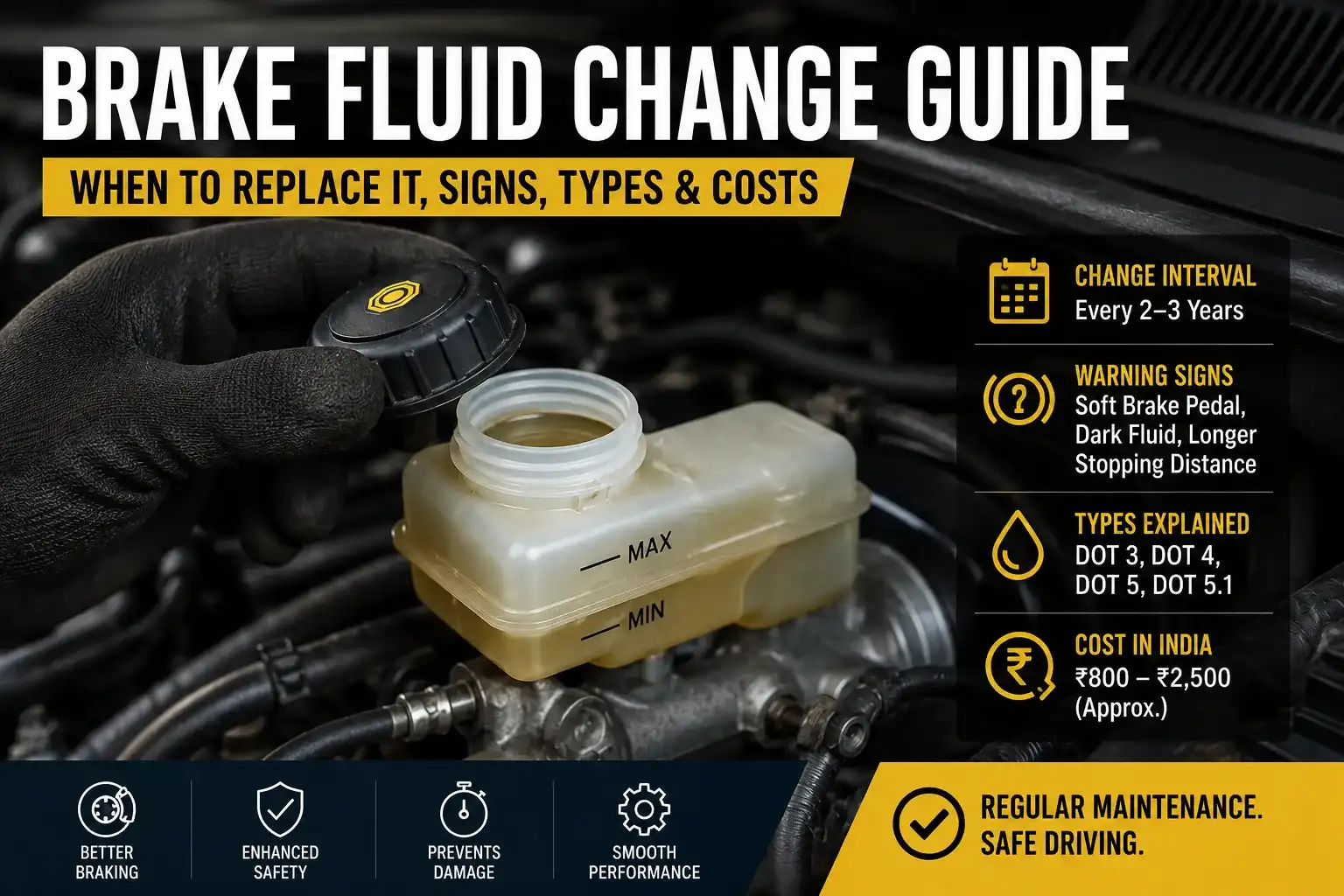
Brake Fluid Change Guide is one of the most important maintenance topics every vehicle owner should understand. While many drivers remember to replace engine oil or rotate their tyres, brake fluid often goes unnoticed—even though it plays a critical role in stopping your vehicle safely.
Unlike engine oil, brake fluid doesn’t lubricate moving parts. Instead, it transfers hydraulic pressure from the brake pedal to the braking system. Over time, however, brake fluid absorbs moisture from the air, reducing its effectiveness and increasing the risk of poor braking performance.
In real-world situations, many drivers only discover brake fluid problems when the brake pedal feels soft or stopping distances increase. By then, moisture contamination may already be affecting the braking system.
If you’ve recently noticed dashboard warning symbols, our guide on Car Dashboard Warning Lights Explained can help you understand whether a brake-related warning requires immediate attention.
Quick Answer
Brake fluid should generally be replaced every 2–3 years or according to your vehicle manufacturer’s maintenance schedule. Because brake fluid naturally absorbs moisture over time, delaying replacement can reduce braking performance, increase corrosion inside the braking system, and potentially compromise safety. Regular brake fluid changes help maintain consistent braking pressure and extend the life of important brake components.
According to the National Highway Traffic Safety Administration (NHTSA), properly maintained braking systems are essential for safe vehicle operation and should be inspected regularly.
Table of Contents
- What Is Brake Fluid?
- Why Brake Fluid Is Important
- How Brake Fluid Works
- When Should You Change Brake Fluid?
- Warning Signs of Old Brake Fluid
- Types of Brake Fluid
- Brake Fluid Change Process
- Costs
- FAQs
What Is Brake Fluid?
Brake fluid is a specially formulated hydraulic fluid that transfers the force from your foot pressing the brake pedal into pressure that activates the brake calipers or wheel cylinders.
Unlike engine oil or coolant, brake fluid works inside a sealed hydraulic system.
When you press the brake pedal:
- Hydraulic pressure builds inside the master cylinder.
- Brake fluid carries that pressure through brake lines.
- Brake calipers squeeze the brake pads against the brake discs.
- The vehicle slows safely.
Without properly functioning brake fluid, even perfectly good brake pads and discs cannot stop the vehicle effectively.
Why Is Brake Fluid So Important?
Modern braking systems depend entirely on hydraulic pressure.
Brake fluid offers several important functions:
- Transfers braking force instantly.
- Lubricates internal hydraulic components.
- Prevents corrosion inside brake lines.
- Maintains braking performance under high temperatures.
- Helps operate ABS and Electronic Stability Control systems.
For example, during emergency braking on a highway, brake temperatures can rise dramatically. High-quality brake fluid resists boiling, helping maintain consistent braking performance.
The Brake Safety Information from the U.S. Department of Transportation explains why regular brake system maintenance is an important part of vehicle safety.
How Does Brake Fluid Work?
Brake fluid operates using hydraulic pressure.
Here’s a simplified explanation:
- You press the brake pedal.
- The master cylinder compresses the brake fluid.
- Pressure travels through sealed brake lines.
- Brake calipers clamp the brake pads.
- Friction slows the wheels.
One important characteristic of brake fluid is that it is nearly incompressible. This allows braking force to be transmitted almost instantly from the pedal to the wheels.
However, moisture contamination changes this behaviour.
As brake fluid absorbs water over time, its boiling point decreases. Under heavy braking, tiny steam bubbles may form inside the hydraulic system, making the brake pedal feel soft or spongy.
When Should You Change Brake Fluid?
Most manufacturers recommend replacing brake fluid every:
- Every 2 years
- Every 30,000–40,000 km
- Or according to the owner’s manual
However, replacement intervals depend on:
- Driving conditions
- Climate
- Vehicle type
- Brake system design
- Manufacturer recommendations
In real-world situations, vehicles driven frequently in heavy city traffic or mountainous regions may require brake fluid replacement sooner because repeated braking generates more heat.
If you’re already following a preventive maintenance schedule, our guide on Check Engine Light Explained also highlights why regular inspections help prevent larger mechanical problems.
Signs Your Brake Fluid Needs Changing
Brake fluid rarely fails suddenly.
Instead, it gradually loses effectiveness over time.
Common warning signs include:
1. Soft or Spongy Brake Pedal
One of the earliest symptoms is a brake pedal that feels softer than usual.
This may indicate moisture contamination or air inside the hydraulic system.
2. Longer Stopping Distance
If your vehicle takes noticeably longer to stop, deteriorated brake fluid could be contributing to reduced braking efficiency.
Of course, worn brake pads, tyres, or suspension components can also affect stopping performance.
3. Dark or Dirty Brake Fluid
Fresh brake fluid is usually:
- Clear
- Light yellow
- Slightly amber
Old brake fluid often becomes:
- Dark brown
- Dirty
- Cloudy
Dark fluid usually indicates contamination and oxidation.
4. Brake Warning Light
Some vehicles illuminate the brake warning light when hydraulic pressure drops or brake fluid levels become low.
If your dashboard displays a warning symbol, consult our article on Car Dashboard Warning Lights Explained to understand whether immediate attention is required.
5. Burning Smell During Heavy Braking
During repeated hard braking, contaminated brake fluid may begin to boil.
Although unusual, drivers may notice:
- Reduced braking performance
- Brake fade
- Burning smell
- Soft brake pedal
The Bosch Brake System Guide explains how excessive heat affects hydraulic braking performance and why quality brake fluid is essential.
Different Types of Brake Fluid
Choosing the correct brake fluid is just as important as changing it on time.
Using the wrong type can damage seals and reduce braking performance.
| Type | Base | Typical Dry Boiling Point | Common Applications |
|---|---|---|---|
| DOT 3 | Glycol-based | ~205°C | Older passenger cars |
| DOT 4 | Glycol-based | ~230°C | Most modern vehicles |
| DOT 5 | Silicone-based | ~260°C | Military and specialty vehicles |
| DOT 5.1 | Glycol-based | ~270°C | High-performance and ABS-equipped vehicles |
DOT 3
- Lower boiling point
- Suitable for older vehicles
- More affordable
DOT 4
The most common brake fluid used in modern passenger vehicles.
Advantages include:
- Higher boiling point
- Better heat resistance
- Widely recommended for ABS-equipped cars
DOT 5
Unlike DOT 3 and DOT 4, DOT 5 is silicone-based.
It does not absorb moisture but should never be mixed with glycol-based brake fluids.
DOT 5.1
Designed for high-performance braking systems.
Offers:
- Excellent heat resistance
- Fast hydraulic response
- Compatibility with most modern ABS systems
Before selecting any brake fluid, always check your owner’s manual. The SAE International publishes technical standards used throughout the automotive industry for braking and hydraulic systems.
If you’ve also experienced unusual steering vibration or handling issues while braking, our guide on Wheel Bearing Noise Symptoms explains another common cause that can sometimes be mistaken for brake-related problems.
How Is Brake Fluid Changed?
Changing brake fluid involves removing old, moisture-contaminated fluid and replacing it with fresh fluid while eliminating any trapped air from the braking system. This process is commonly known as a brake fluid flush or brake bleeding.
Although the exact procedure varies between vehicle manufacturers, the basic steps are similar.
Step 1: Inspect the Brake Fluid Reservoir
The technician first checks:
- Brake fluid level
- Fluid colour
- Signs of contamination
- Reservoir condition
Dark or cloudy fluid usually indicates it’s time for replacement.
Step 2: Remove Old Brake Fluid
Special brake bleeding equipment or a vacuum pump removes the old hydraulic fluid from the braking system.
Fresh brake fluid is continuously added to prevent air from entering the system.
Step 3: Bleed Each Brake Caliper
Brake fluid is replaced wheel by wheel.
Typically, technicians follow the sequence recommended by the manufacturer to ensure all old fluid is removed.
Step 4: Refill with Fresh Brake Fluid
Only the brake fluid specification recommended by the manufacturer (DOT 3, DOT 4, or DOT 5.1) should be used.
Mixing incompatible brake fluids can damage seals and reduce braking performance.
Step 5: Test the Brake Pedal
Once bleeding is complete, the technician checks:
- Brake pedal firmness
- Brake fluid level
- Leaks
- ABS operation (if applicable)
A short road test confirms that braking performance has returned to normal.
Can You Change Brake Fluid Yourself?
Technically, yes—but it isn’t recommended for beginners.
Unlike changing engine oil, brake fluid replacement directly affects one of the vehicle’s most important safety systems.
DIY brake fluid replacement requires:
- Correct brake fluid specification
- Brake bleeding equipment
- Safety precautions
- Knowledge of the hydraulic system
- Proper disposal of used brake fluid
For example, if air enters the brake lines during the process, the brake pedal may feel soft, reducing stopping performance.
For most drivers, having brake fluid changed by a qualified technician is the safest option.
Brake Fluid Change Cost in India
The total cost depends on the vehicle, workshop, brake fluid specification, and whether additional brake system repairs are needed.
| Service | Estimated Cost (India) |
|---|---|
| Brake Fluid Inspection | ₹200–₹500 |
| Brake Fluid Replacement | ₹800–₹2,500 |
| Brake Fluid Flush (ABS Vehicles) | ₹1,500–₹4,000 |
| Premium DOT 5.1 Fluid | ₹2,000–₹5,000 |
Prices are approximate and may vary depending on the vehicle brand, city, and service centre.
Replacing brake fluid on time is usually far less expensive than repairing damaged calipers, ABS components, or brake master cylinders caused by neglected maintenance.
Common Mistakes Drivers Make
Ignoring Replacement Intervals
Many drivers believe brake fluid lasts for the lifetime of the vehicle.
In reality, it gradually absorbs moisture, reducing its boiling point and braking efficiency.
Using the Wrong Brake Fluid
DOT 3, DOT 4, DOT 5, and DOT 5.1 are not always interchangeable.
Always follow your owner’s manual.
Mixing Different Brake Fluids
DOT 5 (silicone-based) should never be mixed with glycol-based fluids such as DOT 3 or DOT 4.
Mixing incompatible fluids can damage seals and reduce braking performance.
Only Topping Up Old Brake Fluid
Adding fresh fluid to contaminated fluid does not remove moisture already present inside the braking system.
A complete brake fluid flush is often necessary.
Ignoring Brake Warning Signs
Drivers sometimes continue driving despite noticing:
- Soft brake pedal
- Increased stopping distance
- Brake warning light
- Burning smell after repeated braking
Delaying inspection increases safety risks.
Best Practices
To keep your braking system in excellent condition:
- Follow the manufacturer’s brake fluid replacement schedule.
- Use only the recommended DOT specification.
- Check brake fluid levels during routine servicing.
- Replace brake fluid every 2–3 years unless otherwise specified.
- Have the braking system inspected whenever brake performance changes.
- Replace worn brake pads before they damage brake discs.
If your vehicle also displays a warning light, our guide on Check Engine Light Explained explains how to respond appropriately to dashboard alerts before they become costly repairs.
Preventive Maintenance Tips
Brake fluid maintenance works best as part of a complete vehicle maintenance routine.
Good habits include:
- Inspecting brake fluid during every scheduled service.
- Avoiding prolonged storage of opened brake fluid containers, as they absorb moisture from the air.
- Checking brake hoses for leaks or cracks.
- Replacing brake pads before they wear excessively.
- Having the ABS system inspected if warning lights appear.
The Car Care Council recommends regular brake inspections as part of preventive maintenance to improve vehicle safety and reliability.
If you notice reduced braking performance together with unusual dashboard warnings, our guide on Check Engine Light Explained can help you understand whether multiple issues may require professional diagnosis.
Frequently Asked Questions
How often should brake fluid be changed?
Most manufacturers recommend replacing brake fluid every 2–3 years or every 30,000–40,000 km, although you should always follow your vehicle’s maintenance schedule.
What happens if brake fluid isn’t changed?
Old brake fluid absorbs moisture, lowering its boiling point and increasing the risk of brake fade, corrosion, and reduced braking performance.
Can I simply top up brake fluid instead of replacing it?
No. Topping up only restores the fluid level. It does not remove moisture or contaminants already present in the hydraulic system.
How do I know if my brake fluid is bad?
Common signs include:
- Dark or cloudy fluid
- Soft brake pedal
- Longer stopping distances
- Brake warning light
- Reduced braking performance
Which brake fluid should I use?
Always use the specification recommended in your owner’s manual, such as DOT 3, DOT 4, or DOT 5.1. Never substitute a different type unless approved by the manufacturer.
Is brake fluid replacement expensive?
Not usually. In India, most brake fluid replacement services cost between ₹800 and ₹2,500, depending on the vehicle and workshop.
Can moisture really damage brake fluid?
Yes. Brake fluid naturally absorbs moisture from the atmosphere over time, reducing its boiling point and increasing the likelihood of brake fade during heavy braking.
Is changing brake fluid a DIY job?
Experienced DIY enthusiasts with the correct tools may perform a brake fluid change, but because braking is a critical safety system, professional servicing is recommended for most drivers.
Key Takeaways
- Brake fluid transfers hydraulic pressure from the brake pedal to the brakes.
- Moisture contamination gradually reduces braking performance.
- Most vehicles require brake fluid replacement every 2–3 years.
- Dark brake fluid, a soft pedal, or longer stopping distances are common warning signs.
- Always use the manufacturer-recommended brake fluid specification.
- Regular brake fluid maintenance improves safety and helps protect expensive brake components.
Conclusion
Following a Brake Fluid Change Guide is one of the simplest yet most effective ways to maintain safe and reliable braking performance. Although brake fluid is often overlooked during routine maintenance, it plays a vital role in transferring braking force and protecting the hydraulic braking system.
Replacing brake fluid at the recommended interval helps maintain a firm brake pedal, prevents moisture-related corrosion, and supports consistent braking under everyday driving conditions. Whether you drive mainly in city traffic or frequently travel on highways, investing in timely brake fluid maintenance is far more affordable than repairing neglected brake components.
Combined with regular inspections of brake pads, discs, tyres, and dashboard warning lights, fresh brake fluid helps ensure your vehicle remains ready to stop safely whenever you need it.
Author: Carsinfos Editorial Team
Published: July 21st, 2026