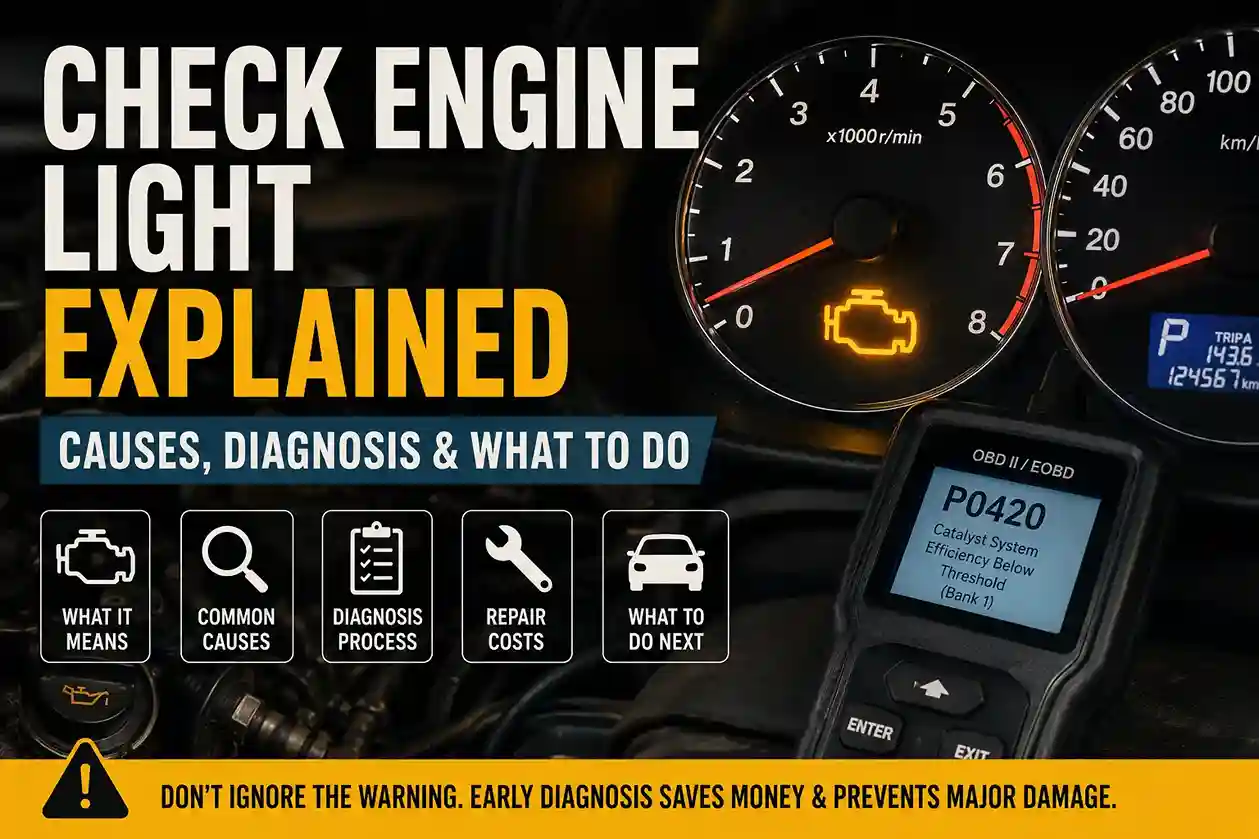
Check Engine Light Explained is one of the most common topics drivers search for after seeing an unexpected warning illuminate on their dashboard. Whether it’s a steady yellow engine symbol or a flashing warning light, this indicator is your vehicle’s way of telling you that something in the engine or emissions system requires attention.
In many cases, the problem is relatively minor, such as a loose fuel cap. In other situations, however, the warning may indicate a serious issue that could affect engine performance or even lead to expensive repairs if ignored.
In real-world situations, many drivers continue using their vehicle because it still feels normal to drive. While that may sometimes be acceptable for a short period, ignoring the warning without proper diagnosis is never a good long-term strategy.
If you’re unsure what other dashboard symbols mean, our guide on Car Dashboard Warning Lights Explained provides a detailed overview of the most common warning indicators found in modern vehicles.
Quick Answer
The check engine light indicates that your vehicle’s onboard diagnostics (OBD-II) system has detected a fault affecting the engine, emissions, ignition, fuel system, or related sensors. A steady light usually means the vehicle should be inspected soon, while a flashing light often indicates a more serious problem that requires immediate attention to help prevent engine or catalytic converter damage.
According to the National Highway Traffic Safety Administration (NHTSA), drivers should never ignore dashboard warning lights, especially when vehicle performance changes or the warning begins flashing.
Table of Contents
- What Is the Check Engine Light?
- How the Check Engine Light Works
- Steady vs Flashing Check Engine Light
- Common Causes
- Symptoms That May Accompany the Warning
- What You Should Do First
- Diagnosis
- Repair Costs
- FAQs
What Is the Check Engine Light?
The check engine light—also called the Malfunction Indicator Lamp (MIL) or Engine Management Light—is connected to your vehicle’s onboard computer.
Modern cars constantly monitor hundreds of operating conditions, including:
- Fuel delivery
- Air intake
- Ignition timing
- Exhaust emissions
- Oxygen sensors
- Engine temperature
- Catalytic converter efficiency
When the computer detects a fault outside normal operating limits, it stores a diagnostic trouble code (DTC) and illuminates the check engine light.
For example, if an oxygen sensor begins sending incorrect readings, the engine control module (ECM) may adjust the air-fuel mixture, causing the warning light to appear even before noticeable drivability problems develop.
How Does the Check Engine Light Work?
Every modern vehicle sold in India uses an OBD-II (On-Board Diagnostics II) system.
The system continuously monitors numerous sensors throughout the engine.
These include:
- Oxygen sensors
- Mass airflow sensor (MAF)
- Crankshaft position sensor
- Camshaft position sensor
- Knock sensor
- Engine coolant temperature sensor
- Evaporative emissions system
- Fuel injectors
If any monitored value falls outside acceptable limits, the ECU records an error code that technicians can retrieve using a diagnostic scanner.
The Society of Automotive Engineers (SAE International) defines many of the standardized OBD-II diagnostic codes used across manufacturers.
Steady vs Flashing Check Engine Light
Understanding whether the warning light is steady or flashing can help determine how urgently the issue should be addressed.
| Steady Check Engine Light | Flashing Check Engine Light |
|---|---|
| Fault detected | Serious fault detected |
| Usually safe for short trips | Stop driving as soon as safely possible |
| Vehicle often drives normally | Engine may misfire |
| Inspection recommended soon | Immediate diagnosis recommended |
| May affect fuel economy | Risk of catalytic converter damage |
Steady Check Engine Light
A steady light generally indicates that the vehicle has detected a fault requiring attention, but it may still be safe to drive carefully for a short period if no other symptoms are present.
Common examples include:
- Loose fuel cap
- Minor sensor failure
- EVAP system leak
- Aging oxygen sensor
However, scheduling an inspection as soon as practical is still recommended.
Flashing Check Engine Light Explained
A flashing check engine light is significantly more serious.
It often indicates an active engine misfire that allows unburned fuel to enter the exhaust system.
This can quickly overheat and damage the catalytic converter.
If the warning begins flashing:
- Reduce speed safely.
- Avoid hard acceleration.
- Pull over if the vehicle runs poorly.
- Arrange professional assistance if necessary.
If your engine is also running rough or vibrating, you may find our guide on Engine Misfire Causes: Symptoms, Diagnosis & Fixes helpful for understanding what may be happening.
Most Common Causes of the Check Engine Light
1. Loose or Damaged Fuel Cap
Surprisingly, one of the simplest causes is an improperly tightened fuel cap.
A loose cap can allow fuel vapours to escape, triggering the evaporative emissions monitoring system.
Fortunately, this is usually an inexpensive fix.
2. Faulty Oxygen Sensor
The oxygen sensor measures oxygen levels in the exhaust gases.
Incorrect readings can result in:
- Poor fuel economy
- Increased emissions
- Reduced engine performance
Ignoring a faulty sensor for too long may eventually affect the catalytic converter.
The U.S. Environmental Protection Agency (EPA) explains how emissions control systems help reduce vehicle pollution and why maintaining them is important.
3. Engine Misfire
Misfires occur when one or more cylinders fail to burn fuel correctly.
Symptoms often include:
- Rough idling
- Loss of power
- Engine shaking
- Flashing check engine light
If you’ve noticed hesitation during acceleration, our article on Why Your Car Loses Power While Accelerating may also help identify related problems.
4. Faulty Mass Airflow (MAF) Sensor
The MAF sensor measures how much air enters the engine.
Incorrect airflow readings may cause:
- Poor acceleration
- Increased fuel consumption
- Rough idle
- Hard starting
5. Catalytic Converter Problems
The catalytic converter reduces harmful exhaust emissions.
If it becomes clogged or damaged, drivers may notice:
- Reduced engine performance
- Poor acceleration
- Sulphur (“rotten egg”) smell
- Reduced fuel efficiency
Replacing a catalytic converter is usually much more expensive than fixing the original issue that caused it.
6. Spark Plug or Ignition Coil Failure
Worn spark plugs or failing ignition coils frequently trigger the check engine light.
These components are responsible for igniting the air-fuel mixture inside the engine cylinders.
When they fail, combustion becomes inefficient, leading to rough running and possible misfires.
7. Vacuum Leaks
Modern engines rely on carefully controlled airflow.
A cracked vacuum hose or intake leak can disturb this balance and trigger diagnostic trouble codes.
Symptoms That May Accompany the Check Engine Light
Depending on the underlying cause, you may also notice:
- Reduced fuel economy
- Rough idle
- Hard starting
- Poor acceleration
- Engine vibration
- Engine stalling
- Increased exhaust smoke
- Unusual engine noises
For example, if you hear knocking sounds together with the warning light, it’s worth reading Car Engine Knocking Sound: Causes and Fixes, as ignition-related problems can sometimes occur alongside engine management faults.
What Should You Do First?
Seeing the check engine light can be unsettling, but taking a calm and systematic approach is the best course of action.
Here’s what you should do:
- Check whether the light is steady or flashing.
- Pay attention to any changes in vehicle performance.
- Ensure the fuel cap is properly tightened.
- Avoid aggressive acceleration if the engine feels abnormal.
- Schedule an OBD-II diagnostic scan as soon as possible.
In real-world situations, a simple diagnostic scan often identifies the fault within minutes, helping technicians pinpoint the issue instead of relying on guesswork.
Can You Drive with the Check Engine Light On?
The answer depends on how the warning light behaves and whether the vehicle shows other symptoms.
If the Check Engine Light Is Steady
In many cases, a steady check engine light indicates a non-critical fault that still requires attention. If the vehicle drives normally without unusual noises, overheating, or a noticeable loss of power, you can often drive it cautiously for a short period while arranging an inspection.
However, delaying repairs for weeks or months can allow minor problems to become more expensive.
If the Check Engine Light Is Flashing
A flashing check engine light is much more serious.
It commonly indicates an engine misfire severe enough to send unburned fuel into the catalytic converter. Continuing to drive in this condition may damage expensive emissions components and reduce engine performance.
If the light flashes:
- Reduce speed immediately.
- Avoid hard acceleration.
- Stop driving if the engine runs roughly.
- Arrange professional assistance.
If the engine is also shaking, our guide on Engine Misfire Causes: Symptoms, Diagnosis & Fixes explains why immediate attention is important.
How Mechanics Diagnose a Check Engine Light
Professional diagnosis is much more effective than replacing parts based on guesswork.
1. Connect an OBD-II Scanner
The first step is connecting a diagnostic scanner to the vehicle’s OBD-II port.
The scanner retrieves Diagnostic Trouble Codes (DTCs), such as:
- P0300 – Random/Multiple Cylinder Misfire
- P0171 – System Too Lean
- P0420 – Catalytic Converter Efficiency Below Threshold
- P0135 – Oxygen Sensor Heater Circuit Fault
These codes provide a starting point, but they do not always identify the exact failed component.
2. Inspect Live Sensor Data
Modern diagnostic tools display live readings from:
- Oxygen sensors
- Fuel trims
- Engine coolant temperature
- Airflow readings
- Throttle position
- Ignition timing
Technicians compare these values with manufacturer specifications to identify abnormal behaviour.
3. Perform Physical Inspection
Depending on the fault code, the mechanic may inspect:
- Spark plugs
- Ignition coils
- Wiring connectors
- Vacuum hoses
- Air intake system
- Fuel injectors
- Battery voltage
For example, a damaged vacuum hose may trigger a lean mixture code without requiring replacement of any electronic sensor.
4. Confirm the Repair
After repairs are completed, technicians clear the stored codes and perform a road test to ensure the warning light does not return.
Common Check Engine Light Repair Costs in India
Repair costs vary depending on the underlying problem, vehicle model, and labour charges.
| Problem | Estimated Cost (India) |
|---|---|
| OBD-II Diagnostic Scan | ₹500–₹2,000 |
| Fuel Cap Replacement | ₹300–₹1,000 |
| Spark Plug Replacement | ₹1,000–₹4,000 |
| Ignition Coil Replacement | ₹2,000–₹8,000 |
| Oxygen Sensor Replacement | ₹3,000–₹10,000 |
| Mass Airflow Sensor | ₹4,000–₹12,000 |
| Catalytic Converter | ₹15,000–₹80,000+ |
Prices are approximate and may vary depending on the vehicle brand, city, and workshop.
Common Mistakes Drivers Make
Ignoring the Warning Light
Many drivers continue using their vehicle for weeks because it still feels normal.
Unfortunately, some engine management faults gradually worsen over time.
Replacing Parts Without Diagnosis
Changing sensors or spark plugs without reading fault codes often results in unnecessary expenses.
Always diagnose the root cause first.
Clearing the Code Without Fixing the Problem
Some drivers use inexpensive scan tools to erase warning lights.
Although the light may disappear temporarily, it usually returns if the underlying fault remains.
Continuing to Drive with a Flashing Light
A flashing check engine light should never be ignored.
Doing so can lead to catalytic converter damage and much higher repair bills.
Best Practices
To reduce the likelihood of check engine light problems:
- Follow the manufacturer’s service schedule.
- Replace spark plugs at recommended intervals.
- Use high-quality fuel from reputable stations.
- Tighten the fuel cap after every refuelling.
- Address unusual noises or vibrations promptly.
- Have warning lights diagnosed early rather than waiting for additional symptoms.
If you notice declining fuel efficiency, our guide on Why Your Car Mileage Is Decreasing Suddenly can help identify possible contributing factors.
Preventive Maintenance Tips
Many check engine light issues can be prevented with regular maintenance.
Good habits include:
- Changing engine oil on schedule.
- Replacing air filters when needed.
- Inspecting hoses for cracks or leaks.
- Keeping the battery terminals clean.
- Monitoring coolant levels.
- Servicing the ignition system periodically.
The Car Care Council recommends routine preventive maintenance to improve vehicle reliability and reduce unexpected breakdowns.
Frequently Asked Questions
What does the check engine light mean?
It means the vehicle’s onboard diagnostic system has detected a fault affecting the engine, emissions system, or related sensors.
Is it safe to drive with the check engine light on?
A steady light may allow limited driving if the vehicle operates normally, but a flashing light requires immediate attention.
Can a loose fuel cap trigger the check engine light?
Yes. A loose or damaged fuel cap can cause an evaporative emissions system fault, illuminating the warning light.
Why is my check engine light flashing?
A flashing light commonly indicates an active engine misfire that could damage the catalytic converter if ignored.
Will the check engine light turn off by itself?
If the issue is temporary and corrected—for example, tightening a loose fuel cap—the light may turn off after several normal driving cycles. However, persistent faults require diagnosis and repair.
How much does it cost to diagnose a check engine light?
An OBD-II diagnostic scan typically costs between ₹500 and ₹2,000 in India, depending on the workshop and vehicle.
Can low engine oil cause the check engine light?
Low engine oil more commonly triggers the oil pressure warning light, but severe engine problems caused by inadequate lubrication may also result in check engine-related fault codes.
Can I reset the check engine light myself?
Although some scan tools allow you to clear diagnostic codes, resetting the light without fixing the underlying issue is not recommended because the warning is likely to return.
Key Takeaways
- The check engine light indicates that the vehicle’s diagnostic system has detected a fault.
- A steady light usually requires prompt inspection but is often less urgent than a flashing light.
- A flashing check engine light can indicate a serious engine misfire and should be addressed immediately.
- Professional diagnosis with an OBD-II scanner helps identify the root cause efficiently.
- Early repairs often prevent more expensive damage to the engine and emissions system.
Conclusion
Understanding the Check Engine Light Explained warning can help you respond appropriately and avoid unnecessary repairs. While some causes—such as a loose fuel cap or aging sensor—may be relatively minor, others can affect engine performance, fuel economy, and emissions if left unresolved.
Rather than ignoring the warning or replacing parts based on guesswork, have the vehicle inspected using an OBD-II diagnostic scan. Acting early not only helps reduce repair costs but also improves reliability and keeps your vehicle running efficiently. Combined with regular maintenance and timely servicing, paying attention to the check engine light is one of the simplest ways to protect your car and enjoy safer, more dependable driving.
Author: Carsinfos Editorial Team
Published: July 20th, 2026