
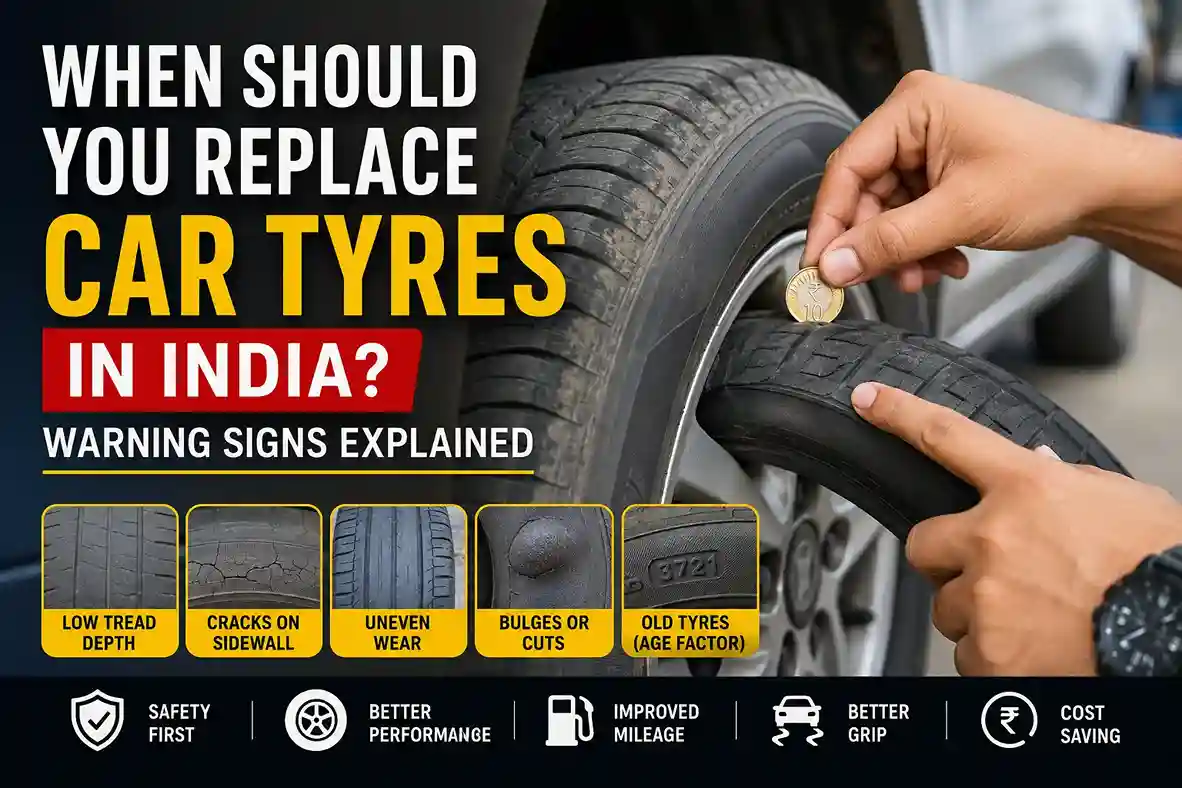
If you are asking When Should You Replace Car Tyres in India? Warning Signs Explained, the safest answer is: do not wait until a tyre fails on the road. Tyres wear gradually, and by the time a problem becomes obvious to the driver, the rubber may already be past a safe point. NHTSA says tyres should be replaced when tread reaches 2/32 of an inch, recommends checking tread at least monthly, and also says some manufacturers advise replacement by age even if tread still looks usable. AAA is even more conservative for everyday driving, noting that many drivers should consider replacement once tread reaches 4/32 of an inch, because stopping distances start getting worse before the absolute legal limit is reached.
That matters in India because our roads can be demanding: heat, potholes, speed breakers, heavy rain, and long highway runs all put extra stress on tyres. If you already follow basics like How to Check Car Tyre Pressure at Home in India and Why Your Car Mileage Is Decreasing Suddenly, tyre replacement should be part of the same maintenance habit, not an afterthought. Correct pressure, correct tread depth, and timely replacement all work together to keep the car safe and efficient.
When Should You Replace Car Tyres in India?
The practical answer is usually based on three things: tread depth, visible damage, and age. NHTSA says the legal minimum tread depth is 2/32 of an inch, but AAA says replacement at 4/32 of an inch is often wiser for wet-weather safety because braking performance starts to decline before the tyre is fully bald. NHTSA also advises checking the tyre’s age, and notes that some manufacturers recommend replacing tyres every six years regardless of use.
In real-world situations, that means a tyre can look “okay” from a distance and still be due for replacement. For example, a car that does a lot of city driving may wear its front tyres unevenly, while a car used for Best Cars for Long Drives in India 2026 may keep enough tread but age out from heat and time. Tyre condition is not just about how many kilometres the car has covered; it is also about where and how it has been driven.
Warning Signs That It Is Time to Replace Your Tyres
1) Tread is too shallow
This is the most obvious warning sign. NHTSA says to replace tyres at 2/32 of an inch, and AAA recommends thinking about replacement once tread reaches 4/32 of an inch because wet braking begins to suffer. Michelin also explains that tread wear indicators are built into the tyre and become visible as the tread wears down to its minimum safe depth.
If you drive in monsoon conditions, shallow tread is not a small issue. Water cannot be cleared away properly, so the tyre loses grip faster on wet roads. That is one reason a well-maintained car can still feel unsafe if the tyres are worn out. If mileage has also dropped, it is worth reading How to Improve Car Mileage in India because worn tyres can increase rolling resistance and affect efficiency.
2) Cracks, cuts, or sidewall damage
Visible damage is a clear reason to act. NHTSA advises drivers to inspect tread and sidewalls for cuts, punctures, bulges, scrapes, cracks, or bumps, and to do that inspection at least monthly and before long trips. Sidewall damage is especially serious because the sidewall carries a lot of the tyre’s load and stress.
A tyre with a bulge, deep cut, or exposed cord should not be treated as a “later” problem. That is one of the classic cases where replacement is safer than repair. If you are already checking the car before purchase, How to Check Used Car Before Buying in India is a useful companion read because tyre condition is one of the easiest ways to judge how carefully a car has been maintained.
3) Uneven wear across the tread
Uneven wear often means the tyre is not the only issue. Michelin’s guidance on irregular wear notes that one-sided wear can point to alignment or related suspension problems. That means a tyre may look worn on one edge while the rest of it still has depth left. In that case, replacing the tyre without fixing the alignment problem can just repeat the same issue on the new set.
This is where owners often make a costly mistake. They replace tyres, skip alignment, and then wonder why the new set wears out early too. If you have noticed your car drifting slightly or the steering wheel sitting off-center, that is a sign to stop guessing and get the suspension and alignment checked. Tyre wear and car suspension problems often travel together, even if the tyre is the part you notice first.
4) Vibration, thumping, or odd noise while driving
Tyres can tell you something is wrong before you hear a mechanic say it. AAA says unusual vibrations or thumping noises may indicate an out-of-balance tyre, a flat spot, or even a separated belt. That is not a symptom to ignore, because a tyre with an internal structural problem can fail suddenly.
If vibration gets worse at speed, do not assume it is just the road surface. Check the tyre first, then the wheel balance, then the suspension. The driver usually notices the shake before a complete failure happens, which makes this one of the most valuable early warning signs.
5) Tyres are old, even if they still have tread
Age matters. NHTSA says some manufacturers recommend tyre replacement every six years regardless of use, and Bridgestone also says tyres should be periodically inspected for age-related issues, damage, improper inflation, or overloading. Heat, sunlight, and long parking periods can age rubber even when the tread looks decent.
This is especially relevant in India, where tyres often face strong sun and hot road surfaces. A car that is driven less can still need tyre replacement if the rubber has hardened or started to crack with age. If you mostly use your car for weekend highway trips, Best Cars for Long Drives in India 2026 is worth comparing alongside your maintenance schedule, because long trips make old tyres more risky.
How to Check Whether Your Tyres Need Replacement
A quick home inspection can catch many problems early.
Look at the tread first. If the tread wear bars are level with the surface, Michelin says the tyre has reached minimum tread depth and should be replaced. You can also use the penny test or a tread gauge, but the most important thing is to check all four tyres, not just the one that looks worst.
Then inspect the sidewalls. Look for cracks, bulges, cuts, and embedded damage. NHTSA recommends doing this monthly and before long trips. While you are at it, check pressure cold, because underinflation can make wear worse and handling less stable. If you want a simple routine for this, How to Check Car Tyre Pressure at Home in India is a good place to start.
Common Mistakes Car Owners Make
One common mistake is waiting for a tyre to become visibly bald. By the time that happens, the car may already be less safe in wet braking and emergency manoeuvres. Another mistake is replacing only one tyre when two or four should be changed as a set for better balance and grip. A third mistake is ignoring age and focusing only on kilometres. NHTSA and tyre manufacturers both point out that age, condition, and damage matter even when the tyre still has usable tread.
A fourth mistake is skipping alignment after installing new tyres. If the old set wore unevenly, the new tyres can wear the same way. That is why it is smarter to treat the tyre change as part of a wider maintenance check, not as a one-line purchase. If you are already tracking other maintenance items like How Often Should You Change Engine Oil in India and Car Dashboard Warning Lights Explained, tyre replacement should sit right beside them.
Best Practices Before You Buy New Tyres
Choose tyres based on the car’s size, load needs, and the kind of roads you drive most often. A city car that rarely leaves smooth roads may not need the same tyre setup as a family SUV or a highway touring sedan. Make sure the size matches the manufacturer recommendation, check the manufacturing date, and compare the tyre’s wet grip and durability rather than just the price tag. Bridgestone notes that periodic inspections for punctures, impact damage, improper inflation, and overloading are part of good tyre care, which is a useful reminder that a tyre purchase should be matched with maintenance habits.
If your car is older or has a lot of highway use, think about the tyres as part of the overall driving package. In some cases, the right tyre choice makes the car quieter, safer, and more comfortable. That matters just as much as the vehicle itself, whether you drive a hatchback, sedan, or compact SUV.
FAQ
How many kilometres do car tyres last in India?
There is no fixed number because tyre life depends on road quality, pressure, driving style, heat, and maintenance. Many tyres wear out based on condition before they reach a specific kilometre limit.
Should I replace tyres at 3 years?
Not always. If the tread is healthy and there is no damage, 3 years may be too early for many drivers. But if the tyres are cracking, heavily worn, or exposed to harsh heat and parking conditions, replacement may be justified earlier.
What is the legal tread limit?
NHTSA says the minimum legal tread depth is 2/32 of an inch. AAA recommends considering replacement earlier, at 4/32 of an inch, because wet stopping distances begin to worsen before the legal limit is reached.
Can I keep using tyres with cracks?
Small surface marks are not always urgent, but visible cracking, bulges, exposed cord, deep cuts, or sidewall damage should be treated seriously and inspected by a professional.
Conclusion
The safest answer to When Should You Replace Car Tyres in India? Warning Signs Explained is to replace them when tread is too shallow, age is too high, or the tyre shows visible damage or abnormal wear. NHTSA’s 2/32-inch minimum is the hard safety line, but AAA’s 4/32-inch guidance is a better everyday benchmark for wet-road confidence. Add monthly checks, look for cracks and bulges, and pay attention to vibrations or uneven wear before they turn into roadside trouble.
If you keep tyre checks tied into your regular car-care routine, along with How to Check Car Tyre Pressure at Home in India and How to Improve Car Mileage in India, you will usually spot trouble early enough to avoid both expensive repairs and unsafe driving.
Author: Carsinfos Editorial Team
Published: May 28th, 2026