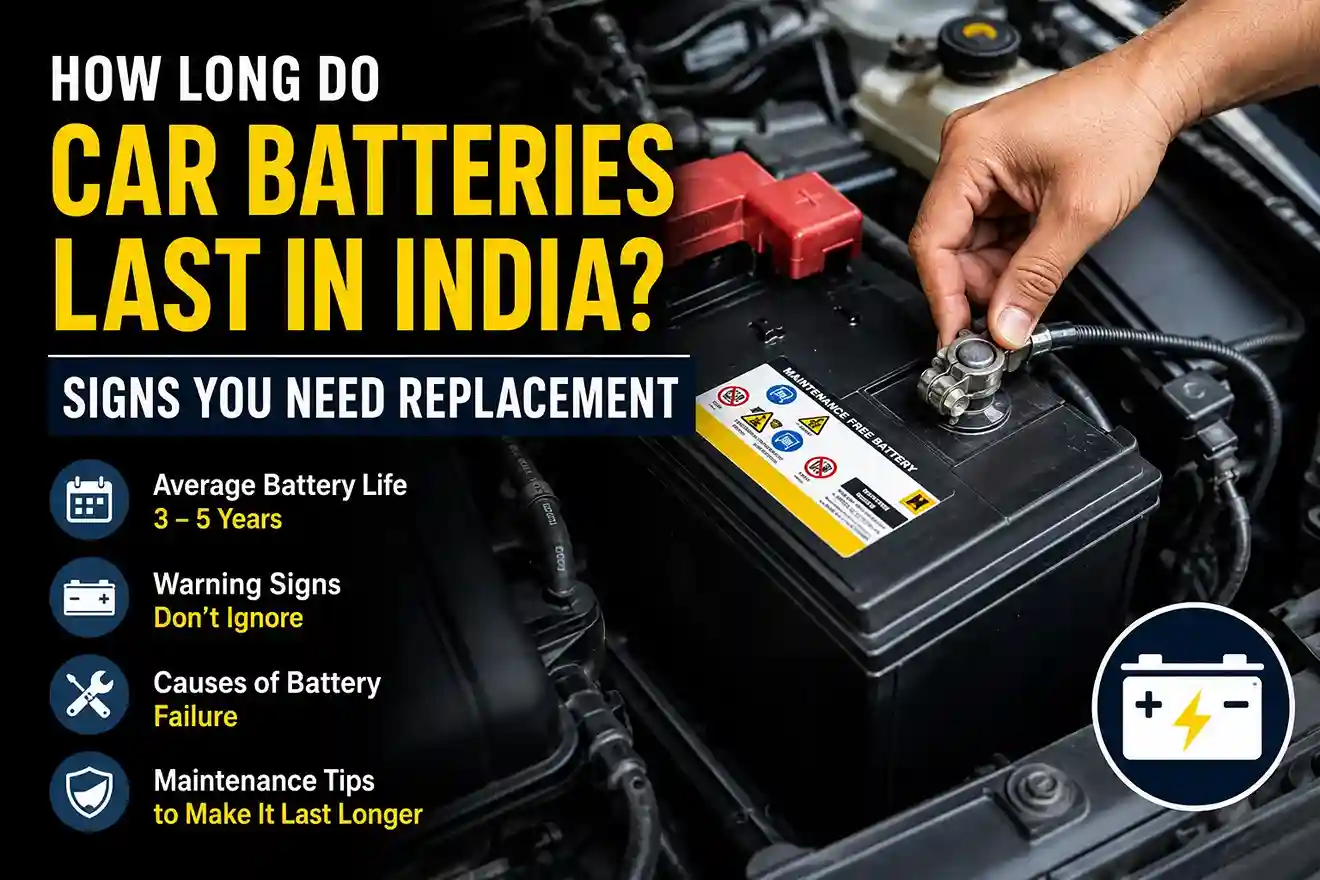
If you are asking How Long Do Car Batteries Last in India? Signs You Need Replacement, the practical answer is usually about 3 to 5 years, but in hotter climates the useful life can drop closer to the lower end of that range. AAA says batteries typically last three to five years, and it specifically notes that heat shortens battery life; Interstate Batteries gives the same general lifespan range and also points out that extreme temperatures and infrequent use can reduce it further.
That matters in India because heat, traffic, and short daily trips can all work against battery health. If your car spends a lot of time parked in the sun, used mostly for short commutes, or loaded with electrical accessories, the battery may age faster than the calendar suggests. For drivers already keeping up with basics like How Often Should You Change Engine Oil in India and How to Improve Car Mileage in India, battery care should sit in the same routine-maintenance bucket.
How Long Do Car Batteries Last in India?
The most realistic expectation for a typical lead-acid car battery is 3 to 5 years. AAA says battery life is usually in that band, while also noting that heat can cut that down, and Interstate Batteries repeats the same lifespan range while warning that hot and cold extremes, high electrical use, and drive time all influence longevity. In simple terms, a battery in a hot Indian city with heavy traffic may not last as long as one in gentler conditions with regular highway use.
In real-world situations, the battery may start giving trouble before it fully fails. That is why a car that is still “starting today” can still be telling you it is on the way out. If your vehicle already shows warning signs and you want a quick visual refresher, keep Signs Your Car Battery Is Weak and Car Dashboard Warning Lights Explained handy while you inspect the car. AAA also notes that regular battery testing is a smart part of routine maintenance, with a six-month testing cadence often recommended by battery experts.
Signs You Need Battery Replacement
The most useful battery warnings are usually easy to notice if you pay attention early. AAA’s warning-sign guidance includes slow cranking, dim headlights, corrosion, and other signs that the battery is weakening.
Here are the signs that matter most:
- Slow engine cranking when you turn the key or press the start button. AAA lists this as one of the classic signs of a weak battery.
- Dim headlights or weak interior lights, especially at idle or just before starting. That often means the battery is struggling to supply power.
- Corrosion on the terminals or visible buildup around the battery posts. AAA flags corrosion as a warning sign that should not be ignored.
- Repeated jump-starts within a short period. A battery that keeps needing help is usually near replacement time.
- Battery age above 3 years in hot conditions or 4 to 5 years in general. At that point, replacement planning becomes sensible even if the battery has not failed yet.
- Electrical glitches like weak central locking response, infotainment resets, or inconsistent accessory behavior. Those are often early indicators that the electrical system is no longer getting steady battery support.
If those signs sound familiar, a battery test is smarter than waiting for a complete failure. That is especially true if your car is part of a daily commute and a dead battery would cause real disruption. A simple test is often cheaper than the stress of an unexpected no-start morning.
What Shortens Battery Life in India?
Heat is the biggest enemy. AAA says batteries tend to last longer in cooler conditions and shorter in hotter climates, and Interstate Batteries says extreme temperatures shorten battery life. That is one reason Indian summers can be so hard on weak batteries.
Short trips also hurt. Interstate Batteries notes that infrequent driving and limited recharge time reduce battery life because the battery may not fully recover between starts. If your daily use is mostly short city runs, the battery works hard while the alternator has less time to recharge it. High electrical load matters too: air-conditioning use, infotainment, lights, chargers, and start-stop systems all add demand.
That is why a battery may fail “early” even when the car looks otherwise healthy. The issue is often the pattern of use, not just the brand of battery. If your vehicle also struggles with AC performance, Car AC Not Cooling Common Reasons Easy Fixes is worth reading because electrical strain and heat often travel together in daily use.
What To Check Before Replacing the Battery
Before buying a new battery, it is worth confirming that the battery itself is the problem and not a charging issue. AAA’s battery-service guidance highlights testing, installation, and safe handling, while Interstate Batteries recommends regular battery checks rather than waiting for failure. A battery test can save you from replacing a part that was not actually the root cause.
Check these items first:
- battery age
- terminal corrosion
- loose clamps
- repeated jump-start history
- charging behavior after a normal drive
- any warning lights or electrical irregularities
If the battery is older and the symptoms line up, replacement is usually the practical choice. If the battery is still young but failing, ask the workshop to inspect the alternator and charging system as well. In other words, do not just buy a battery because the car did not start once. A proper diagnosis is the better purchase.
Common Mistakes Car Owners Make
One common mistake is waiting until the battery dies completely. That turns a planned replacement into an emergency one. Another mistake is assuming every starting issue is automatically a battery issue. Sometimes the root cause is a charging fault, corrosion, or a loose terminal rather than the battery cell itself. AAA’s guidance on weak-battery warning signs is useful precisely because it encourages diagnosis before failure.
Another mistake is choosing the cheapest battery without checking the vehicle’s needs. Some cars, especially newer ones, require specific battery types or capacities, and Interstate Batteries advises checking the owner’s manual or dealer guidance for the correct fit. If you are already the kind of owner who checks details like How to Check Car Tyre Pressure at Home in India and How to Check Car Brake Pads at Home in India, this is the same habit applied to electrical health.
A third mistake is ignoring the rest of the electrical system after replacement. If the new battery keeps draining, there may be a parasitic draw, a charging fault, or another component pulling power when the car is off. In that case, a workshop inspection is the sensible next step. If you suspect a broader safety issue, NHTSA also provides a way to report a vehicle safety problem or check recall information through its official safety tools.
Best Practices to Make a Battery Last Longer
A battery usually lasts longer when it stays charged, clean, and lightly stressed. Interstate Batteries recommends periodic battery testing, and AAA’s maintenance guidance also emphasizes regular checks and proper upkeep. Keeping the terminals clean, avoiding long periods of inactivity, and not leaving electrical loads on when the engine is off all help.
If you do not drive much, try to run the car long enough to recharge the system properly. If you park outside in harsh heat, shade helps. And if the battery is already over three years old, pay closer attention to starting speed and voltage-related symptoms. The goal is not to stretch the battery forever; the goal is to replace it before it strands you.
FAQ
How many years do car batteries last in India?
Most car batteries last around 3 to 5 years, but hot weather, short trips, and heavy electrical use can shorten that lifespan. AAA and Interstate Batteries both give that same general range.
What are the first signs of a weak battery?
Slow cranking, dim lights, corrosion, and repeated jump-start needs are some of the most common signs. AAA specifically lists those symptoms in its replacement guidance.
Should I replace the battery after 3 years?
If you live in a hot region or use the car mostly for short trips, yes, it is smart to start planning around that point. AAA notes that hot climates typically shorten battery life, and many batteries in warm conditions may need replacement closer to 3 years.
Can a bad alternator look like a bad battery?
Yes. That is why battery testing matters before replacement. AAA and Interstate Batteries both stress testing and proper diagnosis instead of guessing.
Conclusion
For most drivers, the answer to How Long Do Car Batteries Last in India? Signs You Need Replacement is simple: expect 3 to 5 years, but assume the lower end if your car lives in heat, traffic, and short-trip conditions. Watch for slow cranking, dim lights, corrosion, and repeated jump-starts, because those are the signs that usually show up before a full failure. AAA and Interstate Batteries both point to heat, infrequent driving, and electrical load as major life-shortening factors, which fits the way many Indian cars are actually used.
If your battery is already acting weak, do not wait for the car to stop completely. Test it, confirm the charging system, and replace it on your schedule instead of the battery’s schedule. That is the easiest way to avoid a no-start morning and keep the rest of your car routine steady.
Author: Carsinfos Editorial Team
Published: May 24th, 2026