
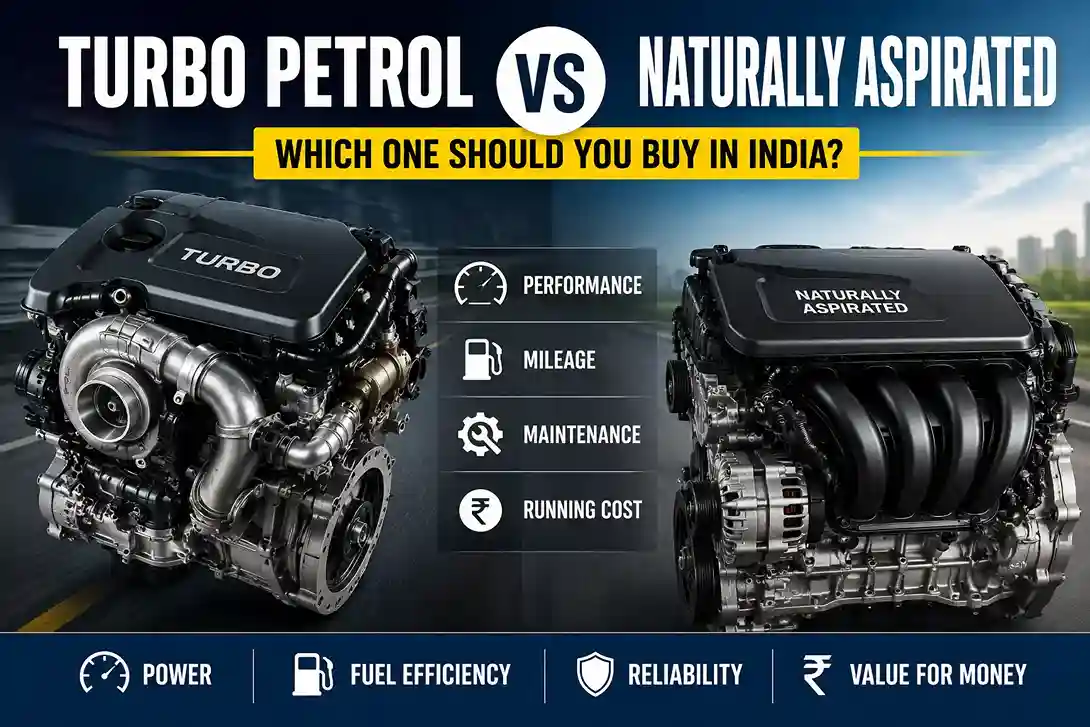
The debate around Turbo Petrol vs Naturally Aspirated Engine has become much more relevant for Indian car buyers in recent years because the choice now affects not only performance, but also fuel efficiency, driving feel, maintenance expectations, and long-term ownership costs. If you are already comparing buying decisions like Petrol vs Diesel Cars in India 2026 or trying to understand where mileage and running costs matter most, this engine choice can shape the entire ownership experience. The good news is that there is no one-size-fits-all answer; the better engine depends on how you drive, what kind of roads you use, and what you expect from the car. Gasoline cars are spark-ignited internal combustion vehicles, and modern turbocharged gasoline engines have become a major part of the efficiency-and-performance conversation.
Turbo Petrol vs Naturally Aspirated Engine: What is the real difference?
A naturally aspirated engine draws air into the cylinders without forced induction, while a turbo petrol engine uses exhaust-driven boost to pack more air into the engine. The U.S. Department of Energy explains that a boosted engine is one with a turbocharger or supercharger, while a naturally aspirated engine is one without that boost hardware. In practical terms, a turbo petrol engine can deliver stronger low- and mid-range torque from a smaller displacement, while a naturally aspirated engine usually offers a more linear, predictable power delivery. DOE’s engine research also repeatedly compares naturally aspirated and boosted designs because the trade-offs are important for efficiency and drivability.
For many Indian buyers, this difference becomes obvious in everyday driving. A turbo petrol can feel quick and flexible in traffic or on highways, especially if you like effortless overtakes without pushing the engine hard. A naturally aspirated engine can feel calmer and simpler, with power that builds in a more progressive way. If you are the kind of buyer who also reads practical ownership guides like How to Improve Car Mileage in India or Why Your Car Mileage Is Decreasing Suddenly, you already know that the “best” engine is usually the one that matches real use instead of brochure excitement.
Why turbo petrol engines have become so popular
Turbo petrol engines have gained ground because automakers want to balance performance, fuel economy, and emissions. EPA’s 2026 Automotive Trends Report notes that gasoline turbocharged engines accounted for more than 44% of U.S. vehicle production in model year 2024, and many of those engines use “turbo downsizing” to combine the fuel economy of a smaller engine with the power of a larger one when boost is needed. That same pattern is visible across much of the global market, including the kinds of compact SUVs and premium hatchbacks many Indian buyers consider today.
This matters in India because buyers often want one car to do several jobs at once. A family car may need city smoothness during the week, highway confidence on weekends, and reasonable fuel efficiency the rest of the time. That is why turbo petrol power has become common in many newer models that sit in the same shopping basket as Best Cars Under 15 Lakh in India and Best SUVs Under 10 Lakh in India. If the car is tuned well, turbo petrol can give you the feeling of a bigger engine without necessarily moving to a bigger engine size. EPA’s trend data supports that broader industry direction.
Where naturally aspirated engines still make sense
Naturally aspirated engines remain attractive because they are simple, familiar, and usually easier to understand over a long ownership period. With no turbocharger, there are fewer boost-related components in the system, and that simplicity can appeal to buyers who want predictable behavior and less mechanical complexity. In many markets, naturally aspirated engines are still valued for their smoothness, ease of use, and straightforward maintenance profile. DOE’s fuel and engine research specifically points out that octane sensitivity and boost-related behavior matter much more in boosted engines than in naturally aspirated ones, which is another way of saying these two engine types behave differently under load and during calibration.
That is one reason naturally aspirated engines still make sense for buyers who prioritize calm city driving, lower stress, and a simple ownership experience over outright punch. If you usually drive in relaxed conditions, do not care much about aggressive acceleration, and prefer a car that feels easy to live with every day, a naturally aspirated engine can be the more satisfying choice. This is especially true when the rest of the car already fits your needs, whether you are cross-shopping Manual vs Automatic Cars: Which One Should You Buy? or comparing value in Best Family Cars Under 10 Lakh in India.
Turbo petrol vs naturally aspirated engine: the key trade-offs
The real decision comes down to how much you value punch versus simplicity.
A turbo petrol engine usually gives you:
- stronger overtaking ability
- better low-end and mid-range pull
- a more modern performance feel
- the sense that the car is working less hard in normal driving
A naturally aspirated engine usually gives you:
- smoother, more linear response
- simpler long-term ownership
- less concern about boost-related complexity
- a driving feel that is easy to predict in traffic
In real-world situations, turbo petrol often feels better when the car is fully loaded, climbing highways, or being used for quick merges and overtakes. Naturally aspirated engines can feel friendlier in stop-go traffic and less dramatic for drivers who prefer a relaxed pace. If you are comparing engines for a car that will also be judged on everyday economy, it makes sense to read Best Mileage Cars in 2026: Top Fuel Efficient Cars in India alongside this discussion, because the final choice is rarely about peak horsepower alone.
Which engine is better for city driving?
For dense city use, naturally aspirated engines still have a strong case because they deliver power in a simple, forgiving way. They are easy to drive at low speeds, and the throttle response tends to feel familiar to most drivers. Turbo petrol engines can still work very well in the city, but they usually feel best when the engine is not constantly being asked for tiny bursts of power from very low rpm. Some drivers love that extra response; others find the smoother simplicity of a naturally aspirated engine more relaxing.
If your daily routine includes school runs, office commutes, and short errands, the calmer delivery of a naturally aspirated engine may be enough. If your city use still includes frequent highway trips or long weekend drives, a turbo petrol can feel more rewarding without forcing you into a bigger engine category. That is why this choice should sit next to broader buying questions like whether your car should be a compact SUV, sedan, or hatchback in the first place. Posts such as Best SUVs Under 10 Lakh in India and Best Cars Under 15 Lakh in India can help narrow the car class before you decide on the engine.
Which engine is better for highways and long trips?
For highway use, turbo petrol often has the edge because it can produce stronger torque without requiring a large displacement. That usually translates into easier overtakes, less frequent downshifting, and a more relaxed feel when cruising at higher speeds. EPA’s trend reporting and DOE’s engine research both show why manufacturers keep moving toward smaller boosted engines: they can combine efficiency benefits with performance reserves when needed.
Naturally aspirated engines can still be perfectly fine on highways, especially if the car is light and the engine is tuned well. The trade-off is that you may need to work the engine harder to get the same passing confidence. That is not a problem for everyone. In fact, many drivers prefer the predictable power delivery of an NA engine because it feels consistent and easy to judge. If you have ever compared cars based on ownership comfort rather than just specs, you probably already know that the smoother choice is not always the most exciting one.
Common mistakes buyers make
One common mistake is chasing the words “turbo” without checking the rest of the car. A weak suspension, poor tyres, or a badly tuned gearbox can ruin the experience no matter how good the engine sounds on paper. Another mistake is assuming a turbo petrol always means better mileage. In the right conditions, turbo downsizing can help efficiency, but aggressive driving, heavy traffic, and frequent boost use can reduce those gains. EPA’s reports make clear that turbocharged engines are often used as part of a broader efficiency strategy, not as a magic shortcut.
A second mistake is ignoring your own driving style. If you spend most of your time in calm city traffic and rarely push past moderate speeds, a naturally aspirated engine may be all you need. If you drive loaded, travel on highways often, or simply enjoy a more responsive car, turbo petrol may be the better fit. Buyers who already pay attention to warning signs, engine health, and fuel usage in articles like How to Improve Car Mileage in India usually make better engine choices because they think beyond the showroom floor.
Best practices before you decide
Before choosing between turbo petrol and naturally aspirated engines, test both in the exact kind of driving you actually do. Do not rely only on a short dealership loop. Try crawling traffic, a fast lane-change, and a short open-road stretch if possible. Pay attention to how the engine behaves below 2,000 rpm, how smooth it feels when accelerating gently, and how much effort it seems to need when the car is loaded.
It also helps to compare variants rather than engine types in isolation. Sometimes the turbo petrol version comes only in a higher trim, while the naturally aspirated version may have a better value-to-feature ratio. That is why many buyers should compare the full package against other articles such as Best Automatic Cars Under 10 Lakh in India and Best Family Cars Under 10 Lakh in India. The engine matters, but the trim, gearbox, and feature list matter too.
FAQ
Is turbo petrol better than naturally aspirated engine in India?
Not always. Turbo petrol is usually better if you want stronger performance and a more flexible drive, while naturally aspirated engines are often better if you want simplicity and a relaxed ownership experience. DOE and EPA research show why boosted engines have become popular, but the right answer still depends on your usage.
Which engine gives better mileage?
That depends on the car, gearbox, and driving style. Turbocharged engines can be efficient when they are downsized and driven gently, but hard acceleration and frequent boost use can reduce the advantage. EPA’s Automotive Trends Report describes turbo downsizing specifically as a way to combine smaller-engine economy with larger-engine power when needed.
Are naturally aspirated engines cheaper to maintain?
They are often simpler mechanically because they do not include turbo hardware, which is one reason many buyers like them. That does not automatically make every naturally aspirated car cheaper overall, but simplicity is a real ownership advantage. DOE’s materials on boosted versus naturally aspirated designs highlight why the systems are different in complexity and behavior.
Should first-time buyers choose turbo petrol or naturally aspirated?
First-time buyers who want stress-free driving and simple behavior often feel more comfortable with naturally aspirated engines. First-time buyers who value quick response and highway confidence may prefer turbo petrol. The right answer depends more on your driving pattern than on the engine label itself.
Conclusion
The best way to think about Turbo Petrol vs Naturally Aspirated Engine is not as “modern versus old,” but as “what matches my driving?” Turbo petrol engines usually win on punch, flexibility, and the feeling of effortless performance. Naturally aspirated engines usually win on simplicity, predictability, and easy everyday manners. EPA and DOE materials show why turbocharged engines have become such an important part of modern vehicle design, but they also make clear that naturally aspirated engines still have a valid place in the market.
If your priority is a relaxed, uncomplicated commute, a naturally aspirated engine may be the smarter choice. If your priority is stronger highway performance and a more energetic drive, turbo petrol is usually worth the extra attention. Either way, the smartest buyer is the one who matches the engine to real life, not the brochure. For more context before you decide, it also helps to compare the broader ownership picture through Petrol vs Diesel Cars in India 2026 and Why Your Car Mileage Is Decreasing Suddenly
Author: Carsinfos Editorial Team
Published: May 20th, 2026