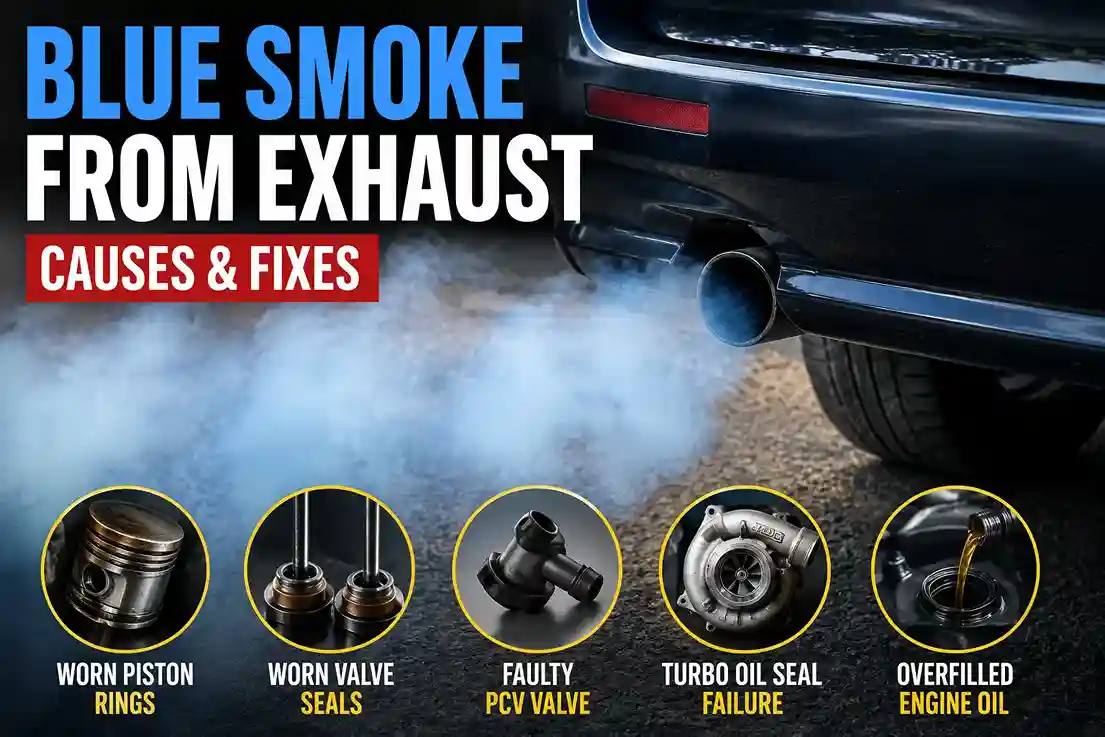
Seeing blue smoke from the exhaust can be alarming, especially if your car has always run smoothly. While a small amount of white vapor on a cold morning is usually harmless, blue smoke is different. It often indicates that engine oil is entering the combustion chamber and burning along with the fuel. Understanding the Blue Smoke From Exhaust Causes can help you identify problems early and avoid expensive engine repairs.
In real-world situations, some drivers notice blue smoke only during startup, while others see it when accelerating or driving downhill. These patterns can provide valuable clues about the underlying issue. Ignoring blue exhaust smoke may lead to increased oil consumption, reduced engine performance, and long-term engine damage.
If you’ve also noticed unusual engine behavior, our guide on Engine Misfire Causes explains how combustion-related issues can affect performance and fuel efficiency.
Quick Answer
Blue smoke from the exhaust usually means the engine is burning oil. Common causes include worn piston rings, damaged valve stem seals, a faulty PCV valve, turbocharger oil seal failure, or excessive engine oil. Identifying the source early can help prevent serious engine damage and costly repairs.
According to the Car Care Council, unusual exhaust smoke should never be ignored because it often indicates mechanical issues that require inspection.
Table of Contents
- What Does Blue Smoke From the Exhaust Mean?
- Why Blue Smoke Should Never Be Ignored
- Common Blue Smoke From Exhaust Causes
- Symptoms That Usually Accompany Blue Smoke
- How Mechanics Diagnose the Problem
- Repair Options
- Prevention Tips
- FAQs
What Does Blue Smoke From the Exhaust Mean?
A healthy gasoline or diesel engine should produce little to no visible exhaust smoke once it reaches normal operating temperature.
Blue smoke generally indicates that engine oil is entering the combustion chamber and burning during combustion. Because engine oil burns differently than fuel, it creates a bluish or blue-gray exhaust.
For example, if worn internal engine components allow oil to leak into the cylinders, the burning oil exits through the exhaust system as blue smoke.
The exact cause depends on when the smoke appears:
- Only during startup
- While accelerating
- During deceleration
- Continuously while driving
Each situation points toward different mechanical issues.
Why You Should Never Ignore Blue Smoke
Many drivers continue using their vehicle because it still “drives normally.”
Unfortunately, that can become an expensive mistake.
Blue smoke often indicates internal engine wear that gradually becomes worse over time.
Ignoring the problem may result in:
- Increased engine oil consumption
- Fouled spark plugs
- Catalytic converter damage
- Reduced fuel economy
- Loss of engine power
- Failed emissions tests
- Expensive engine repairs
According to the National Highway Traffic Safety Administration (NHTSA), unusual vehicle symptoms should be inspected promptly because mechanical failures can affect overall vehicle safety and reliability.
If your dashboard warning lights also appear, our article on Check Engine Light Explained can help you understand what those warnings may indicate.
Common Blue Smoke From Exhaust Causes
1. Worn Piston Rings
One of the most common causes of blue exhaust smoke is worn piston rings.
Piston rings seal the combustion chamber and prevent engine oil from entering the cylinders.
As the engine accumulates mileage, these rings may wear or lose tension.
When this happens:
- Oil leaks into combustion chambers
- Oil burns with fuel
- Blue smoke appears
- Compression decreases
- Engine performance suffers
Additional symptoms include:
- Higher oil consumption
- Reduced acceleration
- Lower fuel economy
- Loss of engine compression
In real-world situations, older vehicles with high mileage are more likely to experience worn piston rings.
2. Worn Valve Stem Seals
Valve stem seals prevent oil from leaking down the valve guides into the combustion chamber.
Over time, heat and age can harden or crack these seals.
Typical symptoms include:
- Blue smoke during startup
- Smoke after long periods of idling
- Oil consumption
- Occasional misfires
For example, if blue smoke appears only after the vehicle has been parked overnight, worn valve seals are often a likely cause.
3. Faulty PCV Valve
The Positive Crankcase Ventilation (PCV) valve helps regulate crankcase pressure.
If it becomes clogged or fails:
- Excess crankcase pressure develops
- Oil is forced into the intake
- Engine burns oil
- Blue smoke appears
Fortunately, replacing a PCV valve is often much less expensive than repairing internal engine damage.
Regular engine maintenance, including timely oil changes, can reduce the likelihood of PCV-related problems. Our guide on How Often Should You Change Engine Oil in India explains why proper oil maintenance is essential for engine health.
4. Turbocharger Oil Seal Failure
Turbocharged engines use engine oil to lubricate the turbocharger bearings.
If the turbo’s oil seals wear out:
- Oil leaks into the intake
- Oil enters the exhaust
- Blue smoke becomes noticeable
- Turbo efficiency decreases
Other warning signs include:
- Whining noises
- Reduced boost pressure
- Poor acceleration
- Increased oil consumption
According to SAE International, proper lubrication is essential for the longevity of turbocharged engines, and oil-related failures are a common cause of premature turbo damage.
5. Too Much Engine Oil
Surprisingly, overfilling the engine with oil can also produce blue smoke.
Excess oil may:
- Foam inside the crankcase
- Increase crankcase pressure
- Reach the combustion chamber
- Burn during combustion
This usually occurs after an oil change if the oil level exceeds the manufacturer’s recommended limit.
Always check the dipstick after adding engine oil.
Symptoms That Usually Accompany Blue Smoke
Blue smoke rarely appears by itself.
You may also notice:
- Frequent oil top-ups
- Burning oil smell
- Reduced engine power
- Rough idle
- Poor fuel economy
- Oily spark plugs
- Check Engine Light
- Increased exhaust emissions
If rough running accompanies blue smoke, our article on Alternator Failure Symptoms can help you rule out charging system problems that may also affect engine performance.
Can Blue Smoke Damage Other Components?
Yes.
Burning engine oil doesn’t only affect the engine.
Over time it can damage:
- Catalytic converter
- Oxygen sensors
- Spark plugs
- Turbocharger
- Exhaust system
These secondary repairs often increase the total repair cost if the original oil-burning problem is left unresolved.
How Mechanics Diagnose Blue Smoke
Diagnosing blue exhaust smoke isn’t about replacing parts based on guesswork. A qualified technician will inspect the engine systematically to identify where the oil is entering the combustion chamber.
Visual Inspection
The first step is often a simple visual inspection.
A mechanic may check for:
- Oil leaks around the engine
- Oil level and condition
- Smoke color and odor
- Exhaust tailpipe residue
- PCV valve operation
These initial observations can narrow down the list of possible causes before more detailed testing begins.
Compression Test
A compression test measures how well each cylinder seals during the compression stroke.
Low compression may indicate:
- Worn piston rings
- Damaged cylinders
- Valve sealing problems
If compression readings vary significantly between cylinders, additional investigation is usually recommended.
Leak-Down Test
A leak-down test provides more detailed information than a standard compression test.
Compressed air is introduced into each cylinder, allowing technicians to determine where pressure is escaping.
For example, air escaping through the crankcase may indicate worn piston rings, while leakage through the intake or exhaust valves can point to valve-related issues.
Turbocharger Inspection
For turbocharged vehicles, mechanics inspect:
- Turbo shaft play
- Oil leakage
- Compressor housing
- Turbine housing
Oil around the turbocharger or excessive shaft movement often suggests worn turbo seals or bearings.
Spark Plug Inspection
Removing the spark plugs can reveal valuable clues.
Oil-fouled spark plugs often indicate that engine oil is entering the combustion chamber.
If only one or two plugs show oil deposits, the issue may be isolated to specific cylinders.
Can You Continue Driving With Blue Smoke?
The answer depends on the severity of the problem, but blue smoke should never be considered normal.
If the smoke appears briefly during startup and disappears, you may have worn valve stem seals. While the vehicle might still be drivable for a short period, it should be inspected soon.
However, continuous blue smoke while driving is more serious.
You should avoid extended driving if you notice:
- Heavy blue smoke
- Rapid oil loss
- Engine overheating
- Reduced engine power
- Knocking sounds
- Check Engine Light
Ignoring these symptoms can eventually lead to severe engine damage.
If the vehicle also begins overheating, our guide on Why Your Car Is Overheating explains additional warning signs that require immediate attention.
General Repair Costs
Repair costs vary depending on the underlying cause, vehicle make, engine type, and labor rates.
Typical repairs may include:
| Problem | Typical Repair |
|---|---|
| Faulty PCV valve | Replace PCV valve |
| Worn valve stem seals | Replace valve seals |
| Turbo oil seal failure | Rebuild or replace turbocharger |
| Worn piston rings | Major engine repair or rebuild |
| Overfilled engine oil | Drain excess oil and inspect engine |
Minor issues such as a faulty PCV valve are generally inexpensive to fix, while worn piston rings or severe engine wear may require extensive repairs. Obtaining a professional diagnosis before replacing parts can help avoid unnecessary expenses.
How to Prevent Blue Smoke From the Exhaust
Although some engine wear is unavoidable with age, good maintenance habits can significantly reduce the risk of oil-burning problems.
Change Engine Oil on Time
Fresh engine oil provides proper lubrication and helps reduce wear on internal engine components.
Using the correct oil grade recommended by your vehicle manufacturer is equally important.
Our detailed guide on How Often Should You Change Engine Oil in India explains maintenance intervals and factors that affect oil life.
Check Engine Oil Level Regularly
Make it a habit to inspect the dipstick every few weeks or before long trips.
Driving with low oil or excessive oil can both create engine problems.
Replace the Air Filter
A clogged air filter can affect engine performance and increase contamination inside the engine.
Replacing it according to the maintenance schedule helps support efficient combustion.
Address Small Problems Early
Ignoring minor oil consumption often allows internal wear to become worse.
For example, replacing a worn PCV valve early may prevent excessive crankcase pressure that could contribute to additional engine problems.
Follow the Manufacturer’s Service Schedule
Routine maintenance is one of the best ways to maximize engine life.
According to the Car Care Council, following recommended maintenance schedules helps improve vehicle reliability and reduce the likelihood of major repairs.
Common Mistakes Drivers Make
Many drivers unintentionally make the situation worse.
Common mistakes include:
- Continuing to drive despite heavy blue smoke
- Ignoring frequent oil top-ups
- Using the wrong engine oil
- Overfilling the engine with oil
- Delaying engine inspections
- Replacing parts without proper diagnosis
- Ignoring warning lights
- Assuming blue smoke is “normal” in older vehicles
In real-world situations, early diagnosis often costs significantly less than repairing an engine after months of continued oil burning.
Best Practices
If you notice blue smoke from your exhaust:
- Check the engine oil level immediately.
- Observe when the smoke appears (startup, acceleration, or continuously).
- Monitor oil consumption.
- Avoid aggressive driving until the issue is diagnosed.
- Schedule an inspection with a qualified mechanic.
- Keep maintenance records for future reference.
- Use manufacturer-approved engine oil.
- Address warning lights promptly.
These simple steps can help minimize damage while the underlying issue is being identified.
Frequently Asked Questions
Is blue smoke always caused by burning engine oil?
In most cases, yes. Blue smoke usually indicates that engine oil is entering the combustion chamber and burning with the air-fuel mixture.
Is blue smoke worse than white smoke?
Not necessarily. Blue, white, and black exhaust smoke each indicate different problems. Blue smoke generally points to oil burning, while white smoke may indicate coolant entering the engine and black smoke often suggests excessive fuel.
Can low engine oil cause blue smoke?
Low oil itself doesn’t create blue smoke, but an engine that’s consuming oil due to internal wear often develops low oil levels over time.
Does blue smoke mean my engine needs replacing?
Not always. Some causes, such as a faulty PCV valve or worn valve stem seals, can often be repaired without replacing the entire engine.
Can a bad turbocharger cause blue smoke?
Yes. Worn turbocharger oil seals can allow engine oil to enter the intake or exhaust system, producing blue exhaust smoke.
Will changing the engine oil fix blue smoke?
Only if the smoke is related to overfilled or incorrect oil. Internal engine wear requires proper mechanical repair.
Should I stop driving immediately if I see blue smoke?
If the smoke is heavy, continuous, or accompanied by warning lights, overheating, or loss of power, it’s safest to stop driving and have the vehicle inspected.
How can I tell if my engine is burning oil?
Common signs include blue exhaust smoke, frequent oil top-ups, burning oil smell, oily spark plugs, and reduced engine performance.
Key Takeaways
- Blue smoke from the exhaust usually indicates that the engine is burning oil.
- Common causes include worn piston rings, damaged valve stem seals, PCV valve failure, turbocharger oil seal leaks, and excessive engine oil.
- The timing of the smoke (startup, acceleration, or continuous driving) provides important diagnostic clues.
- Early diagnosis can prevent expensive engine repairs.
- Routine maintenance and timely oil changes help reduce the risk of oil-burning problems.
Conclusion
Understanding the Blue Smoke From Exhaust Causes can help you recognize one of the earliest warning signs of internal engine problems. Whether the issue stems from worn piston rings, aging valve seals, a faulty PCV valve, or a leaking turbocharger, identifying the cause early gives you the best chance of preventing more serious damage.
If you notice blue smoke, don’t assume it’s just a characteristic of an older vehicle. Pay attention to when it occurs, monitor your engine oil level, and arrange for a professional inspection if the problem persists. With regular maintenance and prompt repairs, you can extend your engine’s lifespan, improve performance, and avoid costly breakdowns in the future.
Author: Carsinfos Editorial Team
Published: July 28th, 2026