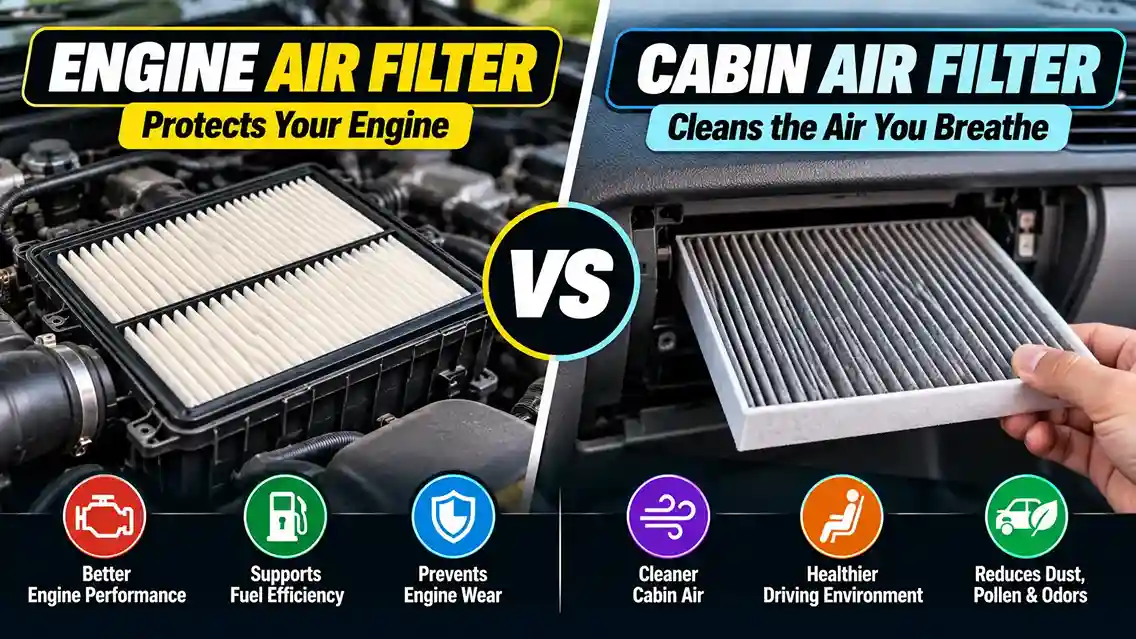
Engine Air Filter vs Cabin Air Filter is a common source of confusion for car owners. Both filters clean incoming air, both are inexpensive maintenance items, and both can become dirty over time. But they serve completely different purposes.
The engine air filter protects the engine’s air-intake system by filtering air before it reaches the engine. The cabin air filter cleans air entering the passenger compartment through the heating, ventilation, and air-conditioning system. One is primarily about engine operation and protection; the other is about cabin airflow and the air you breathe inside the vehicle.
Mixing up the two can lead to missed maintenance. A driver might replace the cabin filter while forgetting the engine filter, or replace the engine filter and assume the HVAC filter has also been taken care of. In reality, they need to be inspected and replaced separately.
Engine Air Filter vs Cabin Air Filter: What Is the Difference?
The simplest way to remember the difference is:
Engine air filter = protects the engine’s air supply
Cabin air filter = filters air entering the passenger compartment
The engine needs a controlled supply of clean air for combustion. The cabin air filter works with the HVAC system to remove airborne material before that air enters the interior.
They are usually located in different parts of the vehicle as well. The engine filter is commonly housed in the engine’s airbox, while the cabin filter may be behind the glove box, below the dashboard, or near the HVAC intake.
A Ford owner’s guide available through NHTSA describes a cabin air filter as a system intended to reduce airborne particles such as dust, spores, and pollen entering the vehicle interior.
That difference in purpose is why you should never consider one filter a replacement for the other.
What Does the Engine Air Filter Do?
The engine air filter sits in the intake path before air reaches the engine.
Its primary purpose is to prevent dust, dirt, sand, insects, and other particles from entering the engine’s air-intake system.
This matters because the engine contains closely fitted moving components. Unfiltered abrasive particles can contribute to wear over time. An NHTSA-hosted vehicle manual specifically warns that all air entering the engine intake must be filtered because abrasive particles in unfiltered air can rapidly wear engine components.
A clean engine filter also helps maintain appropriate airflow through the intake system.
When the filter becomes heavily restricted, airflow can be reduced. How noticeable the effect is depends on the vehicle, engine-management system, filter condition, and severity of restriction.
For drivers concerned about fuel efficiency, filter condition belongs on the overall maintenance checklist rather than being viewed as a miracle mileage fix. The U.S. Department of Energy’s fleet-maintenance recommendations include checking and replacing air filters regularly as part of preventive maintenance. DOE vehicle-maintenance best practices provide a useful reference.
What Does the Cabin Air Filter Do?
The cabin air filter is part of the vehicle’s HVAC airflow system.
When you use fresh-air ventilation or certain climate-control settings, outside air passes through the cabin filter before being delivered into the passenger compartment.
Depending on the filter design, it can help trap:
- Dust
- Pollen
- Road debris
- Some airborne particles
- Leaves and other larger contaminants
Some cabin filters also use activated carbon or similar materials to help reduce certain odors or gaseous pollutants.
The important point is that cabin filters differ in design and filtration capability. A basic particulate filter and a premium activated-carbon filter are not necessarily going to perform identically.
Research archived by the U.S. Environmental Protection Agency has examined the filtration performance of automotive cabin air filters and the role of filtration in vehicle-cabin air quality. EPA-indexed research on automotive cabin air filters provides additional technical background.
How to Tell Which Filter Is Dirty
The symptoms are usually different.
Signs of a dirty engine air filter
You may notice:
- Reduced engine response
- Slightly weaker acceleration
- Changes in fuel economy
- Restricted airflow-related symptoms
- A visibly dirty filter element during inspection
Some modern cars may also use electronic monitoring to determine when the engine air filter needs service. An NHTSA-hosted vehicle manual, for example, describes a system that monitors filter restriction and provides a service message under certain operating conditions.
Signs of a dirty cabin air filter
The most noticeable symptoms are usually related to the HVAC system:
- Weak airflow from the vents
- Fan noise that seems louder than usual
- Reduced ventilation performance
- Dust or debris around the filter area
- Musty or stale odors
- Faster accumulation of dust inside the vehicle
If your AC has stopped cooling properly, however, do not automatically blame the cabin filter. Our Car AC Not Cooling? 10 Critical Reasons and Easy Fixes guide explains why low refrigerant, condenser problems, compressor faults, airflow restrictions, and other issues can create similar symptoms.
Does a Dirty Engine Air Filter Reduce Mileage?
This is one of the most common questions.
A heavily restricted engine air filter can affect airflow, but modern fuel-injected engines can compensate for changes in airflow in ways older carbureted engines could not.
That means replacing a moderately dirty air filter on a modern petrol car should not be marketed as a guaranteed dramatic mileage improvement.
The more sensible approach is to treat the filter as one part of regular preventive maintenance.
If fuel economy has changed recently, investigate the full picture. Tyre pressure, traffic conditions, driving style, engine oil, spark plugs and other maintenance issues can all influence fuel consumption.
Our How to Improve Car Mileage in India guide covers these factors in more detail, including tyre pressure, engine maintenance, driving habits and filter condition.
Can a Dirty Cabin Air Filter Affect AC Performance?
Yes, a severely restricted cabin filter can reduce airflow through the HVAC system.
This does not necessarily mean the air-conditioning system is mechanically failing. The AC may still be producing cold air, but too little air may be reaching the cabin.
For example, you may notice that the blower sounds like it is working hard, yet very little air comes out of the vents. In that situation, checking the cabin filter is a sensible early step.
NHTSA-hosted maintenance information notes that cabin filter replacement should follow the vehicle’s maintenance schedule and that dusty, dirty, or heavy-traffic operating conditions may shorten filter life.
This is especially relevant to drivers in dusty cities, areas with construction, or roads with frequent traffic congestion.
Engine Air Filter vs Cabin Air Filter Replacement Intervals
There is no universal replacement interval for either filter.
The correct interval depends on:
- Vehicle make and model
- Engine design
- Filter type
- Climate
- Driving environment
- Traffic conditions
- Dust exposure
- Manufacturer maintenance schedule
This is why a generic “replace every 10,000 km” rule can be misleading.
An owner who mostly drives on clean highways may have very different filter conditions from someone who drives every day on dusty roads.
An NHTSA-hosted maintenance document, for example, notes that cabin air filter life can be shortened by heavy traffic, dirt roads, and dusty environments, making more frequent replacement appropriate in some conditions.
The same principle applies to engine air filters. An NHTSA-hosted owner’s manual advises more frequent inspection when vehicles are used in dusty or dirty conditions.
How Often Should You Check Both Filters?
You do not necessarily need to replace them together.
A better approach is to inspect each filter according to its own maintenance requirements.
For example:
Engine air filter: inspect according to the manufacturer’s service schedule and driving environment.
Cabin air filter: inspect and replace according to the manufacturer’s schedule, with more frequent attention in dusty or heavily congested environments.
If you live in an area with high dust levels, it is reasonable to inspect both more frequently even when the odometer has not reached the standard service interval.
This is one reason regular servicing matters more than a rigid mileage rule. Our How Often Should You Change Engine Oil in India article explains the same maintenance principle for engine oil: the manufacturer’s schedule matters, but severe driving conditions can change what the car needs.
Can You Clean and Reuse an Air Filter?
It depends on the filter.
Disposable paper engine air filters are normally designed to be replaced rather than aggressively washed.
Some specialty reusable filters have different maintenance procedures, but those should be serviced according to their manufacturer’s instructions.
Similarly, cabin filters are generally replacement items. Shaking out a visibly dirty disposable filter may remove some loose debris, but it does not necessarily restore the filter’s original filtration performance.
A common mistake is using compressed air aggressively on a paper filter. Depending on the filter design, this can damage the media or create gaps that allow particles to bypass filtration.
When the filter is heavily loaded with dirt, replacement is usually the more appropriate solution.
Why Indian Driving Conditions Matter
Filter maintenance can be particularly important in parts of India where vehicles regularly encounter:
- Dusty roads
- Construction zones
- Heavy traffic
- Agricultural roads
- Unpaved shoulders
- High levels of airborne debris
City traffic also changes how the cabin filter is used. A vehicle spending hours in congested areas may pull in more roadside pollutants than one driven mostly on open roads.
NHTSA’s seasonal driving guidance specifically recommends checking the cabin air filter before travel, particularly when preparing the vehicle for summer driving. NHTSA summer vehicle-check guidance provides a useful maintenance reference.
For Indian drivers, this same preventive mindset is useful before long highway journeys or during periods of heavy monsoon driving.
Our Monsoon Car Care Tips guide also covers seasonal inspections, fluid checks, battery care, tyres, and other maintenance items.
Common Mistakes Car Owners Make
Assuming both filters do the same job
They don’t. One filters air for the engine, while the other filters air entering the cabin.
Replacing the cabin filter while ignoring the engine filter
This can leave an important engine-maintenance item overdue.
Replacing the engine filter and forgetting the cabin filter
Your engine may be perfectly happy while the HVAC system is struggling with a blocked cabin filter.
Following a universal kilometre interval
Your driving environment matters. Dusty conditions can shorten filter life.
Using water on a disposable filter
Not all filter elements are washable. Check the manufacturer’s instructions.
Blaming the filter for every AC problem
A cabin filter can restrict airflow, but it cannot fix low refrigerant, compressor faults, electrical failures, or a blocked condenser. Our Car AC Not Cooling? 10 Critical Reasons and Easy Fixes guide can help you separate airflow problems from refrigeration-system faults.
Best Practices for Air Filter Maintenance
A few simple habits make filter maintenance easier.
First, check both filters during scheduled servicing rather than waiting for an obvious symptom.
Second, consider your driving environment. Frequent dusty-road driving can justify more frequent inspection.
Third, use the correct replacement part. Filter dimensions, sealing surfaces, filtration media, and airflow characteristics all matter.
Fourth, do not assume a more expensive filter is automatically better for every vehicle. The correct specification and fit are more important than price alone.
Finally, keep records of when each filter was replaced.
This becomes especially useful on older vehicles where service history may not be obvious.
If your vehicle is already experiencing other maintenance symptoms, our Signs Your Car Battery Is Weak guide is another useful check because battery condition, HVAC performance, starting behavior, and other systems are all part of the broader ownership picture.
Which Filter Should You Replace First?
There is no universal answer because it depends on the vehicle’s condition.
If the engine filter is heavily restricted or visibly damaged, prioritize it because the engine intake needs proper filtration and airflow.
If cabin airflow has suddenly become weak and the cabin filter is visibly dirty, replace the cabin filter.
If both are overdue, replacing both during the same service can be convenient.
For example, a car that spends most of its time on dusty roads may need more attention to the engine air filter, while a city commuter that sits in traffic with the HVAC running frequently may notice cabin-filter problems first.
The key is to inspect rather than guess.
Engine Air Filter vs Cabin Air Filter: Quick Comparison
| Feature | Engine Air Filter | Cabin Air Filter |
|---|---|---|
| Main purpose | Protects engine intake and controls incoming air | Filters air entering passenger cabin |
| Location | Usually in the engine airbox | Often behind glove box or near HVAC intake |
| Protects | Engine air-intake system | HVAC system and cabin airflow |
| Common contaminants | Dust, sand, dirt, insects | Dust, pollen, road particles, debris |
| Main symptoms when dirty | Restricted airflow, possible performance changes | Weak airflow, odors, HVAC performance changes |
| Replacement | Follow vehicle-specific maintenance schedule | Follow vehicle-specific maintenance schedule |
| Dusty conditions | May require more frequent inspection | May require more frequent inspection |
FAQ: Engine Air Filter vs Cabin Air Filter
Is the engine air filter the same as the cabin air filter?
No. They are separate filters located in different parts of the vehicle and serve different purposes. The engine filter protects the engine’s intake air, while the cabin filter filters air entering the passenger compartment.
Which air filter affects engine performance?
The engine air filter is the one directly involved in the engine’s intake-air path. A severely restricted filter can affect airflow and engine operation.
Which filter affects AC airflow?
The cabin air filter can affect the amount of air moving through the HVAC system. A severely clogged cabin filter may reduce vent airflow even when the AC itself is functioning correctly.
How often should I replace my car’s air filters?
There is no single interval for every vehicle. Check the manufacturer’s maintenance schedule and consider inspecting the filters more often if you regularly drive through dusty, dirty, or heavily congested environments.
Can I wash a car’s engine air filter?
Most disposable paper engine filters are not intended to be washed. Always check the manufacturer’s instructions for the specific filter.
Can I clean and reuse a cabin air filter?
Some filters can be handled differently, but most disposable cabin filters are designed for replacement. Cleaning a heavily contaminated disposable filter may not restore its original filtration capability.
Does a dirty air filter reduce mileage?
A heavily restricted engine air filter can affect airflow, but modern engine-management systems can compensate for some changes. A mileage drop should therefore be investigated as a complete maintenance issue rather than automatically blamed on the filter.
Should I replace both air filters at the same time?
You can, but you do not have to. Each filter should be replaced according to its own condition and maintenance schedule.
Conclusion
Understanding Engine Air Filter vs Cabin Air Filter comes down to remembering that they perform two completely different jobs.
The engine air filter protects the engine’s intake system and helps maintain an appropriate supply of clean air. The cabin air filter works with the HVAC system to filter air entering the passenger compartment and can affect airflow when it becomes heavily restricted.
Neither filter should be ignored simply because the car still seems to run normally. At the same time, there is no reason to replace either one blindly at every service if the manufacturer’s schedule and the filter’s actual condition do not call for it.
For drivers in dusty, congested, or heavily polluted environments, more frequent inspection may make sense. Before a long trip, it is also worth checking the filters along with tyres, fluids, battery condition, and other routine maintenance items. Our How to Improve Car Mileage in India and Monsoon Car Care Tips guides can help build that broader maintenance routine.
The simplest habit is also the most effective: know which filter does what, inspect both separately, use the correct replacement parts, and follow the manufacturer’s maintenance requirements.
Author: Carsinfos Editorial Team
Published: Oct 1st, 2026