Choosing between CVT vs AMT vs DCT vs Torque Converter is one of the biggest decisions Indian car buyers face once they move beyond manual transmission. On paper, all four are “automatic,” but in real driving they feel very different. Some are smoother, some are quicker, some are cheaper to buy, and some are easier to live with in traffic. Honda describes CVT as a continuously variable automatic transmission designed for a smooth, constant flow of power and better fuel economy, while Maruti Suzuki explains AGS/AMT as electronically automated gear shifting and clutch control without driver intervention. Toyota and Ford, meanwhile, describe torque-converter automatics and dual-clutch transmissions as different engineering solutions with different strengths in smoothness and shift speed.
For buyers comparing popular Indian options like Best Automatic Cars Under 10 Lakh in India or Best Cars Under 15 Lakh in India, the gearbox choice can matter as much as the engine. It affects traffic comfort, highway confidence, fuel efficiency, maintenance costs, and even how long the car feels enjoyable to drive. If you already pay attention to ownership basics such as How to Improve Car Mileage in India and Why Your Car Mileage Is Decreasing Suddenly, you are already thinking the right way. This is not just a specification exercise; it is a daily-use decision.
CVT vs AMT vs DCT vs Torque Converter: What each gearbox actually does
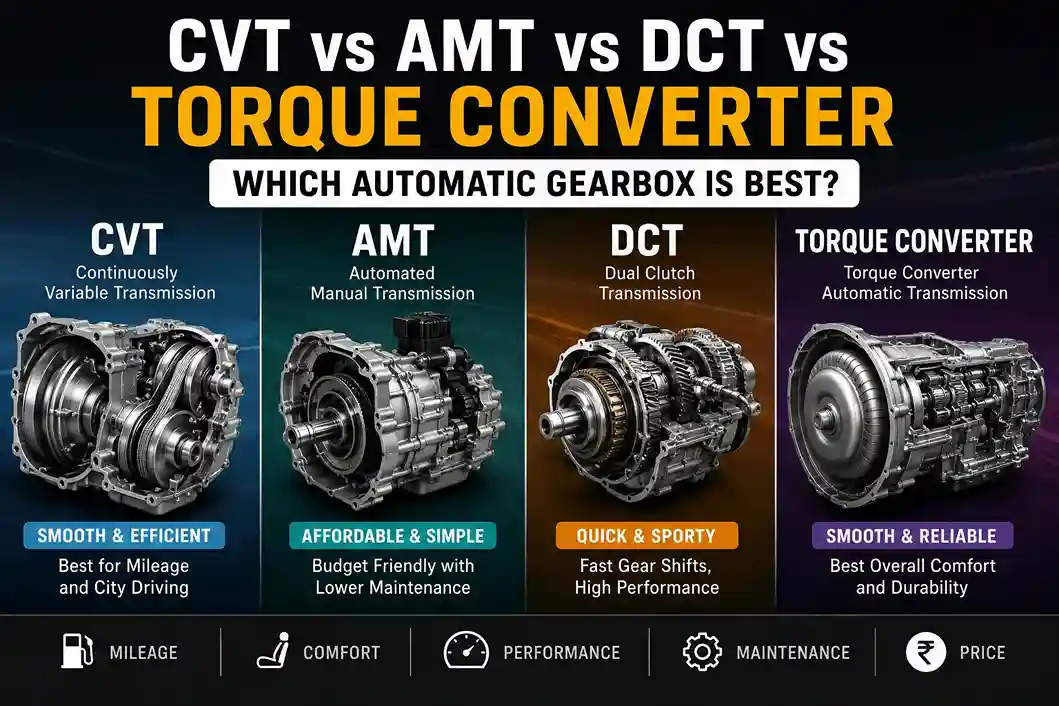
A CVT uses a continuously variable ratio rather than fixed gears, which is why Honda describes it as giving a smooth, constant flow of power and better fuel economy. A torque converter automatic uses a fluid coupling to transmit power and is often tuned for smooth starts and relaxed shifting; Toyota notes that modern automatics can lock the converter in certain gears to reduce power loss and improve efficiency. An AMT is basically a manual gearbox with automated clutch and shift control; Maruti Suzuki says the gear shifts and clutch control are electronically automated. A DCT uses two clutches and is designed for fast, direct shifts; Ford describes its dual-clutch transmission as a quick-shifting transmission.
That one-sentence summary already tells you the core difference: CVT is about smoothness, AMT is about affordability, DCT is about speed, and torque converter is about balanced everyday ease. In real-world situations, that means the “best” gearbox depends on whether your daily drive is mostly bumper-to-bumper traffic, open highways, or a mix of both.
CVT: smooth and relaxed, especially in calm driving
A CVT is a strong choice if you want an easy, unhurried driving feel. Honda’s own description emphasizes the smooth, constant flow of power and the electronically controlled operation that supports better fuel economy. Maruti Suzuki also highlights CVT’s smooth and comfortable driving behavior in its own customer-facing materials. That is exactly why CVTs often appeal to city buyers who value refinement over a sporty feel.
The trade-off is that some drivers do not like the “rubber-band” sensation, where engine revs rise before the car seems to build speed. That behavior is not a defect so much as a characteristic of how a CVT works. If you prefer a calm, smooth, low-stress commute and do not mind a less dramatic acceleration feel, CVT can be excellent. It pairs well with buyers who are already leaning toward practical cars in Best Family Cars Under 10 Lakh in India.
AMT: the budget-friendly automatic
AMT, or AGS in Maruti Suzuki’s terminology, is the simplest automatic in this group. Maruti says the gear shifts and clutch control are automated electronically, and Hyundai describes AMT as delivering the easy and relaxed driving of an automatic with higher efficiency due to its lighter weight and reduced friction compared with traditional automatics. That is why AMT is so common in entry-level cars and budget-oriented variants.
The big advantage of AMT is cost. It usually makes automatic ownership more affordable than CVT, DCT, or torque converter options. The downside is that it can feel slower or more hesitant during gear changes, especially in crawling traffic or during quick overtakes. For many first-time automatic buyers, though, AMT is still a sensible step up from manual ownership because it removes the clutch pedal without pushing the price too high. If you are choosing among compact cars, the comparison often sits right beside Manual vs Automatic Cars: Which One Should You Buy?.
DCT: quick shifts and a more engaging drive
DCT, or dual-clutch transmission, is the most performance-oriented of the four for many buyers. Ford describes its dual-clutch transmission as advanced and quick-shifting, which aligns with how DCTs are generally tuned: faster gear changes, stronger responsiveness, and a more connected driving feel. That is why DCTs are often paired with turbo petrol engines and sporty trims.
The upside is obvious when you drive enthusiastically. A DCT can feel much sharper than an AMT or many CVTs. The downside is that DCTs can be less happy in repeated slow-speed crawling if the calibration is not strong, and they may feel more complex to own. For buyers who care about driving feel and can live with a bit more mechanical sophistication, DCT can be a very satisfying answer.
Torque converter: the most balanced all-rounder
A torque converter automatic remains the most universally easy gearbox to recommend when comfort matters more than outright speed. Toyota’s press materials describe torque-converter automatics delivering smooth starts, with converter lock-up used to reduce power loss and improve fuel economy. Toyota has also highlighted wider torque-converter lock-up ranges in newer transmissions to improve directness and efficiency. That combination explains why torque converters still remain popular across many segments.
In everyday Indian use, torque-converter automatics usually feel very natural in traffic, on hills, and on highways. They are not always the cheapest or the most efficient on paper, but they tend to be easy to live with. That is why they often suit buyers who want one car to do everything reasonably well without needing to think about gearbox behavior every time they drive.
Which gearbox is best for city driving?
For city use, AMT and CVT are usually the most accessible choices, but for different reasons. AMT keeps costs lower, which matters a lot in budget cars. CVT feels smoother, which matters more if refinement is your priority. If you spend most of your time in stop-go traffic and want the least stressful daily drive, CVT or a good torque converter usually feels better than AMT. Honda’s CVT explanation and Maruti’s AGS description both support that basic split in character.
If your city route is short and your budget is tight, AMT still makes sense. If your city use includes longer commutes and frequent crawling, the smoother behavior of CVT or torque converter can be worth the extra money.
Which gearbox is best for highways?
For highways, DCT and torque converter usually stand out. DCT gives quicker shifts and a more enthusiastic response, while torque converter automatics often deliver the most balanced long-distance comfort. Toyota’s and Ford’s descriptions make that difference clear: torque converters focus on smooth power transmission and lock-up efficiency, while dual-clutch transmissions focus on fast shifting.
CVT can still work well on highways, especially in calm cruising, but drivers who like brisk overtakes may prefer DCT or a strong torque converter. AMT is acceptable on highways, but it is usually not the most confidence-inspiring choice if you often drive fully loaded or want quick passing power.
Maintenance and ownership costs matter too
The gearbox you choose also affects what kind of maintenance attitude you need. Hyundai’s transmission maintenance guidance notes that regular automatic transmission oil changes are important for performance, less wear, and avoiding overheating or improper shifting. That is a useful reminder that automatic gearboxes are not “maintenance free”; they simply shift some of the attention from the driver to the workshop.
If you want to keep ownership simple, a torque converter or a well-supported CVT can be very sensible. If you want the lowest purchase price, AMT is usually attractive. If you want the most engaging drive, DCT is usually the answer, but it asks more from both calibration and maintenance discipline. For buyers thinking long term, it helps to compare the gearbox choice with the whole car package, not just the transmission badge.
Common mistakes buyers make
One common mistake is choosing a gearbox only because it sounds modern. Another is assuming all automatics are equally smooth. They are not. A CVT feels very different from a DCT, and an AMT can feel very different from a torque converter. A third mistake is ignoring the way the car will actually be used. A gearbox that feels excellent on a test track may be annoying in daily traffic, and a cheap automatic that saves money up front may feel frustrating later.
A good buying process is to test drive the exact transmission you plan to buy, on roads that resemble your daily route. If you regularly compare car value, cabin space, and running costs through articles like Best Cars Under 15 Lakh in India and How to Improve Car Mileage in India, use the same disciplined approach here.
So, which automatic gearbox is best?
There is no single winner for everyone.
- Best for budget buyers: AMT
- Best for smooth city comfort: CVT
- Best for sporty, quick shifting: DCT
- Best all-rounder: Torque converter
If you want the simplest possible answer, the torque converter is the safest universal recommendation. If you want the most comfort for relaxed driving, CVT is very appealing. If your budget is limited, AMT does the job well enough for many buyers. If you care most about quick reactions and driving enjoyment, DCT is the most exciting option. That is why the real answer to CVT vs AMT vs DCT vs Torque Converter depends less on specifications and more on your driving life.
FAQ
Is CVT better than AMT?
Usually yes, if comfort and smoothness matter most. AMT is generally cheaper, but CVT is typically smoother and more refined. Honda’s CVT description and Maruti’s AGS explanation show why the two feel so different.
Is DCT better than torque converter?
Not always. DCT is usually quicker and more engaging, while torque converter automatics are often smoother and easier to live with in daily use. Ford and Toyota’s official descriptions reflect those different priorities.
Which gearbox is best for Indian traffic?
For heavy traffic, CVT and torque converter automatics are usually the easiest to live with. AMT is the budget option, while DCT works best when you want better response and can accept more complexity.
Which gearbox gives the best mileage?
It depends on the car, tuning, and driving style. Honda says CVT is designed for better fuel economy, while Toyota highlights torque-converter lock-up as a way to reduce power loss and improve efficiency.
Conclusion
When you compare CVT vs AMT vs DCT vs Torque Converter, the best automatic gearbox is the one that fits your budget, your traffic, and your driving style. AMT is the value pick, CVT is the smooth comfort pick, DCT is the performance pick, and torque converter is the balanced everyday choice. For most Indian buyers, the safest path is to test drive the exact car in the exact gearbox you plan to buy, then compare it with the rest of the market using guides like Best Automatic Cars Under 10 Lakh in India and Best Family Cars Under 10 Lakh in India. Once you match the gearbox to real-world use, the decision becomes much easier.
Author: Carsinfos Editorial Team
Published: May 23rd, 2026