Choosing between petrol manual vs petrol automatic is not just a question of driving comfort. It is a money question, too, and the answer is more nuanced than many buyers expect. A manual used to have a clear reputation for better fuel efficiency, but the gap has narrowed a lot as automatics have improved. In the U.S. EPA’s 2025 Automotive Trends Report, modern automatics are described as generally more efficient than manual transmissions, while the U.S. Department of Energy notes that manual transmissions require driver skill and mistakes can increase wear and hurt fuel economy.
If you already care about running costs and small savings, guides like How to Improve Car Mileage in India and How to Check Car Tyre Pressure at Home in India fit naturally into this decision, because the transmission is only one part of the total ownership picture.
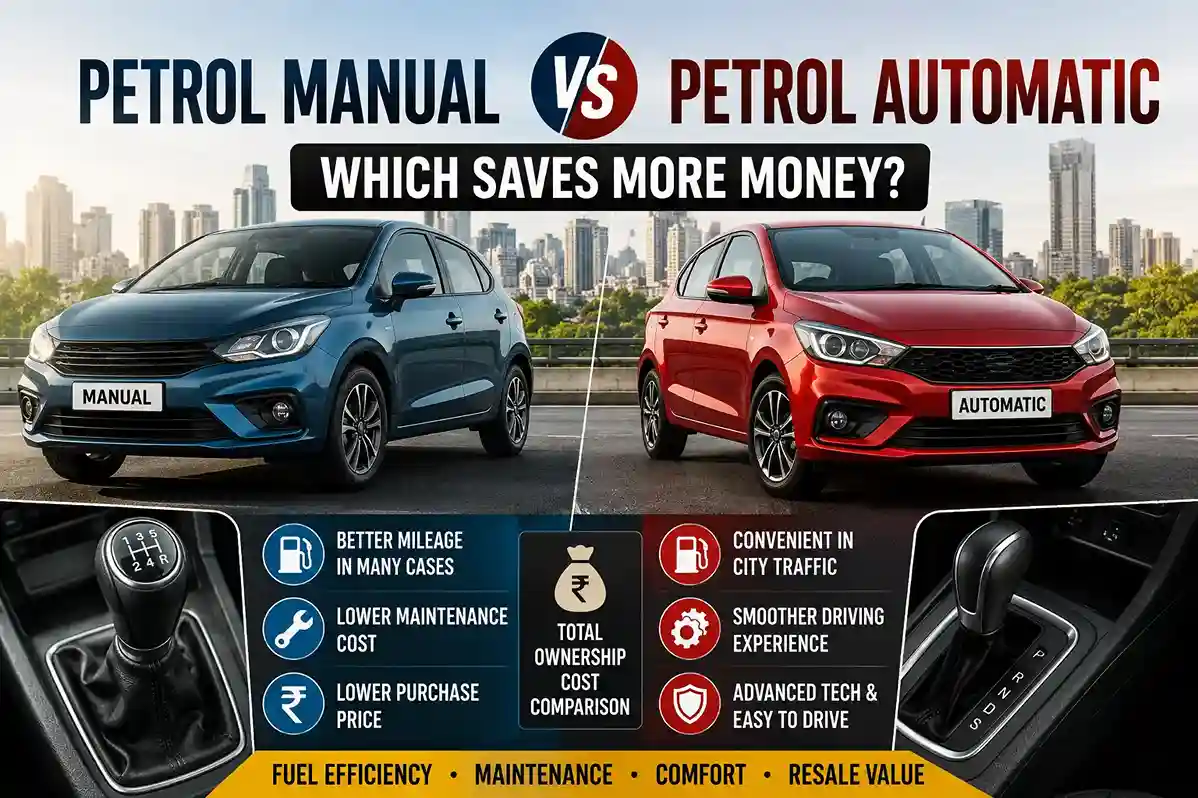
Petrol Manual vs Petrol Automatic: Which Saves More Money?
The short answer is: it depends on what kind of money you mean. If you mean fuel bills alone, a manual is no longer automatically the cheaper choice. EPA says modern automatics are generally more efficient than manuals, and Honda explains that a CVT can improve fuel efficiency by keeping the engine closer to its most efficient range instead of shifting in fixed steps.
If you mean total ownership cost, the answer depends on your daily driving pattern, how much traffic you face, how disciplined you are with maintenance, and which automatic transmission you are comparing against. That is why CVT vs AMT vs DCT vs Torque Converter: Which Is Best? is a useful companion read: “automatic” is not one single thing, and different automatic systems behave very differently in the real world.
Where the Money Actually Goes
A gearbox affects cost in more than one way. It changes:
- fuel consumption over time
- maintenance and repair exposure
- how tiring the car feels in city traffic
- how often a driver’s habits affect efficiency
- how much support the rest of the car needs to stay efficient
That is why the best answer is never just “manual” or “automatic.” In practice, the cheapest choice is the one that suits your commute and your driving style while keeping other running costs under control. For many budget shoppers, that is the same reason articles like Best Cars Under 7 Lakh in India 2026 – Price, Mileage & … matter: variant selection often matters as much as the gearbox itself.
1) Fuel cost over the years
Older buying advice often favored manuals for fuel savings, but that is not a universal rule anymore. EPA says modern automatics are generally more efficient than manual transmissions, and Honda says a CVT can deliver higher fuel efficiency because it gives the engine greater freedom to stay in efficient operating ranges. That means a well-designed automatic can be close to, or sometimes better than, a manual in day-to-day use.
In real-world situations, the driver matters a lot too. A manual can be efficient in the hands of someone who shifts cleanly and avoids unnecessary revving, but the DOE warns that manual-transmission mistakes can increase wear and tear and affect fuel economy. That is one reason manual ownership savings are not guaranteed.
2) Maintenance and wear
Manual cars can appear cheaper because the system is simpler, but that does not mean the running cost is always lower. A manual gearbox asks more from the driver, especially in stop-go traffic, and the DOE notes that manual-transmission mistakes can increase wear and tear. That matters because clutch abuse, poor shifting habits, and constant crawling in traffic can slowly turn a “cheap” manual into a more expensive ownership experience than expected.
Automatic cars, on the other hand, remove a lot of that driver-dependent wear from the equation. They do not eliminate maintenance, but they often reduce the chance that repeated driving mistakes directly affect efficiency. If you are trying to protect mileage in either case, the habits in How to Improve Car Mileage in India are just as important as the gearbox itself.
3) Tyres, alignment, and basic upkeep still change the answer
A surprising amount of fuel economy comes from ordinary maintenance. FuelEconomy.gov says proper tyre inflation and maintenance can improve gas mileage, and NHTSA says underinflated tyres reduce fuel economy and shorten tyre life; it also advises checking tyre pressure at least once a month. That means a manual with poor tyre care can lose its advantage quickly, while an automatic kept in good shape can be more economical than people assume.
That is why How to Check Car Tyre Pressure at Home in India and When Should You Replace Car Tyres in India? Warning Signs Explained are worth keeping in your maintenance toolkit. If the tyres are underinflated, worn, or badly matched, the transmission choice alone will not save much money.
Which One Saves More in City Driving?
For most Indian buyers, city driving is where the decision gets real. Heavy traffic, frequent stops, crawling speeds, and long idling periods make automatic cars feel easier to live with. That does not mean they always use less fuel, but it does mean they often save driver effort and reduce the chance of rough clutch use. DOE’s point about manual-transmission skill and wear is especially relevant here.
If your daily route is mostly bumper-to-bumper traffic, an automatic may deliver better overall value even when the fuel bill is close to a manual. A smooth CVT or well-tuned automatic can also be easier to live with than a manual because the engine and transmission work together more consistently, which is exactly why Honda describes CVTs as improving efficiency and smoothness.
Which One Saves More on Highway Use?
On the highway, the gap can narrow further. A disciplined manual can still be very economical on open roads, especially if the driver keeps the engine in the right band and avoids unnecessary downshifts. But modern automatics are not the fuel-wasting machines they once were. EPA’s report makes it clear that modern automatics are generally more efficient than manual transmissions today, which is a major change from the old assumption that manual always wins.
If your idea of ownership value includes relaxed cruising, less fatigue, and consistent efficiency, an automatic may still be the better economic choice over time. If your priority is maximum driver involvement and you are good with shifting, a manual can still make sense. The answer becomes more about how you drive than what the brochure says.
Common Mistakes Buyers Make
One mistake is assuming every automatic is the same. A CVT, AMT, torque-converter automatic, and DCT do not feel identical, and they do not always cost the same to own. That is why it helps to compare gearbox types before you buy. Our guide on CVT vs AMT vs DCT vs Torque Converter: Which Is Best? breaks down the differences in a simple way.
Another mistake is chasing a transmission choice without thinking about the rest of the car. Tyres, tyre pressure, wheel condition, and driving habits all affect fuel economy. If you want the gearbox decision to pay off, basic care matters just as much as the transmission itself. NHTSA and FuelEconomy.gov both stress regular tyre checks and proper inflation for efficiency and safety.
A third mistake is buying only on showroom price without checking the wider ownership fit. For some buyers, the right answer is buried in the variant ladder, not in the gearbox badge. That is why budget-focused research, like Best Cars Under 7 Lakh in India 2026 – Price, Mileage & …, is useful before signing anything.
Best Practices Before You Decide
A good decision usually comes from a simple three-step check:
- Compare the exact manual and automatic variants of the same model.
- Estimate your yearly kilometres and how much of them are city traffic.
- Check how much maintenance discipline you are realistically willing to follow.
That last point matters because a manual can be very cost-effective in the right hands, but DOE notes that driver mistakes can increase wear and hurt fuel economy. At the same time, a modern automatic can reduce that variability and may be more efficient than older buyers expect.
If you want one extra step that pays off no matter which gearbox you choose, check tyre pressure regularly. It is one of the simplest fuel-saving habits available, and NHTSA says proper inflation helps with safety, durability, and fuel consumption.
FAQ
Is a petrol manual always cheaper than a petrol automatic?
Not always. Manuals were historically seen as cheaper on fuel, but EPA says modern automatics are generally more efficient than manual transmissions now, so the gap depends on the exact car and transmission.
Which transmission is better for city traffic?
An automatic is usually easier and less tiring in city traffic because it removes constant clutch work. DOE notes that manual transmissions require driver skill and mistakes can affect fuel economy, which becomes especially relevant in stop-go driving.
Which one is better for fuel economy today?
That depends on the model. EPA says modern automatics are generally more efficient than manual transmissions, and Honda says CVTs can improve efficiency further by keeping the engine in a more efficient range.
How can I reduce running cost in either one?
Keep tyres properly inflated, follow service schedules, and avoid habits that waste fuel. FuelEconomy.gov and NHTSA both stress that proper tyre pressure supports fuel economy and tyre life.
Should I choose manual if I want the lowest long-term cost?
Only if your driving style and commute suit it. A manual can be economical when driven well, but modern automatics are much closer than they used to be, and sometimes better on efficiency. The smarter answer is the one that fits your real use, not the old rule of thumb.
Conclusion
The honest answer to petrol manual vs petrol automatic: which saves more money? is that there is no single winner for everyone. Manuals can still make sense for buyers who want direct control and are disciplined with driving and maintenance, but modern automatics have become far more efficient than they used to be, and CVT-style systems can improve fuel economy further. EPA, DOE, and Honda all point in the same direction: the old assumption that manual always saves more money no longer holds automatically.
For most buyers, the best move is to compare the exact variants, estimate real-world city and highway use, and keep the car in good shape with small habits like proper tyre inflation and regular maintenance. If you are refining that ownership plan, How to Improve Car Mileage in India and How to Check Car Tyre Pressure at Home in India are two of the most practical next reads.
Author: Carsinfos Editorial Team
Published: June 3rd, 2026