The debate around Hybrid vs Electric Cars in India 2026 is becoming more relevant with every passing year. Rising fuel prices, growing environmental awareness, government incentives, and expanding charging infrastructure have pushed more buyers to consider alternatives to traditional petrol and diesel vehicles.
However, choosing between a hybrid and an electric vehicle (EV) is not as simple as comparing mileage figures or battery sizes. Each technology solves a different problem, and the right choice depends heavily on how and where you drive.
For buyers already comparing ownership costs through guides like EV Charging Cost vs Petrol Cost Per KM in India 2026 and evaluating long-term running expenses through Petrol Manual vs Petrol Automatic: Which Saves More Money?, understanding the hybrid versus electric decision is a logical next step.
So which option makes more sense in India in 2026? Let’s look beyond marketing claims and focus on real-world ownership.
Understanding the Difference Between Hybrid and Electric Cars
Before comparing costs and practicality, it helps to understand how each technology works.
What is a Hybrid Car?
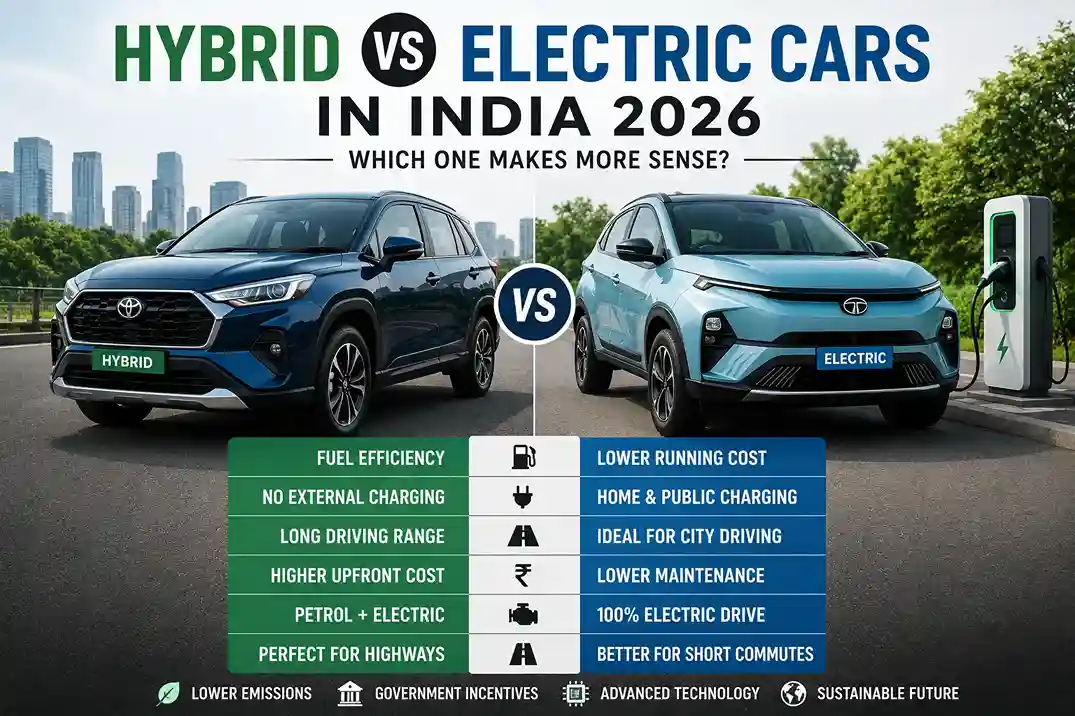
A hybrid car combines a conventional petrol engine with an electric motor and battery system.
The battery charges automatically through regenerative braking and the engine itself, meaning drivers do not need to plug the vehicle into a charging station.
Popular examples in India include the Toyota Hyryder Hybrid, Maruti Suzuki Grand Vitara Hybrid, and Toyota Innova Hycross Hybrid.
What is an Electric Car?
An electric vehicle runs entirely on electricity stored in a battery pack.
Unlike hybrids, EVs require charging through home chargers or public charging stations.
Popular EVs in India include the Tata Nexon EV, Tata Punch EV, MG Windsor EV, Mahindra XUV400 EV, and BYD Seal.
According to the International Energy Agency’s Global EV Outlook, electric vehicle adoption continues to grow worldwide as charging infrastructure and battery technology improve.
Hybrid vs Electric Cars in India 2026: Purchase Price Comparison
One of the first things buyers notice is the upfront cost.
In many segments, hybrid vehicles remain more expensive than equivalent petrol versions because of their dual powertrain system.
EV pricing has improved significantly, but battery costs still influence vehicle pricing.
In real-world situations, buyers often compare the monthly ownership cost rather than the sticker price alone.
For example:
- A strong hybrid SUV may cost ₹18–25 lakh.
- A mid-size EV may fall within a similar price range.
- Entry-level EVs can be cheaper than many hybrids.
Government support also influences pricing. India’s electric mobility initiatives under the Ministry of Heavy Industries continue encouraging EV adoption through various policy measures and infrastructure support programs.
The important takeaway is that purchase price alone rarely determines long-term value.
Running Costs: Where EVs Usually Win
Running cost remains one of the strongest arguments for electric vehicles.
A vehicle powered by electricity generally costs significantly less per kilometre compared to petrol-powered vehicles.
Buyers who have already explored EV Charging Cost vs Petrol Cost Per KM in India 2026 understand how substantial this difference can become over several years.
For example:
- Daily commuters covering 50–80 km often see meaningful savings with EV ownership.
- Home charging can further reduce operating costs.
- Regenerative braking helps improve efficiency in city traffic.
Hybrid vehicles are still extremely efficient compared to conventional petrol cars.
Many strong hybrids deliver fuel economy figures exceeding 25 km/l under favorable conditions.
However, they still depend on petrol.
As fuel prices fluctuate, hybrid operating costs remain partially tied to fuel markets.
Charging Convenience vs Refueling Convenience
This is where many buying decisions are made.
Why Hybrids Feel Familiar
Hybrid ownership requires almost no behavioral change.
Drivers simply refuel at petrol stations as they always have.
There is:
- No charging schedule
- No range planning
- No charger installation requirement
- No charging station dependency
For many buyers, especially first-time alternative-fuel vehicle owners, this simplicity matters.
Why EV Ownership Requires Planning
EVs demand a different ownership mindset.
The availability of home charging often determines whether EV ownership feels effortless or frustrating.
The Bureau of Energy Efficiency highlights the growing role of charging infrastructure in India’s transition toward electric mobility.
For example:
- Apartment residents may face charging challenges.
- Homeowners with dedicated parking often find EV ownership easier.
- Long-distance travelers may need route planning.
In urban environments, EV ownership becomes much easier when charging is available at home or work.
Long-Distance Travel: Hybrid Advantage
India’s charging network continues expanding rapidly.
However, hybrid vehicles still offer a practical advantage for frequent highway users.
A hybrid can travel hundreds of kilometres and refuel within minutes.
An EV may require charging stops depending on route, traffic conditions, battery size, and charging availability.
Drivers who regularly travel between cities may appreciate the flexibility hybrids provide.
For example, a family frequently driving between Hyderabad and Bengaluru might find a hybrid easier to manage today than a pure EV.
That does not mean EVs cannot handle long trips.
They certainly can.
But they often require more planning.
City Driving: EV Advantage
Urban traffic is where EVs truly shine.
Stop-and-go traffic allows electric motors to operate efficiently while regenerative braking recovers energy.
In real-world situations, city drivers often experience:
- Lower operating costs
- Smoother acceleration
- Quieter driving experience
- Less maintenance complexity
Many buyers researching How to Improve Car Mileage in India eventually realize that EVs effectively eliminate traditional mileage concerns altogether.
For dense urban commuting, electric vehicles frequently provide the better overall experience.
Maintenance Costs: What Buyers Should Know
Maintenance is another major consideration.
Electric Cars
EVs have fewer moving parts.
There are no:
- Engine oil changes
- Spark plugs
- Fuel injectors
- Traditional transmission systems
According to the U.S. Department of Energy’s EV ownership resources, electric vehicles generally require less routine maintenance than conventional vehicles.
Hybrid Cars
Hybrid vehicles still contain:
- Petrol engines
- Cooling systems
- Engine oil
- Transmission components
Although hybrids are highly reliable, they remain mechanically more complex than pure EVs.
Over the long term, maintenance costs often favor electric vehicles.
Battery Concerns: Are They Still a Problem?
Battery anxiety remains one of the most common concerns among Indian buyers.
Fortunately, battery technology has improved significantly.
Most manufacturers now provide long battery warranties.
Many EVs sold in India offer battery coverage ranging from 8 years to 160,000 km.
Hybrid batteries also tend to last many years under normal operating conditions.
The International Energy Agency notes ongoing improvements in battery durability, efficiency, and lifecycle management.
For most buyers in 2026, battery longevity should be a consideration—but not necessarily a deal breaker.
Environmental Impact
Both technologies reduce fuel consumption and emissions compared to conventional petrol vehicles.
However, EVs generally offer greater long-term emission reduction potential because they eliminate tailpipe emissions entirely.
The environmental benefit still depends partly on how electricity is generated.
India’s increasing investment in renewable energy strengthens the environmental case for EV adoption over time.
Hybrids remain a valuable transitional technology because they reduce fuel use without requiring charging infrastructure.
Common Mistakes Buyers Make
Choosing Based Only on Fuel Savings
Fuel cost matters, but convenience, infrastructure, and driving habits matter too.
Ignoring Daily Driving Patterns
Someone driving 20 km daily has different needs than someone driving 150 km daily.
Overestimating Range Requirements
Many drivers rarely travel beyond their city’s limits but still focus excessively on maximum range.
Not Considering Home Charging
A home charging setup often determines whether EV ownership becomes convenient.
Ignoring Total Ownership Cost
Vehicle price, maintenance, insurance, charging costs, and resale value should all be considered together.
Best Practices Before Buying
Before deciding between a hybrid and an EV:
- Calculate your monthly driving distance.
- Check charging availability at home and work.
- Consider how often you travel long distances.
- Compare total ownership costs rather than purchase price alone.
- Test drive both vehicle types.
Buyers comparing drivetrain options may also find value in reading CVT vs AMT vs DCT vs Torque Converter: Which Is Best? because transmission preferences often influence vehicle selection in hybrid models.
Which One Makes More Sense in India in 2026?
The answer depends on your lifestyle.
Choose a Hybrid if:
- You frequently travel long distances.
- Charging access is uncertain.
- You want familiar ownership habits.
- You prefer flexibility without route planning.
Choose an Electric Car if:
- Most driving happens within cities.
- Home charging is available.
- You want lower running costs.
- You plan to keep the vehicle for several years.
For many urban Indian buyers, EVs now make more financial sense than ever before.
For buyers prioritizing flexibility and highway convenience, hybrids remain extremely compelling.
FAQ
Are hybrid cars better than electric cars in India?
Not necessarily. Hybrids offer greater refueling convenience, while EVs usually provide lower running costs and maintenance expenses.
Which is cheaper to run: hybrid or electric?
Electric vehicles generally cost less per kilometre to operate, especially when charged at home.
Are EV charging stations common in India in 2026?
Charging infrastructure continues expanding rapidly, particularly in major cities and highway corridors.
Do hybrid cars need charging?
Most strong hybrids sold in India charge themselves automatically and do not require external charging.
Which is better for city driving?
Electric vehicles typically perform exceptionally well in city traffic because of regenerative braking, quiet operation, and lower operating costs.
Conclusion
When comparing Hybrid vs Electric Cars in India 2026, there is no universal winner.
Electric vehicles have become increasingly practical for urban drivers thanks to lower running costs, expanding infrastructure, and reduced maintenance requirements. Hybrids continue offering unmatched convenience for buyers who travel frequently or lack reliable charging access.
The smartest choice depends on how you actually use your vehicle—not on headlines, trends, or marketing promises.
For city-focused drivers with access to charging, EVs often deliver the strongest long-term value. For buyers seeking maximum flexibility and worry-free highway travel, hybrids remain one of the most practical solutions available today.
Author: Carsinfos Editorial Team
Published: June 4th, 2026