
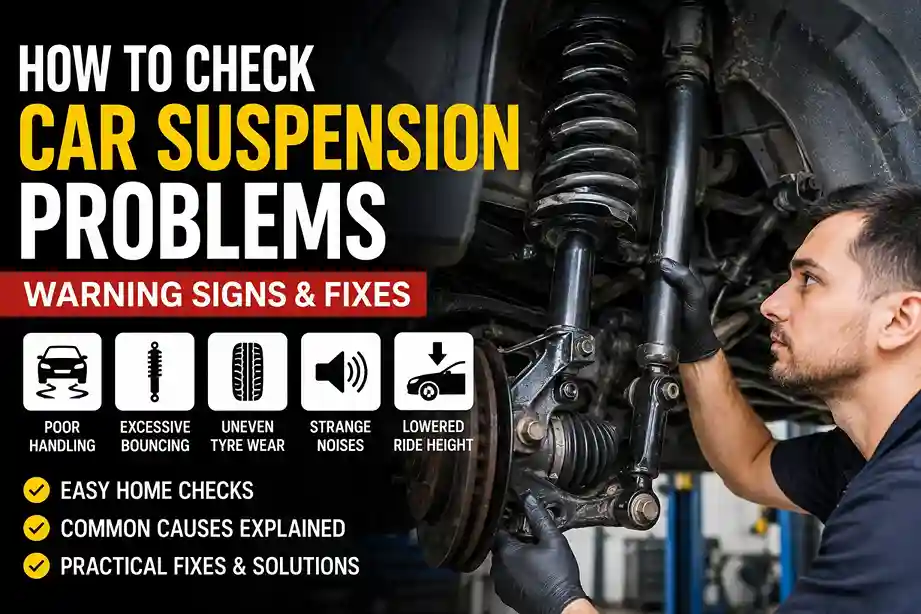
Car suspension problems usually do not begin with a dramatic breakdown. More often, they start with small changes that are easy to ignore: a little extra bounce after a speed breaker, a steering wheel that feels less settled, or tyres that begin wearing unevenly. The earlier you notice those changes, the more likely you are to fix the issue before it becomes a safety concern or a bigger repair bill. That is especially important if you already pay attention to maintenance basics like How to Check Car Tyre Pressure at Home in India, Car Dashboard Warning Lights Explained, and How to Improve Car Mileage in India. NHTSA’s tyre guidance also emphasizes regular inspection and rotation, especially when uneven wear starts to appear.
How to Check Car Suspension Problems Before They Get Worse
The suspension system keeps your tyres in contact with the road while absorbing bumps, potholes, and rough surfaces. It includes shocks, struts, springs, bushings, control arms, mounts, and related hardware. When one part starts wearing out, the signs often show up somewhere else first: in tyre wear, steering feel, braking behavior, or the way the car sits on the road.
A basic home check will not replace a workshop inspection, but it can tell you whether your car needs attention soon. Start with a walk-around inspection, then look for changes in ride height, tyre wear, leaks, and strange noises. If you regularly drive on rough roads, articles like Ground Clearance Explained: Why It Matters on Indian Roads are useful because low clearance, load stress, and suspension wear often overlap in real use.
Common Warning Signs of Suspension Problems
1) The car bounces too much after bumps
A healthy suspension settles quickly after a bump or speed breaker. If the body keeps bouncing more than it should, the shocks or struts may be worn. In real-world situations, this is easiest to notice after a pothole or a tall speed breaker at low speed.
2) The front end dips sharply during braking
If the car nose-dives every time you brake, the suspension may no longer be controlling weight transfer properly. This can make the car feel less composed and may also affect stopping confidence in traffic.
3) The rear squats during acceleration
A little movement is normal, but if the rear drops too much under throttle, the suspension may be too soft, tired, or damaged.
4) The steering feels vague or unstable
Loose steering, wandering on straight roads, or the need for constant correction often points to wear somewhere in the suspension or alignment system. If this happens together with a warning light, Car Dashboard Warning Lights Explained can help you separate a handling issue from another system fault.
5) You hear clunks, squeaks, or rattles
Noise is one of the clearest signs of trouble. A clunk over rough roads can point to worn bushings, loose mounts, bad links, or play in joints. Squeaks often come from rubber parts aging or drying out.
6) The car leans too much in corners
Too much body roll in turns can mean worn dampers or weakened springs. This is especially obvious during lane changes or highway curves.
7) Uneven tyre wear shows up early
Suspension problems often reveal themselves through the tyres first. Look for one-edge wear, cupping, or patchy tread wear. NHTSA notes that tyres should be rotated regularly and sooner if uneven wear appears, because irregular wear can shorten tyre life and affect efficiency.
8) You see fluid leaking near the shocks
If a shock absorber or strut looks oily, that part may be leaking and losing damping ability. That usually means the ride and handling will continue to get worse over time.
9) The car sits unevenly
If one corner looks lower than the others when parked on level ground, that is a major clue. The FTC’s auto repair guidance notes that springs do not normally wear out unless one corner is lower than the others, and overloading can damage them.
A Simple Home Inspection You Can Do
You do not need a lift for an initial check. A careful visual inspection can reveal a lot.
Step 1: Walk around the car
Look for:
- one corner sitting lower than the others
- leaking fluid near a wheel
- visibly damaged rubber parts
- unusual tyre wear
- bent or broken suspension pieces
Step 2: Try the bounce test
Press down firmly on one corner of the car and release. AAA describes the bounce test as a simple way to check shock absorbers, and a car that keeps bouncing instead of settling quickly may need attention.
Step 3: Drive a familiar route slowly
Choose roads you know well and pay attention to how the car behaves over bumps, while braking, and during turns. Small changes are easier to notice when you compare them with how the car used to feel.
Step 4: Inspect the tyres closely
Check all four tyres for uneven wear, side-to-side differences, or wear on only one edge. NHTSA recommends regular tyre checks and rotation, especially when irregular wear appears.
Step 5: Listen carefully
A new noise is often the difference between a simple repair and a bigger one later. If the noise only happens on certain bumps, note exactly when it occurs. That detail helps a mechanic narrow it down faster.
Common Mistakes Drivers Make
One of the biggest mistakes is blaming every rough ride on the road surface. Bad roads do cause stress, but suspension problems show up as a change from your car’s normal behavior, not just as discomfort on uneven pavement.
Another common mistake is replacing only one part and ignoring the rest of the system. For example, worn shocks may appear together with tired bushings or alignment issues. Fixing only the obvious piece can leave the underlying problem untouched.
A third mistake is waiting until tyre wear becomes severe. At that stage, you may need both suspension work and tyre replacement. That turns a manageable repair into a much more expensive one.
What Usually Needs Fixing
Shocks or struts
If the car bounces too much, dives under braking, or feels unstable, the dampers may need replacement. These parts wear gradually, so the change is often slow enough to overlook until the handling feels noticeably different.
Springs
A broken or sagging spring can change ride height and make the car sit unevenly. If one side looks lower, springs should be inspected quickly.
Bushings and mounts
Rubber bushings and mounts keep suspension parts stable and reduce vibration. When they crack or wear out, the car may start clunking, squeaking, or feeling loose.
Alignment
If the suspension is repaired but the car still pulls or the tyres wear unevenly, wheel alignment may be needed. Alignment should usually be checked after suspension work, not before.
Tyres
Tyres and suspension are closely linked. A tyre damaged by bad suspension will not recover just because the suspension is repaired. In many cases, both issues must be addressed together. That is why articles like When Should You Replace Car Tyres in India? fit naturally into suspension maintenance planning.
Best Practices to Prevent Suspension Trouble
A few simple habits can reduce wear and help you catch problems early.
- Slow down over potholes and speed breakers.
- Avoid carrying excess weight for long periods.
- Keep tyre pressure at the recommended level.
- Rotate tyres on schedule.
- Get alignment checked when tyres show unusual wear.
- Inspect the underbody after a hard impact.
- Pay attention to new noises or steering changes.
The FTC also notes that an unbalanced or improperly balanced tyre can cause vibration and wear steering and suspension components prematurely, which is a good reminder that suspension health is not isolated from the rest of the car.
For example, a driver who regularly uses rough city roads may first notice suspension wear through tyre noise or steering drift, while a highway driver might notice it more through body roll or bounce. The symptom depends on how the car is used.
When You Should Get It Checked Quickly
Some suspension issues can wait until your next service appointment. Others should be inspected sooner.
Go for a check soon if you notice:
- heavy bouncing after bumps
- loud clunking from one corner
- visible fluid leakage from a shock absorber
- the car leaning to one side
- strong steering pull or instability
- sudden, severe tyre wear
If the car feels unsafe, do not keep driving casually and hope it improves. Treat it the same way you would treat other serious maintenance problems such as How to Check Car Brake Pads at Home in India or How to Check Car Engine Coolant Level at Home in India. A handling problem can become a control problem quickly.
FAQ: How to Check Car Suspension Problems
How do I know if my suspension is bad?
A bad suspension usually shows up as excessive bouncing, unusual noises, uneven tyre wear, poor steering stability, nose-diving under braking, or a car that sits unevenly.
Can I check suspension problems at home?
Yes, at least at a basic level. A walk-around inspection, bounce test, tyre check, and slow test drive can reveal common warning signs.
Does uneven tyre wear always mean suspension damage?
Not always. Alignment, tyre pressure, and rotation habits can also cause wear. But if the wear is repeated or unusual, the suspension should be checked.
Is it safe to drive with suspension problems?
That depends on the severity. Mild symptoms may only need a short trip to a workshop, but major bouncing, leaks, loud clunks, or unstable handling should be checked quickly.
Should shocks and struts be replaced together?
In many cases, yes, especially on the same axle. Replacing them in pairs usually helps keep the car balanced.
Conclusion
Learning how to check car suspension problems is one of the most useful maintenance habits a driver can build. You do not need special tools to notice the early warning signs. Bouncing, nose-diving, uneven tyre wear, clunks, leaks, steering looseness, and excess body roll all tell a story if you pay attention.
The best approach is simple: inspect the car regularly, compare how it feels now with how it used to feel, and act early when something changes. That is the most practical way to protect ride comfort, tyre life, and safety while keeping suspension repairs from getting out of hand.
Author: Carsinfos Editorial Team
Published: May 30th, 2026