
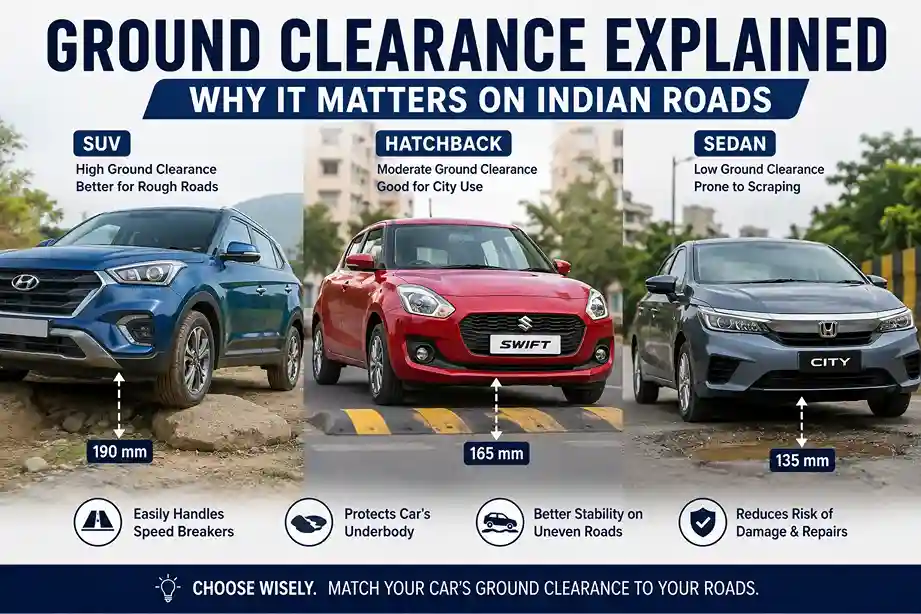
Ground Clearance Explained: Why It Matters on Indian Roads is one of those car-buying topics that sounds simple until you start driving on real roads. In basic terms, ground clearance is the distance between the lowest point of the vehicle and the ground, and manufacturers may measure or describe ride height a little differently depending on the model. Car and Driver defines ride height as the distance between the ground and a fixed reference point on the car body, which is why published numbers should always be read in context rather than as the whole story. On Indian roads, that context matters a lot because speed breakers, potholes, uneven surfaces, and rural stretches are common enough that a car’s underbody can become a daily concern, not a rare one.
If you are already comparing body styles through articles like SUV vs Sedan: Which One Should Indian Families Choose in 2026? or browsing practical buying lists such as Best SUVs Under 10 Lakh in India, ground clearance is one of the most important filters to keep in mind. It also affects whether a car feels easy to live with or constantly vulnerable to scraping. That is why buyers often notice it only after a bad encounter with a tall speed breaker or a deep pothole.
Ground Clearance Explained: what it actually does
Ground clearance is not just a specification line in a brochure. It influences how easily a car can pass over obstacles, how confidently it can handle broken roads, and how much stress the underbody takes when the surface is not smooth. Hyundai’s own Indian-market content notes that higher ground clearance helps manage speed breakers, uneven surfaces, and rural stretches more easily, while Tata says a higher underside height reduces the chance of the vehicle hitting the ground and getting damaged. In other words, clearance is not only about “SUV feel”; it is about avoiding real-world contact between the vehicle and the road.
That is also why manufacturers talk about ground clearance differently depending on the segment. A hatchback may focus on efficiency and everyday usability, while a crossover or SUV may emphasize its stance, rough-road confidence, and ability to absorb bad-road encounters. If you have been comparing Best Hatchback Cars In India – Price, Mileage, Features & Comparison with taller vehicles in Best Family Cars Under 10 Lakh in India, this is one of the key reasons the experience feels so different even when the price is similar.
Why ground clearance matters so much on Indian roads
Indian roads are exactly the kind of environment where ground clearance becomes practical, not theoretical. Hyundai’s India blog explicitly points to speed breakers, uneven surfaces, and rural stretches as reasons higher clearance helps. That lines up with how many mainstream Indian vehicles are marketed: Hyundai says the CRETA’s ground clearance supports confident driving over typical urban road conditions such as speed breakers and uneven surfaces, while Tata highlights 193 mm ground clearance on the Punch as part of its rough-road-friendly stance.
In real-world situations, this means a car with low clearance can force you to slow down heavily before every breaker, angle the car awkwardly in parking ramps, or worry about scraping the bottom with passengers on board. A higher-clearance vehicle does not magically solve bad roads, but it usually gives the driver more confidence and a wider safety margin. That is why many buyers who start by looking at sedans eventually cross-shop compact SUVs and crossovers as their road use becomes clearer.
How much ground clearance do you really need?
There is no universal number that fits every buyer, but the examples in the market are useful. Maruti Suzuki lists the Swift at 163 mm ground clearance, which is a practical figure for a compact hatchback; Tata lists the Punch at 193 mm, which gives it a more SUV-like ability to cope with rougher surfaces. Those two numbers show the basic trade-off well: lower-riding cars can feel easy and efficient in town, while taller vehicles generally offer more reassurance over bad patches.
For mostly city use on decent roads, a well-engineered hatchback or compact sedan can still be perfectly fine if you drive carefully and avoid loading the car in a way that increases scraping risk. For mixed use, frequent speed breakers, full family occupancy, or regular trips outside the city, the extra clearance of a crossover or SUV starts to make more sense. That is why buyers often move from a hatchback shortlist into SUV territory when they compare cars across segments like Best SUVs Under 15 Lakh in India or even Best Cars Under 15 Lakh in India.
Ground clearance is only one part of the story
A common mistake is to think that high ground clearance alone makes a vehicle “good for Indian roads.” It helps, but it is not the full answer. The shape of the underbody, suspension tuning, wheelbase, tyre profile, and even how the car is loaded all matter in practice. That is why two vehicles with similar clearance can still feel very different on the same road. Manufacturer examples show this clearly: Hyundai emphasizes the CRETA’s ability to handle urban road conditions comfortably, while Tata and Maruti publish their ground-clearance numbers as part of a broader vehicle-character story rather than as a standalone promise.
Another point that matters is tyre condition. Even the best ground clearance can be undermined if tyres are underinflated, because the vehicle can sit lower than it should and feel less composed over bumps. NHTSA recommends checking tyre pressure regularly and notes that properly inflated tyres support safe load-carrying capacity, handling, and braking, while underinflation can reduce those qualities. If you are serious about keeping the car comfortable and safe on rough roads, pairing a good-clearance car with proper tyre maintenance is essential. How to Check Car Tyre Pressure at Home in India is a simple next read if you want to make sure the rest of the setup is working as intended.
When higher ground clearance is worth paying for
Higher ground clearance is worth paying for when your driving life actually uses it. If you regularly face broken roads, steep speed breakers, heavy monsoon waterlogging, or uneven village stretches, the extra height can prevent scraping and reduce stress. Tata’s product pages and Hyundai’s India content both frame higher ground clearance as useful precisely because it makes the car more tolerant of rough surfaces and urban obstacles. That is a practical reason many Indian buyers choose compact SUVs even when a lower car might be slightly easier to park or marginally more efficient.
If your driving is mostly on smooth city roads, and you prefer a lower loading height, easier ingress and egress, and often better highway efficiency, a lower vehicle can still be the better choice. That is why the sedan-versus-SUV decision is so personal, and why SUV vs Sedan: Which One Should Indian Families Choose in 2026? remains such an important comparison article for buyers who are stuck between the two. Ground clearance should support your usage pattern, not define it by itself.
Common mistakes buyers make
One common mistake is assuming all SUVs automatically solve road-scraping problems. They do not. Some SUVs are designed more for city comfort than serious rough-road use, and a model with decent clearance can still feel awkward if the wheelbase is long or the suspension is heavily loaded. Another mistake is ignoring tyre pressure and load. A vehicle that is carrying too much weight or running with poor tyre inflation can lose a lot of the real-world advantage that its brochure number suggests. NHTSA specifically advises regular tyre checks and avoiding overload for safe operation.
A third mistake is buying for appearance only. A taller stance may look more premium, but the actual benefit depends on where and how you drive. That is why it helps to compare ground clearance alongside ownership topics like Why Your Car Mileage Is Decreasing Suddenly and Best Family Cars Under 10 Lakh in India. A car that fits your roads, your family size, and your budget is usually a better buy than one that merely looks ready for bad roads.
Best practices before you buy
The best approach is to test-drive the exact car on roads that resemble your daily route. If your commute includes speed breakers, old concrete patches, or hilly entrances, take note of how often the underbody feels vulnerable. Pay attention to passenger load too, because a full cabin can change the way a car behaves over bumps and ramp angles. Manufacturer guidance and public vehicle specs show that clearance is tied closely to daily usability, not just off-road bragging rights.
It also helps to read the road-use story of the car, not just the number. Maruti’s Swift, for example, lists 163 mm clearance as part of a compact-car package, while Tata’s Punch leans into its 193 mm figure as a rough-road asset. Toyota’s SUV history notes how the “high seating position and ground clearance” became part of what people expect from an SUV in the first place. That is a useful reminder that ground clearance is part of the vehicle’s whole identity, not a standalone badge.
FAQ
Does higher ground clearance always mean a better car?
No. Higher ground clearance is helpful on broken or uneven roads, but it is only one factor. Comfort, suspension tuning, tyre setup, fuel use, and your daily route all matter too.
Is ground clearance important for city driving?
Yes, especially in cities with tall speed breakers, basement ramps, and poorly maintained streets. Hyundai’s India content specifically highlights speed breakers and uneven surfaces as places where higher clearance helps.
Are hatchbacks always worse because they sit lower?
Not necessarily. A well-designed hatchback can still be an excellent city car, and Maruti’s Swift shows that 163 mm can be enough for many buyers. The key is whether the car matches your roads and driving style.
Conclusion
Ground Clearance Explained: Why It Matters on Indian Roads comes down to one simple idea: your car should suit the roads you actually drive. Higher ground clearance gives you a better buffer against speed breakers, uneven patches, and rough stretches, while a lower car can still be a smart choice if your roads are smoother and your priorities lean toward city comfort and efficiency. The most useful way to think about it is not “high is always better,” but “what amount of clearance is enough for my daily use?” If you are still narrowing the body style itself, Best Hatchback Cars In India – Price, Mileage, Features & Comparison and Best SUVs Under 10 Lakh in India are good places to compare the practical trade-offs side by side.
Author: Carsinfos Editorial Team
Published: May 26th, 2026