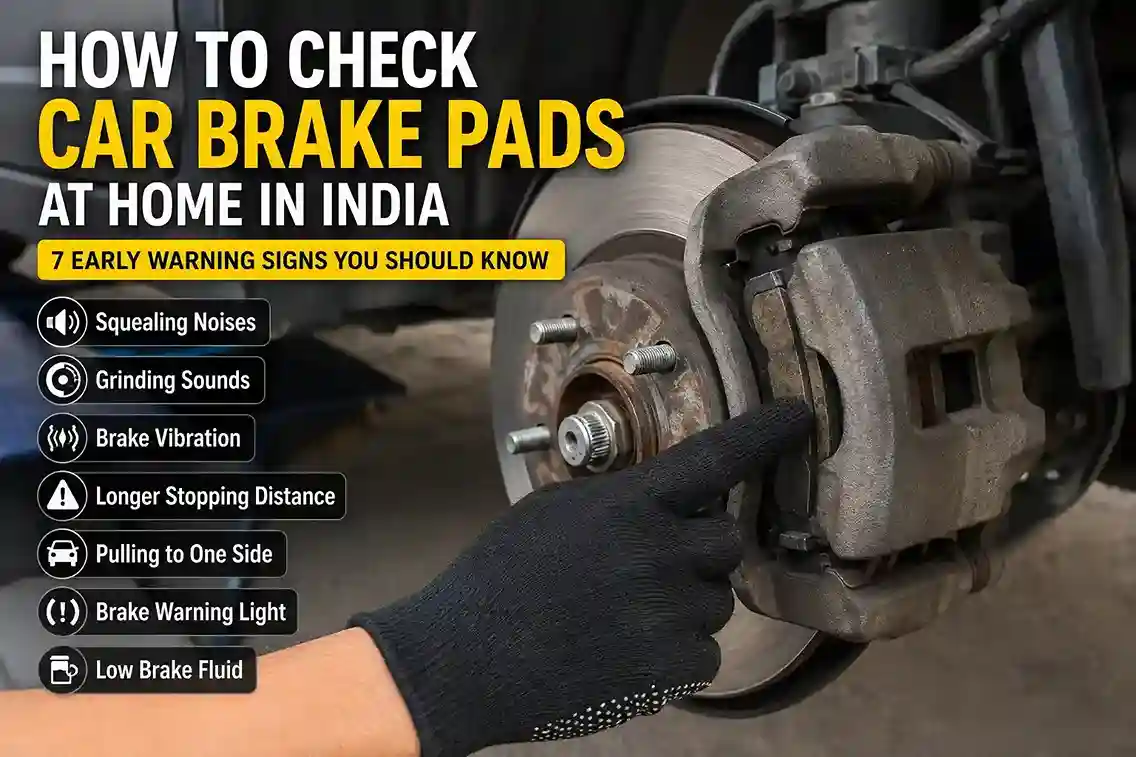
How to Check Car Brake Pads at Home in India is one of the most useful maintenance skills a driver can learn. Brake pads wear down gradually from friction, so the first signs are often small: a faint squeal, a longer stopping distance, a vibration under braking, or a warning light that appears before things get worse. AAA explains that brakes wear because pads clamp onto the rotor and create heat and abrasion, while Consumer Reports and The AA both note that squealing, grinding, pulling, and a softer pedal can all point to worn pads or related brake problems. NHTSA’s brake-performance standards also underline how important reliable braking is for normal and emergency driving. If you already keep an eye on car dashboard warning lights explained, how to check car tyre pressure at home in India, and signs your car battery is weak, brake pads fit naturally into the same simple home-maintenance routine.
Why brake pads matter more than many drivers realize
Brake pads do the heavy lifting every time you slow down. Over time, that friction wears them down, and once the pad material gets too thin, braking performance can suffer and the rotors can take damage too. The AA notes that worn pads can lead to expensive rotor damage if they are ignored, and AAA warns that unusual braking noises or a car that no longer slows down cleanly should be checked promptly. In real-world situations, this usually starts as a small annoyance and ends as a bigger repair bill if the warning signs are missed.
A common mistake people make is waiting until the brakes sound terrible before taking action. By that point, the friction material may already be close to metal-on-metal contact, which is exactly when repair costs rise. That is why a quick at-home inspection matters, especially for cars used daily in heavy city traffic.
7 early warning signs your brake pads need attention
1) Squealing or screeching noises when braking
One of the first and most common warning signs is a high-pitched squeal or screech when the brakes are applied. Consumer Reports says this is often the first sign of excessive pad wear, and The AA notes that brake pad wear indicators can create this sound when the pad material gets low. AAA also lists squealing and similar noises among the signs of a brake problem that should not be ignored.
2) Grinding or scraping sounds
Grinding is more serious than squealing. The AA says a grinding or scraping noise usually means the pad friction material has worn away and the metal parts are touching the rotor, which can damage the discs and hurt braking performance. If you hear this, the car should be inspected quickly instead of driven for days on end.
3) Longer stopping distance or a softer brake pedal
If the car starts taking longer to stop, or the pedal feels softer or less responsive, the brake system may be losing effectiveness. Consumer Reports says worn pads can make the pedal feel softer to depress, and AAA says a brake pedal should feel solid rather than squishy or slowly sinking toward the floor. That does not always mean the pads are the only issue, but it is a clear sign that something in the braking system needs attention.
4) Vibration or pulsing when braking
Brake vibration is another clue that should not be ignored. AAA and Consumer Reports both note that vibration or pulsing during braking can point to worn pads, warped rotors, or uneven brake wear. In practical terms, this often feels like a shake through the steering wheel or a pulsing sensation in the brake pedal during slowdowns.
5) The car pulls to one side when you brake
If the car drifts or pulls left or right under braking, that can point to uneven pad wear, a sticking caliper, or a brake hose restriction. AAA says pulling to one side can happen when brake wear is uneven, and The AA says it can also indicate a sticking caliper or collapsed hose and should be checked quickly by a garage. Consumer Reports also lists pulling as a symptom of worn brake pads or related brake issues.
6) Brake warning light or low brake fluid
A dashboard brake warning light should always be taken seriously. AAA says many cars use a warning light to alert the driver when there is a braking problem, and brake fluid level can fall as pads wear. If your dashboard is already showing warning lights elsewhere, car dashboard warning lights explained is a useful companion read because brake warnings should be treated as part of the wider safety picture.
7) You can visibly see very little pad material left
Some cars let you inspect the pads through the wheel openings. ALLDATA’s quick-inspection guide says you can visually inspect disc brake rotors through the wheel openings, look at the outside pad, and compare the friction material to the metal backing plate; if the material is equal to or thinner than the backing plate, replacement is due. CFI Tire’s inspection guide gives a similar rule of thumb and notes that if the pads are thinner than the recommended thickness, it is time for a replacement.
How to check car brake pads at home in India
A home check should be a quick visual inspection, not a full workshop brake service. ALLDATA says a quick inspection can be done without removing the wheels on cars with spoke-type wheels, but a complete inspection requires wheel removal. ICICI Lombard’s guide recommends parking on a level surface, letting the brakes cool, and then checking the brake pads visually through the wheels before going deeper if needed.
Step 1: Park safely and let the brakes cool
Park on a flat, safe surface, switch off the engine, and engage the parking brake. Do not touch the calipers or rotors immediately after driving because they can be very hot. This sounds basic, but it is one of the most common mistakes people make when trying to inspect brakes at home.
Step 2: Use a flashlight and look through the wheel spokes
If the wheel design allows it, shine a flashlight through the spokes and look at the brake caliper and rotor area. ALLDATA says open or spoke-type wheels are best for quick inspection because you can see the rotor and sometimes the outer pad without removing the wheel. ICICI Lombard also recommends a visual inspection via the wheels as the first step.
Step 3: Check how much pad material is left
Look for the friction material between the caliper and the rotor. If the visible pad material is very thin or nearly level with the backing plate, it is time to schedule replacement. ALLDATA notes that worn pads often reveal deep grooves on the rotor and that pad thickness compared to the backing plate is a useful quick-check method.
Step 4: Compare both sides if possible
Sometimes the inner pad wears differently from the outer pad. ALLDATA specifically notes that the outside pad can look fine while the inside pad is worn out, which is why both sides matter if you can see them. Uneven wear can point to caliper or hardware problems rather than just ordinary pad age.
Step 5: Stop the home check if anything looks serious
If you notice deep grooves, heavy discoloration, fluid leaks, or metal contact, do not keep experimenting. The AA and AAA both say pulling, squealing, grinding, or a low brake warning light are signs that the car should be inspected professionally soon.
If you want to keep your maintenance routine simple, pairing brake checks with how often should you change engine oil in India and how to improve car mileage in India is a smart habit because brakes, engine health, and fuel efficiency are all part of the same ownership picture.
Common mistakes people make
A very common mistake is waiting until the brakes grind before reacting. Another is assuming a squeak is “just normal” and leaving it for months. The AA explains that grinding often means the pad material is already worn away, while AAA says braking should remain solid and stable rather than soft, noisy, or pulling to one side.
Another mistake is checking pads right after a drive. ALLDATA warns that brake calipers and rotors can be very hot, so a rushed inspection can lead to burns or a sloppy assessment. It is also easy to miss a low inner pad if you only glance at the outer side through the wheel.
A third mistake is assuming a warning light only matters if the car still feels normal. Brake-related warning lights, especially when paired with other symptoms, should be treated as a safety issue rather than a cosmetic one. That mindset is the same one you should use for signs your car battery is weak and other warning-focused maintenance checks.
Best practices for brake pad care
The smartest habit is to inspect the brakes during routine service instead of waiting for a clear failure. A general service check once or twice a year is a sensible rule of thumb, and several maintenance guides recommend looking at the brakes whenever unusual sounds, pulling, or longer stopping distances appear.
It also helps to make brake checks part of a larger monthly routine. When you are already doing how to check car tyre pressure at home in India and looking over the dashboard for car dashboard warning lights explained, you are much more likely to catch brake problems early rather than late.
If your car is used in stop-and-go traffic, heavy family trips, or hilly routes, be even more alert. The AA notes that braking performance depends on how the car is driven, and heavier use shortens brake life more quickly than gentle driving. In other words, some drivers will need brake checks sooner than others.
When you should stop driving and book a mechanic
If the car is grinding, pulling sharply, or showing a brake warning light, do not delay. AAA says these are signs that the braking system needs attention, and The AA advises checking the vehicle as soon as possible so the root cause can be identified. Consumer Reports is equally clear that grinding, soft pedal feel, and vibration are not symptoms to ignore.
If you can already see very little friction material left, or the rotor surface looks badly grooved, the pads are likely at the end of their useful life. In that situation, replacement is better than hoping the noise will go away. AAA’s maintenance guidance also notes that once you are down to very little pad material, professional inspection or replacement is the sensible next step.
Frequently asked questions
Can I check brake pads at home without removing the wheel?
Yes, on many cars with spoke-type wheels you can do a quick visual check through the openings. ALLDATA says this is a quick inspection, but a complete brake inspection still requires removing the wheels.
What does a squealing brake mean?
A squeal often means the wear indicator is contacting the rotor or that the pad material is getting low. Consumer Reports and The AA both say squealing is one of the earliest signs of worn brake pads.
What does grinding mean?
Grinding usually means the brake pad material is gone or nearly gone, and metal is contacting the rotor. That can damage the discs and raise repair costs quickly.
How often should I inspect brake pads?
A practical rule is to look them over during routine servicing and at least once or twice a year, especially if you drive in heavy traffic or hear any unusual braking noise.
Is it safe to keep driving if the car pulls to one side when braking?
No, not for long. The AA says pulling can indicate a sticking caliper or brake hose problem and should be checked as soon as possible.
Conclusion
Learning How to Check Car Brake Pads at Home in India gives you a useful first line of defense against avoidable brake problems. A quick look through the wheel spokes, a flashlight check of pad thickness, and a careful ear for squeals, grinding, vibrations, or pulling can tell you a lot before a small issue becomes a bigger repair. AAA, Consumer Reports, and The AA all agree that these warning signs deserve attention, and NHTSA’s braking-performance standards underline why dependable brakes are a safety issue, not just a maintenance item.
Author: Carsinfos Editorial Team
Published: May 16th, 2026