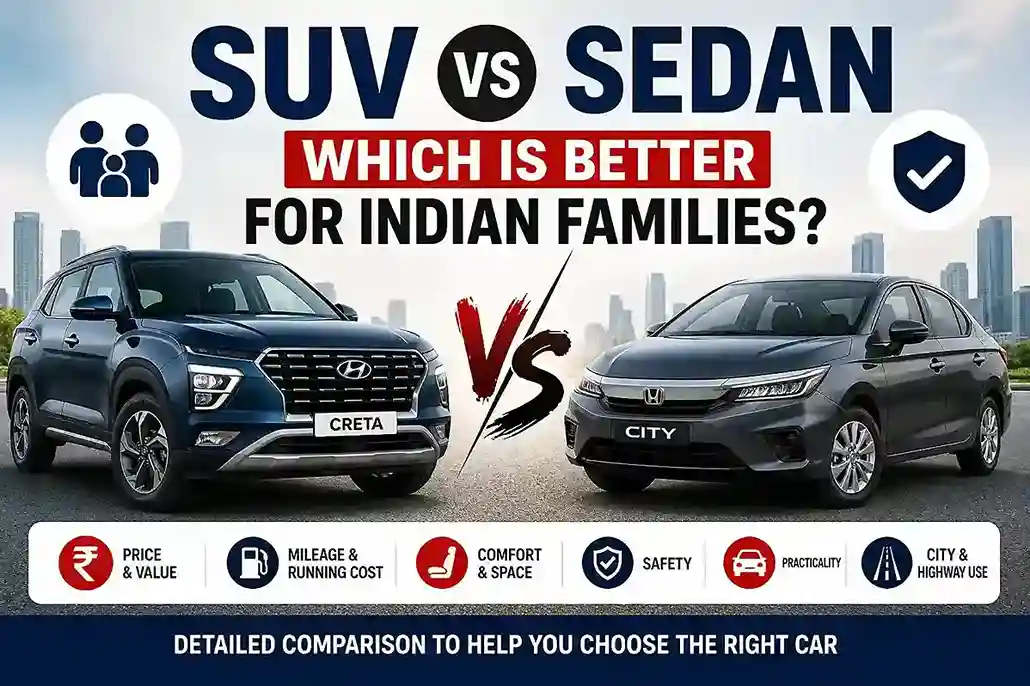
The SUV vs sedan debate is still one of the most practical car-buying decisions for Indian families in 2026. Both body styles solve different problems. Sedans usually appeal to buyers who want a lower driving position, a smoother highway feel, and a traditional boot, while SUVs attract buyers who want a higher seating position, easier visibility, and a more commanding road presence. Current market examples show that this choice is very alive in India: Hyundai’s Creta starts at ₹10.72 lakh ex-showroom, Honda’s City starts at ₹11,99,900, and Maruti’s Ertiga starts at ₹8.80 lakh, which means family buyers can still choose between sedan, SUV, and MPV-style practicality within a similar budget band.
Quick answer
If your family does mostly city driving, values mileage, and wants a more elegant road feel, a sedan often makes more sense. If your family wants a higher seating position, easier ingress and egress, and a car that feels more versatile on rough roads, an SUV usually wins. If your family genuinely needs more than five seats, the 7-seater family category may be the better fit altogether, which is why many Indian buyers also compare this article with CarsInfos’ “Best 7 Seater Cars Under ₹15 Lakh in India” guide.
Why this comparison matters for Indian families
Indian families do not buy cars only for specification sheets. They buy them for school runs, grocery trips, office commutes, weekend travel, monsoon roads, luggage, and the occasional outstation journey. That is why the body style matters so much. A sedan can feel calmer and more efficient for daily use, while an SUV can feel more confident and flexible when the family members are taller, the roads are rougher, or the driving mix changes often. CarsInfos already treats this as a budget-and-use-case decision in its comparison posts, especially the pages for SUVs, sedans, automatic cars, and fuel-type categories.
This also explains why the decision is not just about “which is bigger.” A sedan can deliver better highway composure and a cleaner boot layout, while an SUV can give a better driving position and easier visibility in traffic. For many Indian households, the winning car is simply the one that fits the family’s routine without making ownership stressful. That is an inference based on the way the current market is structured and how manufacturers position their family-focused models.
SUV vs Sedan: price and value
At the same budget, sedans often give you a slightly more refined experience, while SUVs often trade some of that refinement for a taller body and stronger road presence. Honda’s City starts at ₹11,99,900, which places a mainstream sedan firmly in family-buying territory. Hyundai’s Creta base petrol starts at ₹10.72 lakh, showing how a compact SUV can also sit in the same family-buyer zone. Maruti’s Ertiga starts at ₹8.80 lakh, proving that family buyers can also choose a practical three-row vehicle without going into a premium SUV bracket.
That makes price comparison more nuanced than many buyers expect. If you are comparing a sedan and an SUV at roughly the same on-road budget, you may find that the SUV gives more visual presence and higher seating, while the sedan gives a more traditional car feel and sometimes better fuel efficiency. CarsInfos’ “Best Cars Under ₹15 Lakh in India” guide is useful here because it places both body styles inside the same family-budget framework.
SUV vs Sedan: comfort and city driving
In city traffic, the choice often comes down to seating posture and ease of movement. SUVs feel easier for many families because the higher seat is simpler for older parents and children to get in and out of, and the driver gets a clearer view of traffic. Sedans, however, can feel smoother and more relaxed at lower speeds because they sit lower and often feel less bulky in tight lanes or basements. That is why family buyers often need to test both body styles before deciding. This is a practical inference from the current way mainstream family cars are designed and marketed in India.
For Indian urban use, the best answer is not always the tallest car. In dense traffic and in cramped parking, a sedan can be easier to place and more pleasant to maneuver, especially if the family’s daily trips are short and predictable. If the family wants something automatic, CarsInfos’ “Best Automatic Cars Under ₹15 Lakh in India 2026” guide can be used alongside this article because transmission convenience matters just as much as body style for city driving.
SUV vs Sedan: highway use and long trips
On highways, sedans usually feel more settled because of their lower stance and traditional road manners. SUVs, especially compact ones, can still be excellent family tourers, but they often trade some aerodynamic efficiency for the extra height and upright body shape that buyers like. In practice, a sedan can feel calmer at speed, while an SUV can feel more confident when roads are uneven or the family carries a full load of passengers and luggage. That is why the same family may prefer a sedan for long smooth routes and an SUV for mixed road conditions.
If you are comparing example models, Honda City is one of the strongest sedan-style family options in India because Honda lists both manual and CVT automatic variants, with 18.4 km/l for the CVT and 17.77 km/l for the manual. Hyundai Creta, on the other hand, is positioned as a mainstream family SUV with multiple engine and transmission choices, and the current base petrol price starts at ₹10.72 lakh. Those two examples capture the highway-vs-practicality split very well.
SUV vs Sedan: mileage and running cost
Mileage is one of the biggest reasons many families still lean toward sedans. A sedan usually offers a more efficiency-friendly shape, and the lower body can help it feel less thirsty in day-to-day use. Honda’s City CVT official page lists 18.4 km/l for the petrol CVT and 17.77 km/l for the manual, showing that a modern sedan can still deliver strong fuel economy while offering comfort. By contrast, SUV buyers often accept slightly higher fuel use in exchange for the higher seating position and larger stance.
That does not mean SUVs are always inefficient. It means the buyer must decide what matters more: lower running cost or a more commanding everyday feel. For families doing a lot of city commuting and school runs, the sedan often becomes the better value proposition. For families that regularly travel with four or five people and prefer a stronger road presence, the SUV can still be worth the extra fuel spend.
SUV vs Sedan: boot space and luggage
The family-buyer question often ends up being about luggage. Sedans generally offer a separate boot, which is very useful for keeping bags hidden and the cabin calm. SUVs often provide a taller tailgate opening and a more flexible rear area, but the shape and use of space can vary more widely by model. For families who travel often with suitcases, school bags, or a stroller, the boot shape may matter more than the badge on the car. This is why many users compare sedans with the broader family-car and seven-seater content on CarsInfos before buying.
If your family regularly carries more than five people or heavy luggage, a 7-seater may actually make more sense than either a sedan or a compact SUV. That is why CarsInfos’ “Best 7 Seater Cars Under ₹15 Lakh in India” article is a relevant companion piece for families who are not sure whether a sedan or SUV is enough. Maruti’s Ertiga starts at ₹8.80 lakh, which keeps the three-row family option accessible for budget-conscious buyers.
SUV vs Sedan: safety and family confidence
Safety is a major family concern, but body style alone does not decide safety. What matters more is the complete package: structural strength, airbags, braking tech, visibility, tyres, and how the car is actually engineered. The current market shows that family buyers can find strong safety and feature content in both categories, so the choice should not be based on the assumption that one body style is automatically safer. That is an inference based on the range of current models and how they are sold in the Indian market.
For buyers who prioritize a newer SUV-style package, the Tata Nexon remains one of the most important models in this conversation because Tata lists it at ₹7.36 lakh onward and positions it as a petrol-and-diesel compact SUV with advanced safety and tech. For sedan buyers, Honda City remains a strong mainstream benchmark because Honda continues to offer a manual/CVT family sedan with strong mileage and a mature feature set. If a family wants to compare more options, CarsInfos’ “Best Cars Under ₹15 Lakh in India” guide can serve as the broader decision hub.
SUV vs Sedan: which one suits which family?
A sedan is usually the better choice for families that want lower running costs, smoother highway manners, and a more classic car feel. It is often the smarter pick for small families, office commuters, and buyers who spend a lot of time on good roads. Honda City is a good example of that family-sedan profile because Honda offers a practical boot, automatic choice, and mileage figures that remain competitive in the segment.
An SUV is usually the better choice for families that want a higher driving position, a more rugged feel, and better comfort over rough roads. Hyundai Creta is a good example of that mainstream family-SUV formula because it starts at ₹10.72 lakh and sits in the very center of India’s compact-SUV family-buying space. Tata Nexon also fits this logic because its price starts at ₹7.36 lakh and the model remains one of the most visible compact-SUV choices for Indian buyers.
When a 7-seater may be a better idea than both
If your family regularly includes more than five members, or if grandparents frequently travel with you, neither a sedan nor a compact SUV may be ideal. In that case, the 7-seater segment becomes much more practical. CarsInfos already covers this with “Best 7 Seater Cars Under ₹15 Lakh in India,” and the Maruti Ertiga is a clear mainstream example because its starting price is ₹8.80 lakh and it is sold as a family-oriented multi-row vehicle.
That is why this article should not be read as a simple sedan-versus-SUV winner announcement. For some Indian families, the real answer is neither. The actual best choice may be a 7-seater MPV-style vehicle if flexibility matters more than body style.
Buying advice for Indian families
The smartest way to decide is to use the car for your actual daily pattern. If you do mostly city commuting, want easier parking, and care about mileage, a sedan often makes more sense. If you want a more upright driving position, face rough roads, or like the confidence of a taller vehicle, an SUV is usually the better family fit. If you regularly travel with a bigger household, a 7-seater might be the right answer. That practical framework is the reason CarsInfos has separate budget and body-style guides rather than forcing every buyer into one list.
A useful internal reading path on CarsInfos is to compare this article with “Best Sedan Cars Under ₹15 Lakh in India 2026,” “10 Best SUVs Under ₹15 Lakh in India,” “Best Automatic Cars Under ₹15 Lakh in India 2026,” and “Best Cars Under ₹15 Lakh in India.” Those pages help you refine the decision by budget, gearbox, and seating needs instead of comparing body styles in isolation.
Frequently Asked Questions
Which is better for Indian families, SUV or sedan?
For most city-focused families, a sedan is often better because it usually feels smoother, more efficient, and easier to live with. For families that want a higher seating position and more confidence on rough roads, an SUV is often the better choice.
Is an SUV safer than a sedan?
Not automatically. Safety depends on the full vehicle package, not just the body style. Both SUVs and sedans can be safe if the model is engineered and equipped well.
Which gives better mileage, SUV or sedan?
A sedan usually has the edge on fuel efficiency because of its lower and more aerodynamic body shape. Honda’s City CVT mileage of 18.4 km/l is a good example of how efficient a modern sedan can still be.
Which is better for city traffic?
An SUV often feels easier to drive in city traffic because of the higher seating position, but a sedan can feel less bulky and easier to park. The better choice depends on whether visibility or maneuverability matters more to your family.
Which is better for long drives?
Both can work, but sedans usually feel calmer on highways while SUVs offer a more commanding and confidence-rich posture. For a family that travels often, the better choice depends on road quality and seating preference.
Should a family buy a 7-seater instead?
Yes, if you regularly travel with more than five people or need a lot of flexibility. CarsInfos’ 7-seater guide is relevant in that case, and the Maruti Ertiga is a practical mainstream example.
Final verdict
If your family is mostly city-based and wants efficiency, comfort, and an elegant everyday feel, a sedan is often the better choice. If your family wants higher seating, a stronger road presence, and more comfort on mixed roads, an SUV is usually the smarter pick. If your household is bigger or you carry more people regularly, a 7-seater may be the real answer. The best option is not the body style that looks more popular; it is the one that fits your family’s actual routine.
Author: Carsinfos Editorial Team
Published: May 3rd, 2026