
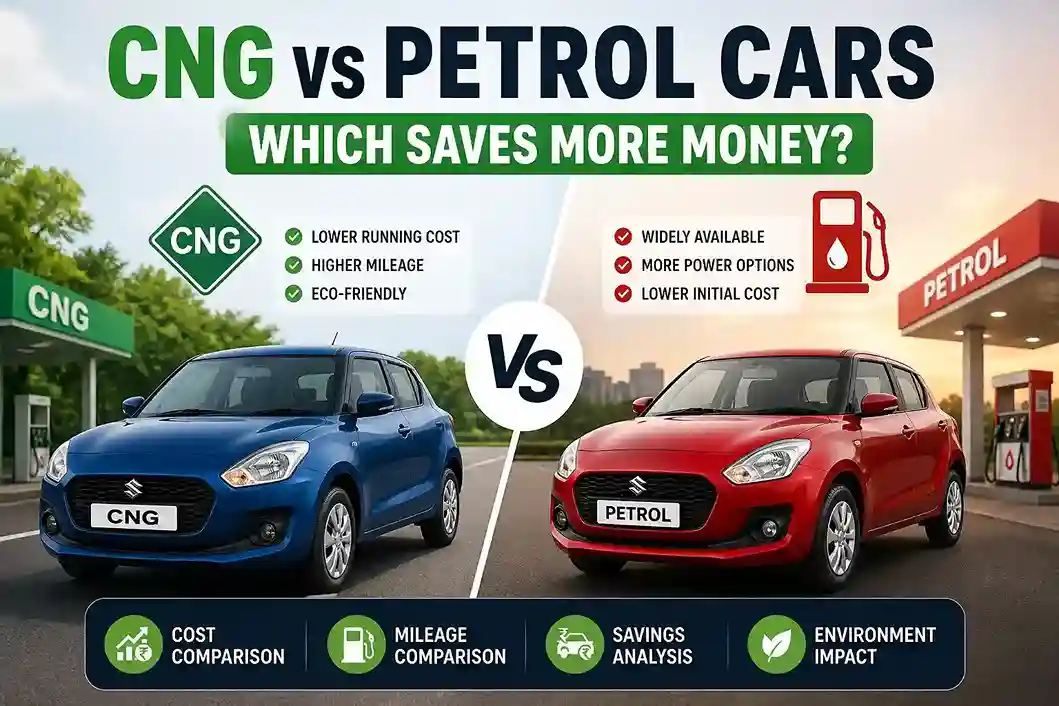
Choosing between a CNG vs petrol cars is not just a fuel-type decision. It is a budget decision, a usage decision, and for many Indian buyers, a monthly savings decision. If you are comparing the broader market first, CarsInfos guides like best cars under ₹10 lakh in India , best mileage cars in 2026, and best family cars under ₹10 lakh in India are useful starting points because they show how fuel efficiency, comfort, and price overlap in real buying decisions.
The short answer is simple: CNG usually saves more money on running cost, while petrol usually wins on convenience, broader model choice, and lower upfront cost in many variants. That trade-off becomes very clear when you compare real prices and official mileage figures from Indian manufacturers and fuel-price sources. Maruti Suzuki positions its S-CNG range as a way to reduce per-kilometre cost, and IGL even provides a CNG savings calculator for buyers who want to estimate their own usage.
What Makes CNG Cheaper to Run?
CNG is cheaper than petrol mainly because the fuel cost per unit of distance is usually lower. When a car gives strong mileage on CNG and the CNG price stays below the petrol equivalent cost per kilometre, the savings stack up quickly over months and years. In Delhi, IGL lists CNG at ₹77.09 per kg effective 1 January 2026, while PPAC’s Delhi retail price archive shows petrol at ₹94.77 per litre on 1 January 2026. Those are real-world prices, not theoretical ones, which makes the comparison much more useful for everyday buyers.
A good way to understand this is to look at official mileage figures from Maruti Suzuki. On its engine page, Maruti lists the Baleno petrol manual at 22.35 km/l and the S-CNG version at 33.73 km/kg. Using the Delhi fuel prices above, the petrol cost works out to about ₹4.24 per km, while the CNG cost is about ₹2.29 per km. That means the Baleno CNG saves roughly ₹1.95 for every kilometre driven. Over 50,000 km, the gap is about ₹97,738. That is exactly why high-running users feel the difference so quickly.
A Smaller Car Also Shows the Same Pattern
Even in a budget hatchback, the fuel gap remains meaningful. Maruti’s Alto K10 price page shows the petrol LXi (O) MT starting at ₹3.99 lakh and the CNG LXi (O) starting at ₹4.81 lakh, which proves that CNG usually asks for a higher entry price. But the brochure also shows mileage of 24.39 km/l for petrol MT and 33.40 km/kg for CNG. At the same Delhi fuel prices, that works out to about ₹3.89 per km on petrol and about ₹2.31 per km on CNG. Over 20,000 km, the difference is roughly ₹31,550. In other words, even a small car can recover a meaningful amount if it is driven regularly.
This is why CNG makes the most sense for users who drive often. Office commuters, cab operators, delivery users, and families with daily city travel usually see the strongest benefit. Maruti’s own S-CNG page says its factory-fitted CNG vehicles deliver best-in-class mileage and lower the per-kilometre cost, which aligns with what real buyers experience in high-use situations.
Why Petrol Still Has Strong Value
Petrol cars are still the easier choice for many buyers because the ownership experience is simpler and the upfront price is often lower. In the Alto K10 example above, the CNG variant costs more than the petrol variant at the time of purchase, even though the running cost is lower later. That pattern is common in the market: petrol asks for less money on day one, while CNG asks for more money upfront but gives back savings over time.
Petrol cars also offer a wider model spread across hatchbacks, compact SUVs, sedans, and automatics. If comfort and transmission choice matter as much as fuel saving, CarsInfos guides like best automatic cars under ₹10 lakh in India and best hatchback cars under ₹10 lakh in India are useful because they show how petrol-powered options often dominate the broader market. For buyers with very tight budgets, the best cars under ₹5 lakh in India guide is also helpful because the lower entry point can matter more than long-term fuel savings.
Real-World Examples: Which One Saves More?
If you compare a Maruti Dzire petrol with a Dzire CNG, the difference is also clear. Maruti lists the Dzire petrol at 24.79 km/l for the manual and 25.71 km/l for the AMT, while the CNG version returns 33.73 km/kg. At the same Delhi prices, the petrol cost comes to about ₹3.82 per km, while the CNG cost is about ₹2.29 per km. That is a savings of roughly ₹1.54 per km. Over 30,000 km, the gap becomes about ₹46,122. This is the kind of running-cost difference that can matter a lot for a family car used every day.
Now compare that with a low-running user who drives only occasionally. The annual savings may still exist, but the payback period becomes longer because the car is not covering enough distance for the fuel advantage to compound quickly. That is the key reason CNG is usually a stronger money saver for people who drive a lot, while petrol often feels more sensible for lower-mileage owners. This conclusion follows directly from the per-kilometre cost gap shown in the calculations above.
The Hidden Part of the Decision: Upfront Cost and Usage Pattern
The money-saving story is not only about fuel cost. It also includes the variant price difference, the convenience of fuel availability, and how often you drive. A CNG car can save a lot on fuel, but you pay more at the time of purchase and you need to be comfortable with CNG-based ownership. Petrol cars may cost more to run, but they are often simpler to live with for buyers who drive less, travel irregularly, or want maximum flexibility in model choice. Maruti’s CNG portfolio and official mileage pages make the running-cost advantage very visible, but the price pages show that the entry cost can be higher too.
In practical terms, this means CNG is usually the better money-saving option when monthly mileage is high, especially in city traffic. Petrol is usually the better convenience-first option when mileage is lower or when the buyer values a simpler purchase decision more than long-term fuel savings. That is also why many buyers first compare category guides like best family cars under ₹10 lakh in India and best cars under ₹10 lakh in India before deciding on fuel type.
Which One Is Better for City Buyers?
For city buyers who drive daily, CNG usually wins on money. The cost-per-kilometre advantage is real, the savings show up fast, and manufacturer-backed CNG systems are now much more mature than older retrofits. Maruti specifically describes its S-CNG vehicles as factory-integrated and tested for durability, which is important because factory-fitted systems are generally the safer and more cohesive ownership option.
For city buyers who drive less and want a smoother “buy today, forget the fuel math” experience, petrol still has value. It is easier to choose, simpler to understand, and available across a wider spread of cars and trims. That is why the best answer is not “CNG always” or “petrol always.” The best answer is “CNG for high-use savings, petrol for lower-use convenience.”
Final Verdict
CNG saves more money than petrol in most high-running use cases. The proof is in the numbers: Delhi CNG at ₹77.09/kg, Delhi petrol at ₹94.77/litre, and official mileage figures such as 22.35 km/l versus 33.73 km/kg for the Baleno, or 24.39 km/l versus 33.40 km/kg for the Alto K10. Those gaps translate into real annual savings that can be large enough to justify the higher purchase price if you drive enough kilometres.
So the final buying rule is straightforward. Choose CNG if your priority is maximum monthly fuel savings and your running is high. Choose petrol if your priority is lower upfront cost, simpler ownership, and more flexibility across models and trims. If you want to estimate the savings for your own commute, IGL’s CNG calculator is a useful starting point.
Frequently Asked Questions
1) Is CNG always cheaper than petrol?
In running cost, CNG is usually cheaper than petrol when you compare the fuel cost per kilometre. In the Delhi example above, the Baleno petrol cost is about ₹4.24 per km, while the Baleno CNG cost is about ₹2.29 per km. That difference is why CNG often saves more money over time.
2) Which saves more money in the long run, CNG vs petrol cars?
CNG usually saves more money in the long run if you drive enough kilometres. On a Baleno example, the savings are about ₹97,738 over 50,000 km. On a Dzire example, the savings are about ₹46,122 over 30,000 km. The more you drive, the more CNG’s lower per-kilometre cost matters.
3) Is CNG worth it for low-mileage drivers?
For low-mileage drivers, CNG can still save money, but the payback is slower because the car is not accumulating enough kilometres quickly enough to fully recover the higher purchase price. That conclusion follows from the price gap and cost-per-km calculations shown above.
4) Why do CNG variants usually cost more at the showroom?
CNG variants usually cost more because they include extra hardware and factory integration. The Alto K10 example shows this clearly: the petrol LXi (O) MT starts at ₹3.99 lakh, while the CNG LXi (O) starts at ₹4.81 lakh. The higher purchase price is part of the trade-off for lower running cost later.
5) Are factory-fitted CNG cars better than aftermarket conversions?
Factory-fitted CNG cars are generally the safer and cleaner choice because the manufacturer designs and tests the system as part of the car. Maruti says its S-CNG vehicles are factory-integrated and tested for durability, and that is one reason many buyers prefer them over ad hoc modifications.
6) How can I estimate my own savings before buying?
You can estimate savings by comparing your expected monthly kilometres, the car’s mileage, and the current fuel prices in your city. IGL provides a CNG savings calculator, which is useful for checking daily, monthly, or yearly savings against conventional fuels.
7) Which type is better for family use?
For a family that drives a lot, CNG often delivers the better money-saving result. For a family that drives less and wants wider choice, easier purchase decisions, and more variant availability, petrol can be the better overall fit. That is why many buyers compare fuel type alongside body style and budget using guides like best family cars under ₹10 lakh in India and best cars under ₹10 lakh in India
Author: Carsinfos Editorial Team
Published: May 5th, 2026