
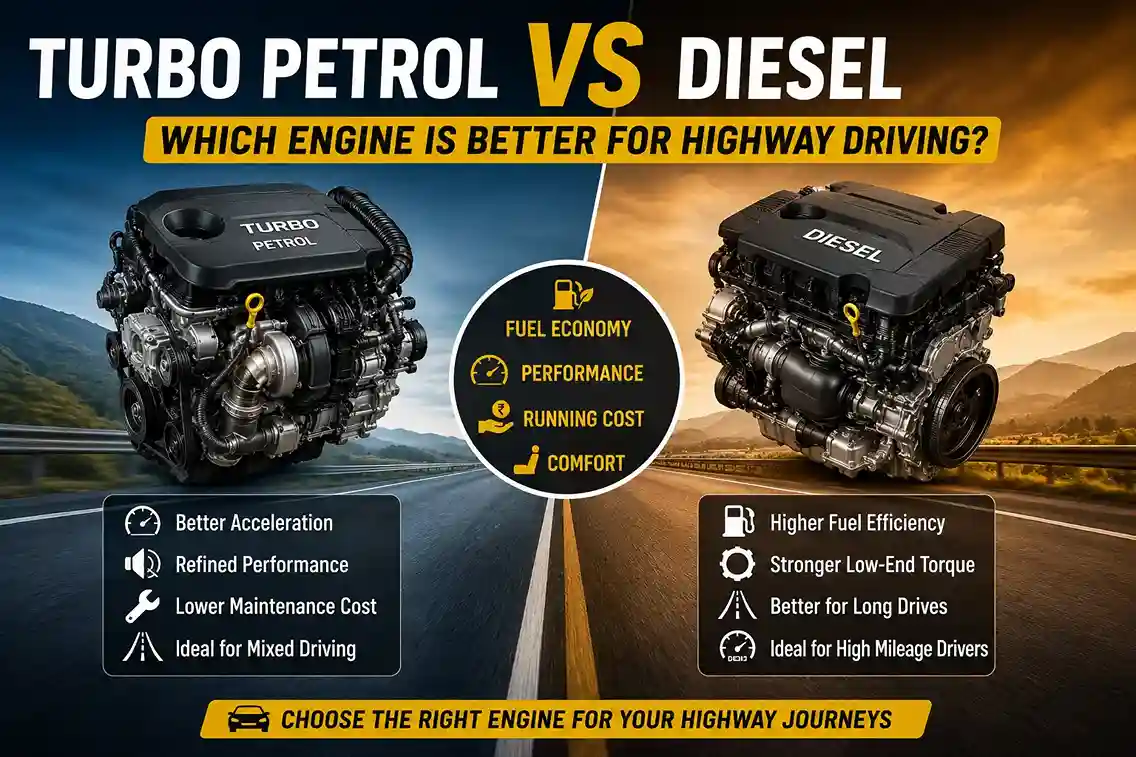
Turbo Petrol vs Diesel for Highway Driving is one of the most common comparisons among Indian car buyers planning frequent road trips and long-distance travel. While both engine types have their strengths, choosing the right one can significantly affect fuel costs, highway comfort, overtaking performance, and long-term ownership expenses. Understanding the differences between turbo petrol and diesel engines will help you make a smarter buying decision based on your driving habits.
If you’re already comparing fuel types, our guide on Petrol vs Diesel Cars in India 2026 provides a broader overview of ownership costs and usage scenarios. However, when it comes specifically to highway performance, the answer is more nuanced.
Understanding Turbo Petrol and Diesel Engines
Before comparing highway performance, it helps to understand how these engines work.
What Is a Turbo Petrol Engine?
A turbo petrol engine uses a turbocharger to force additional air into the combustion chamber. More air allows more fuel to burn efficiently, producing higher power from a smaller engine.
Modern turbo petrol engines offer:
- Strong acceleration
- Improved power output
- Better refinement
- Lower engine weight
If you’re unfamiliar with turbocharging, our detailed explanation of Turbo Petrol vs Naturally Aspirated Engine in India covers the technology in depth.
What Is a Diesel Engine?
Diesel engines generate power differently. They use compression ignition and typically produce higher torque at lower engine speeds.
Benefits often include:
- Excellent highway fuel economy
- Strong pulling power
- Comfortable cruising at lower RPMs
- Better efficiency during long-distance driving
According to the U.S. Department of Energy, diesel engines are generally more thermally efficient than gasoline engines, which contributes to their superior fuel economy.
Turbo Petrol vs Diesel for Highway Driving: Performance Comparison
Acceleration and Overtaking
When driving on highways, quick overtaking ability matters.
Turbo petrol engines usually feel more responsive when accelerating from medium to high speeds. The engine revs quickly and delivers power smoothly.
For example, when overtaking slower traffic on a four-lane highway, many turbo petrol vehicles provide a more enthusiastic response.
Diesel engines, however, deliver strong low-end torque. This means they require fewer downshifts when overtaking at cruising speeds.
In real-world situations, both perform well, but the driving experience differs significantly.
Winner: Depends on Preference
- Turbo petrol: Better for enthusiastic driving
- Diesel: Better for effortless cruising
Fuel Efficiency on Long Highway Trips
Why Diesel Often Wins
Fuel economy remains one of diesel’s biggest advantages.
On long highway journeys, diesel vehicles frequently return better mileage than comparable turbo petrol models.
For drivers covering significant annual distances, this difference can become substantial.
If fuel efficiency is your primary concern, you may also find our article on Best Mileage Cars in 2026 useful.
The International Energy Agency notes that diesel fuel contains more energy per litre than petrol, contributing to higher efficiency under many driving conditions.
Typical Highway Mileage
Turbo Petrol:
- 15–20 km/l (varies by vehicle)
Diesel:
- 18–25 km/l (varies by vehicle)
Actual results depend on speed, traffic, terrain, and driving style.
Winner: Diesel
Highway Comfort and Cruising Ability
Comfort is about more than seats and suspension.
Engine characteristics influence long-distance fatigue.
Modern turbo petrol engines are:
- Quieter
- Smoother
- Less vibrational
Diesel engines have improved dramatically, but many still produce slightly more engine noise.
If comfort is a priority, factors such as suspension also matter. Understanding car suspension warning signs and fixes can help buyers evaluate long-distance ride quality more effectively.
Winner: Turbo Petrol
Torque and Load Carrying Capability
Torque plays a major role during:
- Hill climbs
- Full passenger loads
- Luggage-heavy road trips
- Highway inclines
Diesel engines typically generate significantly more torque at lower RPMs.
For example, a family vehicle carrying five passengers and luggage often feels less strained with a diesel engine.
Winner: Diesel
Long-Term Running Costs
Many buyers focus only on fuel prices.
However, total ownership costs include:
- Fuel
- Maintenance
- Repairs
- Insurance
- Depreciation
Regular maintenance practices such as changing engine oil on time and monitoring vehicle health can significantly influence long-term ownership costs regardless of engine type.
Turbo petrol engines generally have:
- Lower servicing costs
- Simpler emission systems
- Reduced maintenance complexity
Modern diesel vehicles often feature advanced emission control technologies that can increase maintenance expenses over time.
The Society of Automotive Engineers has published extensive research showing how modern emission systems have added complexity to diesel vehicles globally.
Winner: Turbo Petrol
Highway Reliability
Reliability depends heavily on maintenance.
Best practices include:
- Regular oil changes
- Timely filter replacement
- Quality fuel usage
- Proper tyre maintenance
Before any long highway journey, checking your tyres is critical. Our guide on when you should replace car tyres in India explains what to look for before a road trip.
In real-world situations, both modern turbo petrol and diesel engines can comfortably exceed several lakh kilometres when maintained properly.
Winner: Tie
Common Mistakes Buyers Make
Choosing Based Only on Mileage
Fuel economy matters, but it should not be the only factor.
A driver covering 8,000 km annually may never recover the higher purchase cost of a diesel vehicle.
Ignoring Driving Patterns
Many buyers purchase diesel cars despite spending most of their time in city traffic.
Highway-focused drivers often benefit more from diesel ownership.
Overlooking Future Regulations
Emission regulations continue to evolve.
Researching long-term ownership implications before purchasing remains important.
Assuming All Turbo Petrol Engines Are Inefficient
Modern turbo petrol engines have improved significantly and can deliver impressive efficiency when driven sensibly.
Who Should Choose a Turbo Petrol Engine?
A turbo petrol engine is usually ideal if:
- You drive less than 15,000 km annually
- You prefer refined performance
- You enjoy quicker acceleration
- Most trips include mixed city and highway driving
- Lower maintenance costs matter
Who Should Choose a Diesel Engine?
A diesel engine may be the better option if:
- You drive more than 20,000 km annually
- Highway travel is frequent
- Fuel economy is a top priority
- You often carry passengers and luggage
- You prefer strong low-end pulling power
Frequently Asked Questions
Is a turbo petrol engine good for highway driving?
Yes. Modern turbo petrol engines provide excellent cruising ability, strong acceleration, and refined performance on highways.
Does diesel provide better mileage on highways?
In most cases, yes. Diesel engines generally achieve better highway fuel economy than comparable turbo petrol engines.
Which engine is better for long road trips?
Drivers prioritizing fuel efficiency may prefer diesel, while those seeking refinement and responsiveness often prefer turbo petrol.
Is diesel maintenance more expensive?
Modern diesel vehicles can have higher maintenance costs because of additional emission-control components.
Which engine lasts longer?
With proper maintenance, both engine types can provide excellent longevity and reliability.
Conclusion
When comparing Turbo Petrol vs Diesel: Which Engine Is Better for Highway Driving, there is no universal winner. The right choice depends on how you use your vehicle.
Turbo petrol engines offer smoother performance, stronger acceleration, and lower maintenance complexity. Diesel engines excel in fuel efficiency, torque delivery, and long-distance cruising comfort.
For occasional highway travelers and mixed-use drivers, a turbo petrol engine often makes more sense. For high-mileage drivers who spend significant time on highways, diesel remains one of the most economical and capable choices available.
Ultimately, understanding your annual mileage, driving environment, and ownership priorities will help you select the engine that delivers the best value over the long term.
Author: Carsinfos Editorial Team
Published: June 8th, 2026