
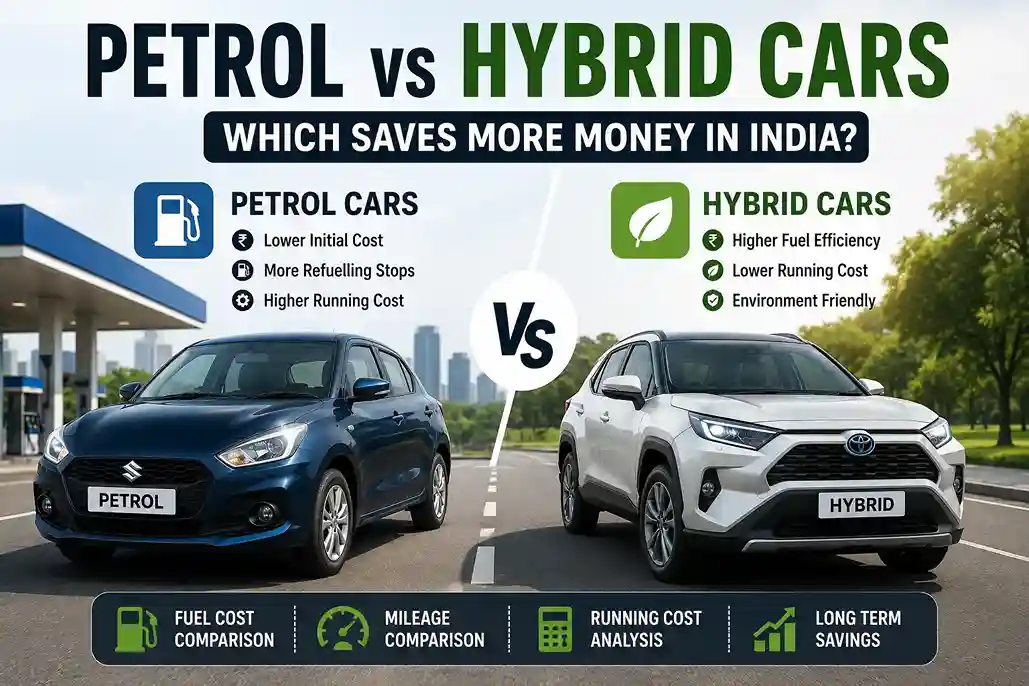
Petrol vs Hybrid Cars is one of the biggest car-buying comparisons in India right now because rising fuel prices are forcing buyers to focus more on long-term savings instead of just showroom price. While petrol cars are usually cheaper to buy initially, hybrid cars promise better mileage, lower running costs, and improved fuel efficiency in city traffic. If you are planning to buy a new car in 2026, understanding the real difference between petrol and hybrid ownership costs can help you make a smarter financial decision.
Choosing between petrol and hybrid cars in India is no longer just about engine preference. It is about fuel savings, daily running cost, traffic conditions, maintenance, and long-term ownership value. Buyers comparing practical family cars often explore guides like best hybrid cars under ₹20 lakh in India, best mileage cars in 2026, and cars under ₹10 lakh before deciding which fuel type fits their budget and driving pattern best.
Why Hybrid Cars Can Save More Money
A hybrid car combines a petrol engine with an electric motor so the vehicle can switch between power sources depending on driving conditions. In Maruti Suzuki’s strong-hybrid explanation, the system uses an engine and electric motor together, recovers energy through regenerative braking, and can also run in electric-only mode under suitable conditions. Toyota describes its self-charging hybrid system in a similar way and says it pairs a gasoline engine with an electric motor for smoother driving and lower emissions. In practical terms, this usually means less fuel burned in stop-go traffic, which is exactly where Indian commuters spend a lot of their time.
That is the main reason hybrids tend to win the savings battle. They are not always cheaper to buy, but they often become cheaper to run. The more you drive, the more that lower fuel consumption matters. Maruti Suzuki also says its strong hybrid technology can deliver an electric-only mode, silent drive, improved acceleration, and higher fuel efficiency, while Toyota says the Hyryder hybrid grades are designed for a quieter and more efficient drive.
Why Petrol Cars Still Make Sense
Petrol cars remain popular because the purchase price is usually lower and the ownership experience is simpler. You do not pay the hybrid premium upfront, you have a larger pool of models to choose from, and you do not need to think about battery-assisted driving behavior. That matters a lot for buyers who drive less or who mainly want an affordable, low-stress car rather than the lowest possible fuel bill. Toyota’s own Hyryder brochure shows the petrol neoDrive grades alongside the hybrid grades, which reflects the market reality: buyers often choose petrol for lower entry cost, even when the hybrid offers better fuel efficiency.
This is why petrol is often the better fit for occasional drivers, second-car buyers, or anyone who wants to keep the purchase budget tight. The long-term fuel saving only becomes a strong advantage when the car is driven enough for those savings to accumulate. If annual running is modest, the petrol car may remain the more practical choice because the upfront premium of a hybrid can take longer to recover.
Real Cost Comparison: Toyota Urban Cruiser Hyryder
The clearest example comes from Toyota’s official Hyryder brochure. Toyota lists the hybrid grades at 27.97 km/l and the petrol neoDrive grades at 21.12 km/l. Using PPAC’s Delhi petrol price of ₹94.77 per litre from 1 January 2026, the fuel cost works out to about ₹3.39 per km for the hybrid and about ₹4.49 per km for the petrol version. That means the hybrid saves roughly ₹1.10 per kilometre in this example. Over 30,000 km, the saving is about ₹32,968; over 50,000 km, the saving is about ₹54,947.
That gap is big enough to matter. For a family that drives daily, it can offset a meaningful share of the hybrid premium over time. Toyota also says the Hyryder hybrid is self-charging and comes with an 8-year hybrid battery warranty, which is important because buyers often worry about battery life and long-term ownership costs. When a company backs the battery for that long, it strengthens the money-saving argument because the hybrid is designed as a mainstream ownership product, not a niche experiment.
Another Real Market Example: Maruti Suzuki Grand Vitara
Maruti Suzuki’s strong-hybrid technology page is another strong signal that hybrids are becoming a serious value choice in India. Maruti says the Advanced Grand Vitara with intelligent electric hybrid system can switch between pure electric, petrol-only, and hybrid mode, and it highlights a fuel-efficiency-focused design with regenerative braking and reduced CO2 emissions. The same page lists the Grand Vitara strong hybrid starting price at ₹18.43 lakh and says the platform can deliver 1200+ km of range on a full tank under its internal testing standards.
That does not mean every hybrid is automatically the right buy. It does mean the hybrid category has matured enough that large manufacturers are now openly positioning it as a fuel-saving, everyday ownership solution rather than a luxury novelty. For buyers who are already considering premium compact SUVs, this can shift the calculation from “Can I afford the car?” to “Can I afford not to save on fuel over the next five years?”
Which One Saves More Money in Daily Use petrol vs Hybrid cars?
For city traffic, the hybrid usually saves more money. That is because hybrids benefit most from frequent braking, crawling traffic, and low-speed driving, where regenerative braking and electric assist do more of the work. Maruti’s strong-hybrid explanation specifically points to regenerative braking and electric-only operation, while Toyota describes its hybrid system as smoother and more efficient with lesser emissions. In a city like Delhi, Mumbai, Bengaluru, or Hyderabad, that kind of usage pattern makes the hybrid advantage more visible over time.
For mixed use or lower annual mileage, the petrol car can still be the smarter financial choice. If you drive only a few thousand kilometres a year, the fuel savings may not fully recover the hybrid’s extra purchase cost quickly enough. That is why the best answer is not “hybrid always” or “petrol always.” The best answer is “hybrid for higher running, petrol for lower running.” The savings math only works when the car is actually used enough for fuel efficiency to matter.
What About Maintenance and Ownership Comfort?
Maintenance is another point buyers think about. Petrol cars generally feel straightforward because the powertrain is familiar and widely understood. Hybrids add more technology, but modern factory-built systems are designed for normal ownership and day-to-day use. Maruti’s hybrid page says the system is meant to feel like a regular car while delivering better efficiency, smoother response, and lower emissions, and Toyota’s brochure emphasizes self-charging convenience instead of plug-in charging. That means the hybrid advantage does not require a major lifestyle change.
Still, buyers who prioritize the lowest purchase price may prefer petrol simply because the financial pain happens later in a hybrid, not at delivery time. That trade-off is the heart of the decision. Petrol lowers the upfront barrier. Hybrid lowers the running cost. The right choice depends on which side of the budget matters more to you right now.
Final Verdict
If the question is strictly which saves more money in India, the answer is usually hybrid for high-mileage users. The Toyota Hyryder example shows a real-world gap of about ₹1.10 per kilometre in favour of the hybrid, and that difference becomes substantial over 30,000 km or 50,000 km. Maruti Suzuki’s strong-hybrid positioning also confirms that hybrid systems are being built specifically around fuel efficiency, range, and lower emissions.
If the question is which should I buy, the answer depends on your driving pattern. Choose petrol if you want a lower sticker price and simpler ownership. Choose hybrid if you drive often, sit in traffic regularly, and want lower fuel bills over the long run. For buyers comparing related categories, CarsInfos guides like best automatic cars under ₹10 lakh in India and best family cars under ₹10 lakh in India can help narrow the final shortlist before making a fuel-type decision.
Frequently Asked Questions
1) Are hybrid cars cheaper to run than petrol cars?
Yes. Hybrid cars are usually cheaper to run because they use a combination of petrol and electric assistance, especially in stop-and-go traffic. Toyota’s Hyryder hybrid and Maruti’s strong-hybrid systems both highlight fuel-efficiency advantages, while PPAC’s petrol price data shows why every kilometre saved matters.
2) Do hybrid cars save enough money to justify the higher price?
For high-mileage users, they often do. In the Hyryder example, the hybrid saves about ₹32,968 over 30,000 km and about ₹54,947 over 50,000 km. That is a meaningful amount if you drive daily.
3) Is a petrol car better for low-mileage drivers?
Usually yes. If your annual running is low, the hybrid premium takes longer to recover, so the lower upfront cost of petrol often makes more sense. The fuel-saving gap only becomes strong when the car is driven enough to compound the benefit.
4) Are hybrids difficult to use in everyday driving?
No. Maruti says its strong hybrid works like a normal car with multiple drive modes, and Toyota says its self-charging hybrid does not require external charging. That makes the ownership experience simple for most buyers.
5) Which hybrid SUV is a good example in India right now?
The Toyota Urban Cruiser Hyryder and Maruti Suzuki Grand Vitara are two of the clearest examples. Toyota lists a 27.97 km/l hybrid grade for the Hyryder, while Maruti positions the Grand Vitara strong hybrid as a fuel-efficient SUV with electric-only capability and a long driving range.
6) What is the biggest advantage of petrol cars?
The biggest advantage is lower upfront cost and simpler buying decisions. Petrol cars usually offer more variants and fewer technology-related concerns, which makes them attractive to buyers who do not drive enough to maximize hybrid savings.
7) What is the best choice for city driving?
Hybrid is usually the better choice for city driving because traffic, braking, and short trips allow the electric motor and regenerative braking to do more work. That is exactly the environment where fuel savings become most visible.
Author: Carsinfos Editorial Team
Published: May 8th, 2026