
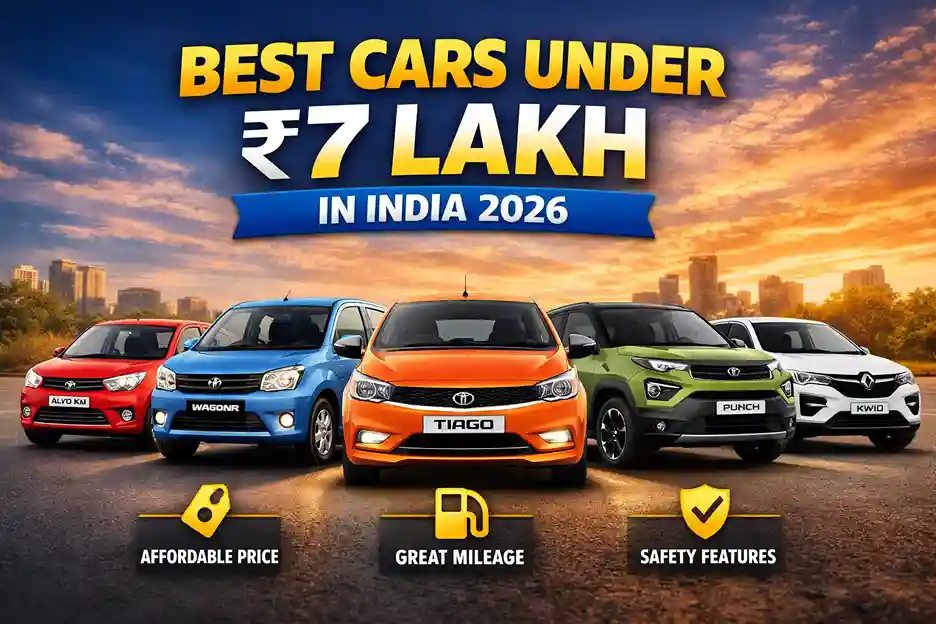
Buying a car under ₹7 lakh in India is one of the smartest choices for value-conscious buyers in 2026. This budget sits in a practical sweet spot. It is high enough to unlock safer cars, more comfortable cabins, automatic gearbox options, better infotainment systems, and even entry-level micro-SUVs, but still low enough to keep EMI, insurance, and ownership costs manageable. For first-time buyers, small families, office commuters, and city drivers, the under 7 lakh segment now offers far better value than it did just a few years ago.
The Indian market has changed quickly. Buyers now expect more than just basic transport. They want a car that looks modern, feels safe on bad roads, returns good mileage, and is easy to maintain. That is why the best cars under 7 lakh in India are no longer only about badge value or a simple price tag. They are about real-world usability, fuel efficiency, and long-term peace of mind.
If you are moving up from an entry-level car, our cars under ₹5 lakh in India guide is a useful starting point. For buyers who want a broader shortlist beyond this bracket, the best cars under ₹10 lakh in India article is also worth checking. Readers who want a more SUV-focused shortlist can also visit our best SUVs under ₹10 lakh in India guide.
Why the Under 7 Lakh Segment Matters
This price band is often the first serious upgrade for Indian buyers. A family that has spent years with a scooter or a very small hatchback usually starts looking here because the jump from two-wheelers to four-wheelers becomes easier to justify. In many cities, this range also covers the cost-conscious buyer who wants a practical second car for daily errands.
What makes this segment appealing is its balance. Buyers can now get compact hatchbacks with smart features, CNG options for lower running costs, and even micro-SUVs that offer a higher seating position and better road presence. The market is also more competitive, which means manufacturers are packing more equipment into affordable variants.
A typical buyer in this range may want a car for office commutes, school runs, and weekend family use. Another buyer may prioritize mileage above everything else. Someone else may want the highest seating position possible because of rough roads or waterlogging in the monsoon. The good news is that there is now a model for each of those needs.
Best Cars Under 7 Lakh in India 2026
Below are some of the most relevant choices for Indian buyers in this budget. Prices can vary by city, variant, insurance, and dealer stock, so the figures below should be treated as starting points rather than fixed final on-road costs.
1. Maruti Suzuki Alto K10
The Maruti Suzuki Alto K10 remains one of the most practical entry-level choices for budget buyers. It is compact, easy to park, light to drive, and backed by Maruti’s massive service network. For buyers who want a low-cost city car that is simple to own, the Alto K10 continues to make a strong case.
Its appeal is straightforward. It is affordable, efficient, and ideal for crowded urban conditions. Families often choose it as a first car because it keeps purchase and maintenance costs in control. Daily office users also appreciate how easy it is to maneuver through traffic and into small parking spaces.
For someone comparing small cars, the Alto K10 offers a very clear value proposition: low entry cost, efficient running, and a trusted service ecosystem. It is one of the easiest cars to recommend when the main priority is practical everyday use.
2. Maruti Suzuki Celerio
If mileage is the top priority, the Maruti Suzuki Celerio deserves serious attention. It is one of the most efficient and city-friendly cars in this budget. The Celerio suits buyers who want a simple, sensible hatchback with good fuel economy and easy ownership.
Maruti has positioned the Celerio as a no-nonsense urban car. It is ideal for users who drive mostly in the city and want a car that feels light, responsive, and economical. The design is practical rather than flashy, but that is exactly what many budget buyers prefer.
This is a smart option for people who care more about value than image. For many households, the Celerio becomes the “use it every day without worrying too much” car.
3. Maruti Suzuki WagonR
The WagonR is one of the most family-friendly cars in this segment because of its tall-boy design, easy ingress and egress, and spacious-feeling cabin. It is especially popular among buyers who want a car that feels comfortable in the city but still handles family duties with ease.
The WagonR is often chosen by older buyers, small families, and urban commuters who want a simple car with enough cabin space for daily use. It is also one of those models that many Indians trust because of its long market presence and easy service availability.
For buyers who want a practical car under 7 lakh, the WagonR remains one of the safest bets in the hatchback category.
4. Tata Tiago
The Tata Tiago is one of the strongest choices for buyers who want a car that feels a little more premium in design and safety than the most basic entry-level hatchbacks. Tata has built the Tiago to appeal to users who care about styling, features, and a more solid feel on the road.
This car is a popular upgrade from ultra-basic hatchbacks because it often gives buyers more confidence in terms of road manners and equipment. It is also a smart pick for first-time buyers who want a car that feels modern without moving into a much higher budget.
If safety and feature balance matter to you, the Tiago deserves a close look. It sits in a very attractive position in the under-₹7 lakh category and is often shortlisted alongside Maruti’s practical models.
5. Renault Kwid
The Renault Kwid is designed for buyers who want a compact, stylish, and budget-friendly city car with SUV-inspired looks. It appeals to younger buyers and urban users who want a small car that feels more interesting than a regular entry hatchback.
The Kwid is especially useful for city-only use, where easy parking, compact size, and low running costs matter most. For buyers who do not need a large cabin or a long list of features, it can be a sensible and visually attractive option.
It is a good example of how the under-₹7 lakh market gives buyers not just basic transport, but also style and convenience at a modest price.
6. Hyundai Grand i10 Nios
The Hyundai Grand i10 Nios is one of the most balanced cars in this category for buyers who want a more polished hatchback experience. Hyundai is known for strong equipment levels, and the Grand i10 Nios benefits from that reputation by offering a neat cabin, city-friendly size, and a modern feel.
This is often the car buyers consider when they want a slightly more refined hatchback than the absolute entry-level options. It works well for city commute, occasional highway use, and small family travel. For many households, it represents a good middle ground between affordability and comfort.
If you prefer a car that feels a bit more premium without crossing the under-₹7 lakh ceiling too quickly, the Grand i10 Nios is a smart shortlist candidate.
7. Tata Punch
The Tata Punch brings SUV-like styling into the budget conversation. It is one of the most important models for buyers who want higher seating, a taller driving position, and stronger road presence. Unlike a conventional hatchback, the Punch gives the feeling of driving something more substantial.
That makes it especially attractive to buyers who travel on uneven roads or who simply prefer the look and stance of a micro-SUV. It also naturally connects with one of the most important comparison topics on CarsInfos: our Tata Punch vs Hyundai Exter comparison. If you are stretching budget slightly higher for a fuller SUV package, check our best SUVs under ₹15 lakh in India guide.
For buyers who want a budget SUV feel without moving into the under-₹10 lakh segment, the Punch is one of the best value options.
Quick Comparison Table: Best Cars Under 7 Lakh
| Car | Starting Price (Approx.) | Best For | Main Strength |
|---|---|---|---|
| Maruti Suzuki Alto K10 | ₹3.69 lakh | First-time buyers | Low cost and easy maintenance |
| Maruti Suzuki Celerio | ₹4.69 lakh | Mileage seekers | Efficient city use |
| Maruti Suzuki WagonR | ₹4.98 lakh | Small families | Space and practicality |
| Tata Tiago | ₹4.59 lakh | Feature-focused buyers | Balanced value and safety feel |
| Renault Kwid | Around ₹4.3 lakh | Urban users | Compact size and style |
| Hyundai Grand i10 Nios | ₹5.47 lakh | Refined hatchback buyers | Premium hatchback experience |
| Tata Punch | ₹5.64 lakh | Mini-SUV buyers | SUV-like stance and road presence |
Which One Should You Buy?
Your ideal car depends on what matters most to you.
If your priority is the lowest possible purchase budget, the Alto K10 is the simplest answer. If running costs and fuel economy matter more than anything else, the Celerio is hard to ignore. If your family wants a roomy, comfortable hatchback, the WagonR is a sensible choice. If you want a more modern feel and a car that feels a bit more substantial, the Tata Tiago and Hyundai Grand i10 Nios deserve attention. If style and compact city ease matter most, the Renault Kwid can still make sense. If you want a micro-SUV with a stronger road presence, the Tata Punch is the obvious shortlist pick.
This is also why many buyers compare the under-₹7 lakh segment with the broader budget and SUV space. Some users prefer to stay in hatchback territory, while others stretch slightly higher for more features. If you are thinking about that move, our best SUVs under ₹10 lakh in India guide is a natural next step. And for buyers who think ahead to lower running costs, the best mileage cars in India article is a helpful companion.
For readers exploring the future of mobility, our electric cars in India guide is also useful because many budget buyers eventually move from fuel-efficient hatchbacks toward EV ownership as the market matures. Buyers who want to compare body styles and space can also look at the Swift vs Hyundai i20 comparison to understand how hatchback preferences differ in real life.
Real-World Buying Examples
A young professional in a metro city may prefer the Alto K10 or Celerio because parking is tight and daily commuting is the main use case. A small family in a tier-2 city may prefer the WagonR or Tiago because they want a bit more space and practicality. A buyer who wants a more premium-feeling hatchback may shortlist the Grand i10 Nios. Someone who wants the look and stance of an SUV, but still wants to stay close to a lower budget, may decide on the Punch.
That is the key insight in this segment. The best car is not the one with the longest spec sheet. It is the one that fits your actual life: your roads, your family size, your commute, your parking space, and your monthly budget.
Important Things to Check Before Buying
Before you book any car under ₹7 lakh, compare the variant-wise price, not just the headline starting price. A base model can sometimes look attractive, but a slightly higher variant may offer much better value if it includes the features you actually need. Check whether the car offers rear parking sensors, a touchscreen, power windows, and basic safety equipment in the variant you want.
You should also think about service network and future resale value. In India, a car that is easy to maintain often becomes a better long-term buy than one with a lower sticker price but expensive upkeep. Also, if you drive mostly in traffic, an AMT or automatic option can be worth paying extra for.
Safety should not be ignored just because the budget is limited. Look for cars that offer airbags, ABS with EBD, stability features where available, and a stronger reputation for build quality. For authority-backed safety information, buyers can also refer to Global NCAP crash-test resources. For broader vehicle testing and certification information, the Automotive Research Association of India is a useful reference point. Buyers who want to understand India’s official road-safety framework can also check the Ministry of Road Transport and Highways.
Conclusion
The best cars under 7 lakh in India in 2026 offer far better value than most buyers expect. From the Maruti Alto K10 and Celerio to the WagonR, Tiago, Kwid, Grand i10 Nios, and Tata Punch, there are multiple choices for different buyer types. Some are better for low-cost ownership, some are stronger on comfort, and some stand out because of styling or SUV-like appeal.
If you want the simplest, most affordable route into car ownership, this segment is full of sensible options. If you want a car that feels more premium, you can still find it here. The key is to compare your real needs with the strength of each model and choose the one that fits your daily life best.
For many Indian buyers, the under-₹7 lakh budget is not just a compromise. It is the point where practicality, features, and long-term value begin to meet.
Frequently Asked Questions (FAQs)
Which is the best car under ₹7 lakh in India?
The best car under ₹7 lakh depends on your priorities. The Alto K10 is excellent for ultra-budget buyers, the Celerio is strong for mileage, the WagonR is practical for families, and the Tata Punch is a great option if you want SUV-like styling.
Which car under ₹7 lakh gives the best mileage?
The Maruti Suzuki Celerio and Alto K10 are often considered strong mileage-focused options in this budget, depending on the variant and driving conditions.
Is Tata Punch under ₹7 lakh a good buy?
Yes. The Tata Punch is a very attractive choice if you want SUV-like stance, city practicality, and a more premium road presence while staying close to a budget bracket.
Which car under ₹7 lakh is best for family use?
The WagonR, Tata Tiago, and Hyundai Grand i10 Nios are all strong family-friendly options depending on whether you prioritize cabin space, comfort, or a more premium feel.
Should I buy a hatchback or a micro-SUV under ₹7 lakh?
Choose a hatchback if your top priorities are fuel efficiency, easy city driving, and lower ownership cost. Choose a micro-SUV like the Punch if you want higher seating, more road presence, and a tougher-looking car.
Are there safe cars under ₹7 lakh in India?
Yes, there are budget cars that include essential safety equipment such as airbags, ABS with EBD, and parking sensors. Safety should always be checked variant by variant before buying.
Author: Carsinfos Editorial Team
Published: April 3rd, 2026